




Blog

All New Inventory Winnsboro Chevrolet Dealer Pre-Owned Inventory Parts Social Finance Service Green News Technology Winnsboro Chevrolet Service Wilson Chevrolet Service Body Shop Winnsboro Used Cars Rental
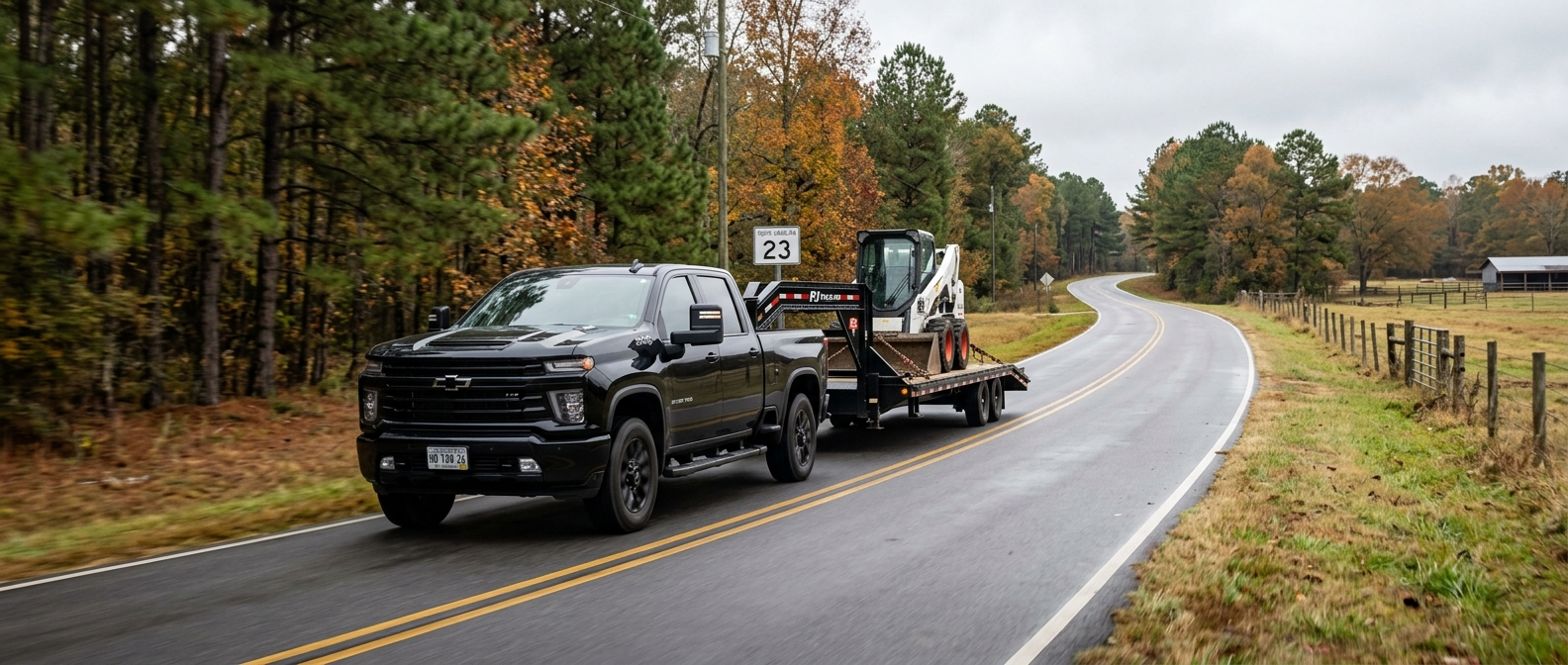
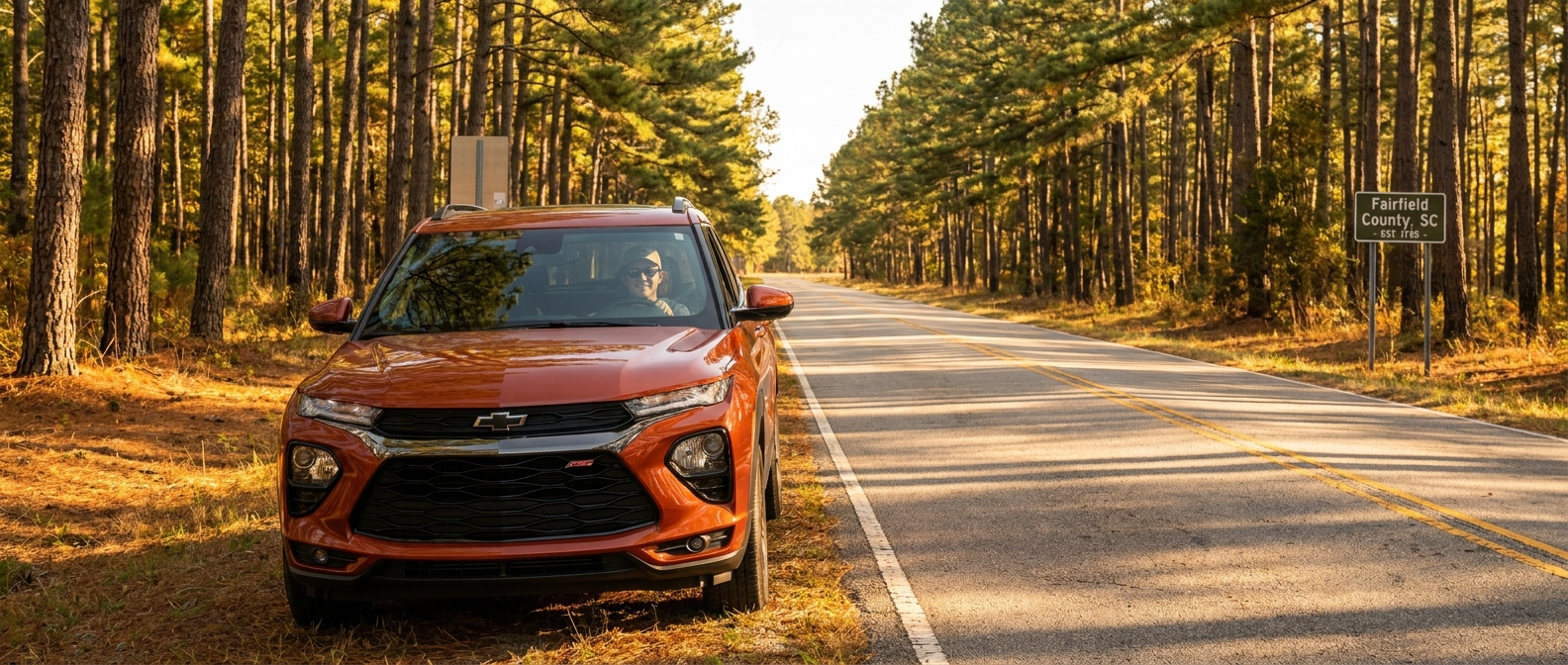
2026 Chevrolet Trailblazer on a rural Fairfield County SC road, ideal safety tech for new drivers

Fairfield County Roads: How the Trailblazer's Standard Safety Tech Works for New Drivers

South Carolina now requires new teen drivers to hold a beginner's permit for at least 180 days before advancing to a restricted license. Six months of supervised time on the road ends right when they start driving alone. The 2026 Chevrolet Trailblazer earns your attention because every safety system that matters for a new driver comes standard on every trim. No package upgrades required. Browse the 2026 Trailblazer at Wilson Chevrolet A fair question before buying is which Chevy has Teen Driver built in. For the Trailblazer, all of them do. The feature works on day one of the restricted license, not just if you happen to buy the right package. What the Trailblazer Does and Doesn't Do in New-Driver Situations The six systems in Chevy Safety Assist are active on every drive, and Teen Driver mode locks them on so they can't be switched off while that key fob is in use. Think about each system in terms of what it handles and what it leaves to you. The table below sorts it out. Situation Do rely on this Don't expect this Approaching traffic too fast Forward Collision Alert warns with audible + visual signal The system to brake for you every time (Automatic Emergency Braking assists, but the driver still steers) Drifting toward lane lines on I-77 Lane Keep Assist applies gentle steering correction The system to hold the lane indefinitely like cruise control Backing out of a tight parking space HD Rear Vision Camera shows a clear view The camera to catch what's outside the camera's field of view Losing track of following distance Following Distance Indicator shows gap in seconds on the dash The indicator to stop the car (it only informs, it doesn't brake) Turning on high beams on dark rural roads IntelliBeam automatically toggles high/low based on oncoming traffic Anything beyond headlight switching. It doesn't see deer Walking up to the car distracted Front Pedestrian Braking can apply brakes for detected pedestrians Detection of every pedestrian in every light condition Driver not buckled Buckle to Drive delays shifting out of Park for 20 seconds A workaround-proof system. Teens figure out workarounds The table above gives you the straight version. These systems reduce the margin for the predictable mistakes a new driver makes. They don't replace the driver, not even close. Teen Driver Mode: The One Feature That Changes the Whole Conversation Teen Driver mode reshapes how a family hands over the keys, because it ties every limit you set to a specific fob and then reports back on what actually happened behind the wheel. Sit in the infotainment system before you hand over the keys. Walking through the settings first is the step that's easy to skip. See current Trailblazer inventory at Wilson Chevrolet Teen Driver ties every limit you set to a specific key fob. When that key starts the car, the settings activate automatically. Your teen doesn't see a prompt and doesn't get an option to skip it. Set it up in five steps. Go to Settings on the 11-inch touchscreen, then select Vehicle, then Teen Driver. Create a four-digit PIN that only you know. You'll need it to view the report card and change any setting. Register the key fob your teen will use as the Teen Driver key. Set a speed warning threshold (the system chimes and logs it) and optionally enable a hard speed cap. You can also set an audio volume limit. Enable Buckle to Drive so the car won't shift out of Park until the driver is buckled. There's a 20-second delay and an alert if they try to skip it. The PIN stays with you. Your teen never sees it. After each drive, go back to the Teen Driver menu and pull the report card. It shows distance driven, top speed reached, wide-open throttle events, and any AEB or ABS activations. The data turns a vague conversation into a specific one. Where this matters most locally is I-77 through Fairfield County, one of the straightest, least congested stretches of highway in South Carolina. The 70 mph posted limit is easy to drift past without noticing, and SC Highway Patrol actively works that corridor. A new driver on I-77 who's never held a sustained highway speed will feel the temptation to push past that limit. The speed warning in Teen Driver makes that moment something you can talk about later. It doesn't stop the car, but it does create a record. Explore financing options for the Trailblazer Worth knowing: Available options like Lane Change Alert with Side Blind Zone Alert and Rear Cross Traffic Alert are not standard on any 2026 Trailblazer trim. They come in an add-on package. Confirm on the window sticker of the specific vehicle you're considering, because "available" means different inventory units will have different configurations. Matching the Right Trim to Where Your New Driver Actually Goes The base LS carries every safety system listed above as standard, and the tradeoff is that it's FWD only (the 1.2L engine) with no remote start and no keyless entry. If your new driver sticks to US 321 and local Winnsboro roads, the LS covers it. If they're regularly running the Equinox up I-77 toward Columbia or Charlotte, AWD availability on the LT and above is worth a conversation, particularly as we move into the wetter months of late fall and winter. The Trailblazer earns a 5-star frontal crash rating from NHTSA and carries zero recalls on file as of the 2026 model year. Those two numbers are the safety baseline. The tech features described here sit on top of it, not instead of it. See Current Trailblazer Offers One more thing worth saying plainly. The Trailblazer's standard safety tech is a good fit for a new driver in Fairfield County, but a used Trailblazer with an older trim that predates some of these standard inclusions is a different vehicle. If you're looking at used options, ask us to confirm which features are actually on that specific car. Get Pre-Approved for Financing Wilson Chevrolet 798 us hwy 321 N BUSINESS, Winnsboro, SC 29180 (803) 402-4233

Read More
2027 Chevrolet Equinox parked at Lake Wateree South Carolina on a sunny fall day

4 Chevrolet Models Worth Considering for Seniors Driving Around Lake Wateree

In this article The Ranking at a Glance 2027 Equinox. Everyday Ease on Two-Lane SC Roads 2027 Trailblazer. For the Senior Who Wants to Keep It Small 2027 Trax, Most Straightforward Option for Easy Parking 2027 Traverse, When Grandkids Come to the Lake Every Weekend If you're spending serious time on the roads between Winnsboro and Lake Wateree, the right vehicle isn't just about comfort. Step-in height matters when your knees aren't cooperating, clear sightlines matter on the two-lane SC routes that snake down through Fairfield County, and you want a cabin that doesn't fight you every time you load gear. Plenty of drivers in this county reach a point where the sedan that served them for years just isn't working anymore. The model that comes up most often as the right answer is the 2027 Chevrolet Equinox. Entry is genuinely easy, the seat sits where you want it, and the feature set doesn't need a manual. But it isn't the only right answer, and the pick depends on what you need. Four Chevrolet models earn a real look here, and we've ranked them straight. The Ranking at a Glance Rank Model Best For Standout Spec 1 2027 Equinox LT Daily driving, errands, I-77 legs 40.9 in. front legroom, standard heated seats, 11.3-in. touchscreen 2 2027 Trailblazer LT Smaller garage, solo trips 174 in. long, up to 31 mpg combined (EPA), AWD available 3 2027 Trax LT Tightest budget, easiest parking 30 mpg combined (EPA), 41.9 in. front legroom 4 2027 Traverse LT Grandkids, longer lake runs 42.6 in. front headroom, 98 cu ft max cargo, 5,000-lb tow capacity 2027 Equinox. Everyday Ease on Two-Lane SC Roads The Equinox earns the top spot because it hits the practical sweet spot for the kind of everyday driving seniors do around the lake, with easy entry and a feature set that stays simple, though it gives up outright towing muscle to hold that balance. Chevrolet lists 40.9 inches of front legroom and a seat height that lets most people step in without contorting or bracing against the doorframe. Those details matter more than they sound when you're making a daily run down US 321 or heading out to Lake Wateree State Recreation Area for the morning. What really sets this one apart goes past the entry. The 11.3-inch touchscreen is large enough to read without squinting, and the standard heated front seats and heated steering wheel on the LT trim earn their keep every October morning in Fairfield County. The EPA rates the 2027 Equinox at 27 mpg combined, which keeps fuel costs reasonable on the mixed city-and-country driving this area throws at you. The drawback worth naming is towing. The Equinox won't pull a boat. Chevrolet rates it for 1,499 pounds, which covers a small pontoon on a trailer in a pinch and not much more. If your Lake Wateree trips involve a serious rig, read the Traverse entry below. For everything else, the Trailblazer and the Equinox sit on different ends of the size spectrum, and the Equinox gives you noticeably more interior room and a smoother highway feel. 2027 Trailblazer. For the Senior Who Wants to Keep It Small The Trailblazer makes sense for the driver who wants a smaller footprint, a size that tucks into the garage without a fight, and strong fuel numbers for frequent short trips, though you trade away some cabin room to land all of that. Some folks in Winnsboro don't want a mid-size anything. They want something that fits comfortably in their garage, parks without drama on the square, and still has enough capability for a run to Sumter National Forest or a quick weekend away. The 2027 Trailblazer slots right into that. At 174 inches long, it's the shortest of the four options here. The EPA rates the Trailblazer at 29 to 33 mpg on the highway depending on engine and drivetrain, which makes it easy to justify for shorter, frequent trips. AWD is available if you want it. The limitation is cabin space. Behind the rear seat you get 25.3 cubic feet, tighter than the Equinox. Two adults and a weekend's worth of gear fit comfortably. Three adults, and it gets tight. Buying caution: On all four models here, verify which trim gives you blind-spot monitoring before you commit. Blind-spot monitoring is a meaningful safety feature for lake-area roads, and it isn't always standard on the base trim. Our team can walk you through exactly which trim level includes it. The 2027 Trailblazer's available AWD and EPA-estimated 31 mpg combined (1.3L FWD) make it the most fuel-efficient and weather-ready compact option in the Chevrolet lineup for senior drivers. 2027 Trax, Most Straightforward Option for Easy Parking The 2027 Trax is the smallest of the group and the easiest to slot into a tight parking spot or driveway, though it comes front-wheel drive only, which suits paved roads more than loose ground near the lake access points. Chevrolet's ECOTEC 1.2L turbo delivers an EPA-estimated 30 mpg combined. Front legroom is generous at 41.9 inches. The infotainment screen steps up to 11 inches on the LT trim, a meaningful jump from the base 8-inch unit. The Trax has one firm limit. The Trax comes front-wheel drive only, full stop. For dry Fairfield County roads and paved lake access points, that's usually fine. But if you're regularly on dirt paths or loose gravel near Lake Wateree, or you want AWD for wet-weather confidence, the Trax isn't your pick. The Trax also gives the most modest highway ride of the four. Fine around town, fine for a run up I-77 to Columbia. On longer hauls, it gets busy. See Our Current Chevrolet Offers 2027 Traverse, When Grandkids Come to the Lake Every Weekend The 2027 Traverse is the one to look at seriously when your Lake Wateree trips regularly carry grandkids, adult children, or friends plus a real boat trailer, though the size means you'll feel it every single time you park in town. Chevrolet builds it with 42.6 inches of front headroom and up to 98 cubic feet of maximum cargo space. Everyone fits in that kind of room, with gear left over. Towing is where the Traverse separates itself, pulling 5,000 pounds when properly equipped, which covers a real boat trailer. That capability sits in a different category than the other three options here, and for some Lake Wateree regulars it's the spec that settles the decision. The EPA rates the 2027 Traverse at 22 mpg combined with FWD, the expected trade-off for a vehicle this capable. The 17.7-inch infotainment touchscreen with Google Built-In gives you the most tech-forward cabin of the group, with easier navigation, sharper maps, and a screen big enough that you're not leaning forward to read it. The tradeoff comes down to size. At just over 204 inches long, this is a vehicle you need to be comfortable parking. In town, that friction is real. On the open roads between Winnsboro and the lake, it never comes up. We keep inventory across the Chevy lineup here in Winnsboro. If you want to step into any of these and feel how the entry, the seat, and the sightlines really work for you, our team is here for exactly that. Explore Financing Options at Wilson Chevrolet Wilson Chevrolet 798 us hwy 321 N BUSINESS, Winnsboro, SC 29180 (803) 402-4233
2026 Chevrolet Camaro SS in Panther Black parked in a Winnsboro SC garage ready for winter storage

What Does a Camaro Need Before Winter Storage in Winnsboro, SC?

In this article What Should You Do to the Oil and Fluids Before You Park? Should You Fill the Tank or Run It Low Before Storage? What's the Right Way to Handle the Battery and Tires? Is There Anything Special About Storing the Camaro Given It's Now Discontinued? Your 2024 Camaro doesn't need a blizzard to earn a proper storage prep. What it needs is the right sequence of steps. Winnsboro winters run milder than the Midwest forums where most storage advice gets written, but January lows still average around 30 degrees Fahrenheit, and the Camaro is now a discontinued collector car. The short list is simple. You want fresh oil, a treated full tank, a battery tender, tires at 40 psi, and a breathable car cover. Together they cover the usual Fairfield County storage window, November through late February. Book your pre-storage service at Wilson Chevrolet's service center before temperatures settle in. What Should You Do to the Oil and Fluids Before You Park? Change the oil before you park the car, not in the spring, because used motor oil carries combustion byproducts and trace moisture that would otherwise sit against your engine's internals for months, and while you're under the hood give the brake fluid and coolant a quick once-over too. Fresh oil is cheap protection against that. Here's the spec detail that matters for the 2024 Camaro: Trim / Engine Engine Oil Spec Capacity (with filter) LT (3.6L V6) 5W-30 dexos1 Gen 2 full synthetic ~6 qt SS (6.2L LT1 V8) 0W-40 dexosR full synthetic ~10 qt ZL1 (6.2L LT4 supercharged V8) 0W-40 dexosR full synthetic ~10 qt The V8 spec is the one that catches people. The 6.2L LT1 and LT4 engines call for 0W-40 dexosR, a different oil than the 5W-30 dexos1 the V6 uses. Drop the lighter oil into a V8 Camaro before a long sit and you've made the one fluid mistake worth avoiding. Chevrolet lists the 0W-40 dexosR as the factory fill for the LT1 and LT4 across all model years of the sixth generation. Beyond the engine, check your brake fluid. The 2024 Camaro calls for DOT 4, and if yours has gone more than a few years, storage is a natural moment to have it inspected. Brake fluid absorbs moisture over time. DOT 4 holds a higher dry boiling point than DOT 3, specifically because these cars push serious heat through the rotors. If you're running a ZL1, one detail is worth knowing. The supercharged LT4 has a separate intercooler coolant circuit, and it sits outside the main engine coolant loop. Have our service team check that level separately before you park it. Explore financing options if you're thinking about adding a second vehicle while the Camaro rests Browse the Chevy Equinox for everyday driving while your Camaro is stored Schedule Pre-Storage Service Should You Fill the Tank or Run It Low Before Storage? Fill it right to the top, because a full tank leaves minimal air space above the fuel, which means less moisture condensing inside the tank, then add a fuel stabilizer rated for ethanol-blended gasoline before you shut it down. Modern pump gas contains up to 10% ethanol, and ethanol is hygroscopic. It pulls moisture from the air. Untreated fuel left sitting for three or four months can degrade, leaving varnish deposits in the injectors and fuel lines. The Winnsboro storage window runs shorter than most northern guides assume. Park around Thanksgiving, pull it back out for a late-February run toward the Lake Wateree area, and you're realistically looking at 10 to 14 weeks, give or take a weekend. A good fuel stabilizer is rated to keep treated fuel fresh for up to 12 months, so you'll sit well inside the margin. Run the car for a few minutes after adding stabilizer so the treated fuel reaches the injectors. Don't idle it for 30 or 40 minutes trying to "charge the battery." Charging the battery is a different step, and idling alone won't bring the engine fully up to operating temperature anyway. A treated, full tank plus a battery tender are the two steps that most directly determine how your Camaro comes out of storage in the spring. What's the Right Way to Handle the Battery and Tires? Keep the battery on a maintainer and set the tires a little high before you park, and you'll sidestep the two problems a stationary Camaro runs into over a Carolina winter, a slow-draining battery and flat-spotted tires. Don't disconnect the battery and walk away. Connect a battery tender, also called a trickle charger or maintainer. Why does a tender matter in a mild climate? A disconnected battery in a cool garage will self-discharge over two to three months, and starting a deeply discharged battery puts stress on the charging system, so the tender holds a full charge continuously without overcharging it. Owners who store their cars every year treat this as standard practice. South Carolina's mild winters mean your garage won't hit the brutal cold that accelerates discharge in Minnesota. But the 2024 Camaro still runs modern electronics, body-control modules, and an active suspension system on ZL1 models, and those systems hold small parasitic draws. A tender wipes that out entirely. On the tires, inflate to 40 psi before parking, a touch above the standard door-placard pressure. Flat spots are the enemy here. A car left stationary for weeks develops them where the tire meets the ground, and higher pressure spreads the load across the contact patch to cut the risk. You won't need jackstands for a 10-to-14-week Carolina window, though the 40 psi is still worth doing. Fresh oil change using the correct spec (0W-40 dexosR for V8 cars, 5W-30 dexos1 for the V6) Full tank with ethanol-compatible fuel stabilizer, engine run briefly to circulate it Battery tender connected and plugged in throughout storage Tires inflated to 40 psi before parking Breathable car cover (not plastic) to protect paint without trapping moisture Is There Anything Special About Storing the Camaro Given It's Now Discontinued? Yes, and it's the kind of thing we'd flag for a friend who just bought a 2024. Chevrolet confirmed in 2023 that the 2024 model year was the final year for the sixth-generation Camaro, the last one rolled off the line in December 2023, and no 2025 or 2026 exists. What you're parking is the last of its kind, which nudges the whole job from routine maintenance toward preservation. So storage now does double duty, protecting condition as much as keeping systems healthy. A few extra steps pay dividends in resale value and long-term condition: Use a breathable fabric car cover, not a tarp. Trapping moisture under plastic is the fastest way to cause paint problems and interior mildew. Place cedar blocks or dryer sheets inside the cabin to deter rodents. South Carolina is warm enough that critters are active later into the fall than they are up north. Block the exhaust tips with a cloth rag (and leave yourself a note on the steering wheel so you don't forget it's there in the spring). Wash and wax thoroughly before covering. Putting a dirty car under a cover lets contaminants sit against the clear coat for months. The Collector's Edition 2024 Camaros (Panther Black, serialized builds) are already drawing attention as instant collectibles. Even a standard 2024 SS or ZL1 is the newest Camaro that will ever exist until Chevrolet announces something new. Treat it accordingly. Frequently Asked Questions What oil does a 2024 Camaro SS need for winter storage? The 2024 Camaro SS uses a 6.2L LT1 V8 engine, and Chevrolet specifies 0W-40 dexosR full synthetic oil for that engine. That's a heavier specification than the 5W-30 dexos1 used in the V6 and four-cylinder trims. Change the oil before parking, not in the spring, so fresh oil sits against your engine internals during storage. Capacity for the 6.2L LT1 is approximately 10 quarts with a filter. Do I need to do anything special for winter storage in South Carolina versus colder states? Winnsboro winters are milder than northern storage guides assume. January lows average around 30 degrees Fahrenheit and hard freezes are rare. That means a shorter storage window (typically 10 to 14 weeks) and no need for jackstands, which are more common in regions with six-month winters. That said, the core steps remain the same: treated full tank, fresh oil, battery tender, tires at 40 psi, and a breathable cover. Don't skip any of them just because the winters are shorter. Should I start my Camaro occasionally during winter storage? Only if you can drive it at least 10 to 20 miles to bring the engine fully to operating temperature. Briefly idling a stored car introduces moisture into the exhaust system and crankcase without burning it off. If you can't drive it, it's better to leave it undisturbed with a battery tender connected than to idle it for a few minutes and put it back. This is one of the most consistently debated points in Camaro owner communities, and the short-idle approach does more harm than good. View Current Chevrolet Specials Wilson Chevrolet 798 us hwy 321 N BUSINESS, Winnsboro, SC 29180 (803) 402-4233

2026 Chevrolet Corvette Stingray on an autumn South Carolina road near Winnsboro

Your 2026 Corvette Fall Prep Checklist for Columbia-Area Drivers

Right now, this October, you're inside one of the best windows of the entire year to drive a Corvette across the South Carolina Midlands. Daytime highs are averaging in the mid-70s, the humidity has finally eased, and the roads around Winnsboro and down I-77 toward Columbia stay dry more often than not. Fall here isn't storage season; it's driving season. One catch separates a great fall run from a frustrating one, and we rarely hear it discussed for South Carolina specifically. The Michelin Pilot Sport 4S tires on your 2026 Corvette Stingray carry a hard 40 degrees Fahrenheit compound threshold. Once overnight lows drop below that mark and stay there, grip degrades and pressure readings fall. Handle the six items on this checklist before each fall outing, and you'll spend the season doing what this car was built for. Browse our current Corvette inventory at Wilson Chevrolet What Goes on the Checklist? Work through these six items in order, and you'll have the routine handled fast. The first three take about ten minutes in the driveway, and the last three happen from the driver's seat before you pull onto the road. Tire pressure (cold, before you move). The door-sticker spec for the 2026 Corvette is 30 PSI cold. In October in the Columbia area, nighttime lows can dip into the mid-to-upper 40s, and tire pressure drops roughly 1 PSI for every 10-degree Fahrenheit fall in ambient temperature. Check pressure before the car has moved an inch. A tire that sat overnight at 48 degrees Fahrenheit and read 30 PSI in September might show 28 or 29 PSI on a cooler morning. You'll want to catch two PSI under spec on a rear-wheel-drive car with 490 horsepower behind you in the driveway, and that's a driveway job rather than an on-ramp surprise. Tire compound temperature awareness. Michelin doesn't recommend using the Pilot Sport 4S below 40 degrees Fahrenheit. The compound stiffens as it nears that threshold, and grip measurably decreases. Our October mornings will touch the upper 40s now and then. You're not in dangerous territory at 50 degrees Fahrenheit, but if the overnight low was 44 degrees Fahrenheit and the car sat outside, give the tires five minutes of easy, steady driving before you load the throttle. Fluid levels (quick visual check). Engine oil, coolant, brake fluid. A mid-engine layout puts the reservoir access points behind the seats, so check your owner's manual for the specific caps. The job takes two minutes. Our service team sees cars arrive with brake fluid that soaked up moisture over summer heat cycles, and you'll want to sort it out before the year ends. Driving mode selection. The 2026 Corvette offers Weather, Tour, Sport, and Track modes (plus Z06/ZR1-specific variants). For a crisp, dry October afternoon over cool pavement, Tour or Sport is the right call. Weather mode trims throttle mapping and brings in the most conservative stability settings, which suits genuinely wet or cold-morning roads, especially if that morning low touched the low 40s. Don't start a fall drive in Track mode while the tires are still cold. The car won't stop you, but the tires won't thank you. Performance Data Recorder check (if equipped). If your 2026 Corvette includes the optional Performance Data Recorder, fall is when you'll want to confirm the SD card has space. Cool, clear days are prime for data-capture runs. Fill the card and you miss the shot. Visual wiper and washer fluid check. Fall leaf litter and morning dew mean you'll reach for them more than you did in summer. South Carolina October averages only about 6 rain days for the month, but when that dew or light mist shows up on a fast road, streaky wipers get your attention fast. Why These Items Matter for Fall Driving in the Midlands Schedule a pre-season service check at Wilson Chevrolet The one big local variable no generic checklist covers is the Columbia area's thermal swing, and fall drivers feel it directly. October here is genuinely dual-natured. The numbers prove it. This week, the National Weather Service recorded a 90-degree high in Columbia on a Thursday and a 46-degree overnight low the following Saturday. That is a 44-degree spread across a few days. Your 2026 Corvette's Michelin Pilot Sport 4S tires were engineered for exactly the warm, dry end of that range. The 6.2-liter LT2 V8 makes 490 horsepower at the crank (495 with the Z51 performance exhaust package), all of it going through the rear wheels via an 8-speed dual-clutch transmission. Matching that output to the grip you've actually got on a 55-degree morning versus a 75-degree afternoon is the skill this checklist supports. Skip the tire pressure check and you give up the single item that ties fall temperatures most directly to how the car behaves. The Corvette's rear tire contact patch is doing a lot of work. Under-inflated by even two PSI, the tire runs hotter at its sidewall and cooler at the tread center, which hurts both handling feel and long-term wear. Two minutes with a quality gauge (not the one on the gas station pump, calibrated more for convenience than accuracy) is time well spent. We'd make the trade every time. On the driving-mode question, we lean toward Tour on the Midlands roads around Fairfield County for the first fifteen minutes of any fall run. Some of the older two-lanes here carry a light coat of dew or leaf residue that clears up as the morning goes on. Tour keeps throttle response measured and traction intervention active without making the car feel sluggish. Once you're on I-77 and the tires have had a chance to warm, Sport finally opens up the way it should. Team note: We're not suggesting the Z51 package is mandatory for fall driving. If you have it, the electronic limited-slip differential and upgraded Brembo brakes are real advantages on variable-condition roads. If you don't, Tour mode's stability settings provide meaningful protection on a cool, damp morning. Tour mode has your back. Item Why it Matters in Fall Tire pressure (cold check at 30 PSI) Every 10 degrees Fahrenheit drop reduces pressure roughly 1 PSI; under-inflated rear tires affect contact patch on a RWD, high-output car Michelin PS4S compound temp (40 degrees Fahrenheit floor) Grip degrades below threshold; Columbia's late-October overnight lows can touch the mid-40s Driving mode (Tour or Sport for cool starts) Track mode demands warm tires; cool mornings on Fairfield County roads call for managed throttle Fluid levels (oil, coolant, brake fluid) Summer heat cycles can introduce moisture into brake fluid; fall is the right time to check Performance Data Recorder card check Clear October days are prime data-capture runs; a full card wastes the opportunity Wipers and washer fluid October leaf and dew residue creates film on the windshield; streaky wipers matter at speed Schedule a Fall Service Inspection The Print-and-Go Recap Explore Corvette financing options at Wilson Chevrolet Tape this version to the garage wall or keep it on your phone, and you've got your pre-drive routine for each October outing with your 2026 Corvette: Check cold tire pressure (30 PSI per door sticker; adjust for ambient temp if morning low was below 50 degrees Fahrenheit). If overnight low was at or below 44 degrees Fahrenheit, drive easy for the first five minutes while tires come to temperature. Confirm driving mode (Tour or Sport for cool-morning starts; Weather mode on genuinely wet or cold roads). Quick visual on fluids: engine oil, coolant, brake fluid reservoir. Wiper condition and washer fluid level (leaf season, dew, light rain). If you have the Performance Data Recorder, check your SD card has space before the run. So that's the whole list. Six items, ten minutes, and the rest of the fall is yours. Columbia-area Corvette owners have a narrow but genuinely good window between now and the point where overnight lows start sitting below 45 degrees Fahrenheit for good. The Midlands doesn't get the hard winters that force northern owners to park their C8s in October. You can drive yours well into November. Just do it on the right side of the tire compound threshold, with proper pressure and the right mode dialed in. Visit Wilson Chevrolet in Winnsboro for service, parts, and your next Corvette Frequently Asked Questions What is the recommended cold tire pressure for a 2026 Corvette Stingray? The door-sticker specification for the 2026 Corvette Stingray is 30 PSI cold, measured before the car has been driven. Cold pressure is calibrated to roughly 68-70 degrees Fahrenheit ambient. For every 10 degrees Fahrenheit the ambient temperature drops below that baseline, expect about 1 PSI of pressure loss. On a fall morning in the Columbia area where the overnight low was 48 degrees Fahrenheit, that means you'll want to check and maybe add a PSI before you pull out. When should a Columbia-area Corvette owner think about wrapping up fall driving? The Michelin Pilot Sport 4S tires on the 2026 Corvette are a max-performance summer compound that isn't recommended below 40 degrees Fahrenheit. For the Columbia, SC area, late October and November are generally still drivable, since the region's average October low sits around 55-56 degrees Fahrenheit and December is when overnight lows regularly threaten the 40-degree mark. Once overnight lows begin touching 44 degrees Fahrenheit or below on a regular basis, plan outings around midday warmth or consult your Wilson Chevrolet service center about options for extending your season responsibly. See Current Chevrolet Specials Wilson Chevrolet 798 us hwy 321 N BUSINESS, Winnsboro, SC 29180 (803) 402-4233

2027 Chevrolet Equinox with open cargo hatch loaded for a fall road trip on a South Carolina highway

Equinox vs. Honda CR-V: Which One Actually Fits Your Fall Road Trip?

October is prime road-trip season in the Midlands. The heat finally breaks, the leaves on US 321 turn amber, and you'll see half of Fairfield County loading up for the Smokies, the Outer Banks, or just a long weekend somewhere north on I-77. Should you be cross-shopping the Equinox with a CR-V? We hear that question around the lot this time of year, and yes, you should. What actually separates them only shows up once you get past the brochure. The brochure won't tell you. Browse our Equinox inventory at Wilson Chevrolet to see what's on the lot right now. The Equinox wins on ride comfort, a broader standard-safety package, and entry value. The CR-V wins on cargo volume and hybrid fuel economy. Which one matters more depends on how many seats you are filling and how far you are driving. How Do These Two SUVs Actually Work Differently? These two share a segment and a price neighborhood, yet they're built around very different ideas of what a road trip asks for, and that split shows up the moment you look at the powertrains, where one leans on stepped gears for confident response and the other on a CVT for smoothness and economy. The 2027 Equinox runs a 1.5-liter turbocharged four-cylinder making 175 horsepower. Every trim now uses an 8-speed automatic. Chevrolet replaced the CVT for 2027 on FWD models, so you'll feel defined, gear-by-gear shifts across the lineup. AWD is optional and raises torque to 203 lb-ft. The 2027 CR-V gives you two paths, a 1.5-liter turbocharged four-cylinder producing 190 horsepower on gas trims, or a 2.0-liter hybrid system making 204 total system horsepower. Gas CR-V models use a CVT, and hybrid models use an eCVT. That transmission difference matters on I-77 more than most comparison articles acknowledge. The Equinox's stepped 8-speed gives you a confident, deliberate response when you merge onto the interstate or pass a slow-moving log truck on a two-lane connector. The CR-V's CVT is smooth and fuel-efficient, though it has that characteristic elastic-surge feel under hard acceleration, especially when the vehicle is loaded. Neither is wrong. They just feel different when you're running 75 mph toward Charlotte with four people and a weekend's worth of gear on board. Feature 2027 Chevrolet Equinox 2027 Honda CR-V (Gas) 2027 Honda CR-V (Hybrid) Engine 1.5L Turbo, 175 hp 1.5L Turbo, 190 hp 2.0L Atkinson + Electric, 204 hp (system) Transmission 8-speed automatic (all trims) CVT eCVT Drivetrain FWD standard, AWD available FWD standard, AWD available FWD or AWD Cargo (seats up) 29.8 cu ft 39.3 cu ft 36.3 cu ft Cargo (seats down) 63.5 cu ft 76.5 cu ft Lower (battery placement) EPA Highway MPG (FWD) 29 mpg 33 mpg 36 mpg Standard Safety Features 15+ (full Chevy Safety Assist suite) Honda Sensing suite Honda Sensing suite Towing (AWD, gas) 1,500 lbs 1,500 lbs 1,000 lbs (hybrid) Sources: Chevrolet lists the 2027 Equinox transmission change and 29-mpg highway figure. The EPA rates the gas 2027 CR-V FWD at 33 mpg highway and the hybrid FWD at 36 mpg highway. Honda's spec sheet lists the cargo figures above. Which One Do You Actually Need for the Roads Around Here? Generic national comparisons stop being useful right here, because the right pick depends on your actual load and your actual route, and the I-77 corridor from Winnsboro to Charlotte runs 90-plus miles of sustained highway cruising, so if you're taking the family for a fall trip, you're running loaded. So here's where it splits. Choose the Equinox if: You're filling most or all five seats. When the rear seats are occupied, the cargo gap matters most, 39.3 cubic feet (CR-V) versus 29.8 cubic feet (Equinox) behind those seats. That's nearly 10 cubic feet, which is meaningful. But when you've got three people in the back, neither vehicle lets you fold those seats anyway. You're working with whatever fits in the trunk. The Equinox's hidden under-floor storage compartment gives you a dedicated slot for valuables or smaller items you want out of sight, which is handy on a multi-day trip. Chevrolet also includes over 15 standard safety features from the base trim up. Adaptive Cruise Control, Automatic Emergency Braking, Blind Spot Intervention, Rear Cross Traffic Braking, Forward Collision Alert, Lane Keep Assist, and more, which makes long interstate stretches noticeably less fatiguing. Need more room for a bigger group? The Traverse offers three rows with 98.2 cubic feet of max cargo. Choose the CR-V if: You're traveling as a couple or with one or two kids, and you plan to keep those rear seats folded most of the time. The 76.5-cubic-foot maximum cargo volume is genuinely class-leading on gas trims. The CR-V is the better cargo hauler when you've got the flexibility to use all of it. And if fuel efficiency is your deciding factor, the CR-V Hybrid AWD is rated by the EPA at 37 mpg combined, compared to 26-27 mpg combined for the Equinox, and that difference adds up on a long run north, especially once you're past Charlotte. See our current new inventory at Wilson Chevrolet for available Equinox trims and configurations. One honest concession from our side, the Equinox doesn't offer a hybrid option. If you're stretching every mile out of a tank, the CR-V Hybrid has a real, verifiable advantage that no amount of comfort-ride framing changes. See Current Equinox Offers A Few Terms Worth Knowing Term What it means in plain language CVT Continuously Variable Transmission. No fixed gears, engine revs smoothly but can feel rubbery under hard acceleration eCVT A hybrid-specific version that blends electric motor and engine input for efficiency Chevy Safety Assist Chevrolet's standard six-feature safety bundle: AEB, Front Pedestrian Braking, Lane Keep Assist, Forward Collision Alert, Following Distance Indicator, and IntelliBeam automatic high beams EPA Combined MPG The fuel economy estimate that blends city and highway driving (55% highway, 45% city in EPA testing) What This Means for Your Next Vehicle Here's the bottom line for someone leaving Winnsboro this fall, and it really comes down to who's riding along and how far you're pushing, because these two SUVs reward different trips rather than crowning one outright winner, and knowing your own pattern settles it faster than any spec chart will. If you're the household that packs light and travels as a couple, or you put real value on hybrid efficiency for longer trips, the CR-V, especially the hybrid, is worth serious consideration. We'll say that plainly. But if you're loading up five seats with the family for a long weekend, or you simply want a confidence-inspiring, smooth-riding SUV with a full safety suite standard and a transmission that feels like a conventional automatic on the highway, the Equinox is the stronger fit for that specific drive. Our team's consistent read, customers who switch from the CR-V to the Equinox mention the ride quality and the breadth of standard safety tech. Both are verifiable specs, not marketing. Chevrolet lists 15-plus standard features including Adaptive Cruise Control on every trim, and it's a feature that eases driver fatigue on the I-77 stretch between Winnsboro and Charlotte. Take a closer look at the Equinox lineup and find the right configuration for your next trip. Frequently Asked Questions Is the Chevy Equinox or Honda CR-V better for highway road trips? For drivers who fill all five seats frequently, the Equinox delivers a comfort-tuned ride, 15-plus standard safety features including Adaptive Cruise Control standard on every trim, and the Equinox's 8-speed automatic gives the highway driving a confident, familiar feel. The CR-V's gas trims have a CVT, which some drivers find less satisfying under load. That said, if maximum cargo volume is the priority and you're often traveling as a couple or small group with seats folded, the CR-V's 76.5 cubic feet of maximum cargo space and its hybrid powertrain's EPA-rated 37 mpg combined (AWD hybrid) are real advantages. The better pick depends on how many seats you are filling and how much weight you give to fuel economy versus ride character. Does the Honda CR-V have more cargo space than the Chevrolet Equinox? Yes. Substantially. The 2027 CR-V offers 39.3 cubic feet of cargo behind the rear seats and 76.5 cubic feet with them folded, per Honda's specifications. The 2027 Equinox offers 29.8 cubic feet behind the rear seats and 63.5 cubic feet fully folded, per Chevrolet's specifications. The gap is largest when the rear seats are up (nearly 10 cubic feet). Note that CR-V Hybrid trims have less cargo than gas trims (36.3 cu ft behind the rear seats) because of battery placement. Value Your Current Vehicle Toward an Equinox Wilson Chevrolet 798 us hwy 321 N BUSINESS, Winnsboro, SC 29180 (803) 402-4233

2026 Chevrolet Tahoe at a South Carolina lake boat ramp, ready for towing

Three Full-Size Family SUVs Compared for Fairfield County Life: Tahoe, Expedition, and Traverse

Most families shopping a big three-row SUV around Winnsboro walk in with two names already in mind, the Chevrolet Tahoe and the Ford Expedition. There's a third truck that belongs in that conversation, and it sits right here on our lot at Wilson Chevrolet. The 2026 Traverse closes the gap on passenger room and cargo while towing a capable 5,000 pounds, and it does it at a meaningfully different entry point than either full-size, which reshapes the whole comparison. Here's what we've learned helping Fairfield County families weigh these three. The deciding factor rarely comes down to the spec sheet. It comes down to two things, how heavy whatever you're pulling to Lake Wateree is, and how far you run I-77 every week. The short version Tow heavy rigs (over 8,000 lbs): The 2026 Tahoe maxes at 8,400 lbs (5.3L V8, RWD, Max Trailering Package); the 2026 Expedition tops the class at 9,600 lbs (4x4, Heavy-Duty Tow Package). Traverse caps at 5,000 lbs. Best cargo flexibility: Tahoe delivers 122.7 cu ft with seats folded; Traverse leads its own class at 97.6 cu ft; Expedition MAX reaches 123.1 cu ft but requires the extended body. Best fuel economy: Tahoe with the available Duramax diesel is EPA-rated at 21 city / 28 highway. The Expedition 4x4 (EcoBoost V6) runs about 16 city / 22 highway. Traverse (2.5L turbo) earns 20 city / 26 highway. Budget-conscious 3-row family: The Traverse is the right call. Full-size towing and full-size comfort are only worth paying for when you actually use them. Committed to Chevy and need serious tow capacity: The Tahoe, especially with the Duramax diesel, is built for exactly that. Browse the 2026 Chevrolet Tahoe at Wilson Chevrolet How Do These Three SUVs Actually Compare? On paper, these three split by the job far more than the badge, so start there before you start comparing trims. Tahoe and Expedition are full-size, body-on-frame haulers built around weight, while the Traverse is a unibody crossover that trades the top tow numbers for better mileage and an easier daily footprint. Our numbers below fill in the rest. The specs below are based on Chevrolet's published figures for the 2026 Tahoe and Traverse, and Ford's published specifications for the 2026 Expedition. Towing figures assume proper equipment packages. They are not base configurations. Spec 2026 Chevrolet Tahoe 2026 Ford Expedition 2026 Chevrolet Traverse Max tow (properly equipped) 8,400 lbs 9,600 lbs (4x4 SWB) 5,000 lbs Engine options 5.3L V8 / 6.2L V8 / 3.0L Duramax diesel 3.5L EcoBoost V6 (400-440 hp) 2.5L turbo 4-cyl (328 hp) Seating capacity Up to 9 (LS bench) / 8 most trims Up to 8 Up to 8 Max cargo (seats folded) 122.7 cu ft 108.5 cu ft (SWB) 97.6 cu ft Cargo behind 3rd row 25.5 cu ft 22.9 cu ft 22.9 cu ft EPA fuel economy (best config) 21 city / 28 hwy (diesel RWD) ~16 city / 22 hwy (4x4 EcoBoost) 20 city / 26 hwy Body-on-frame Yes Yes No (unibody crossover) Best for Towing + long haul efficiency (diesel) Maximum tow capacity Family budget + daily driving A few things jump off that table. The Expedition's headline tow number is real, but it only applies to the short-wheelbase 4x4 with the Heavy-Duty Trailer Tow Package installed. Without that package, the 4x2 base Expedition is limited to 6,000 lbs per Ford's published towing guide. Tahoe leans on packages too for its 8,400 lb ceiling (5.3L V8, RWD, Max Trailering). Build your specific truck before you commit to a tow number. How Much Are You Actually Pulling? Most of the answer rides on trailer weight, and around here that number tends to land lower than the full-size badge suggests. A boat and a weekend's gear sit well inside the Traverse's range, while a loaded horse trailer or a big fifth-wheel pushes you squarely into full-size territory. Both ends point at different trucks. A pontoon boat or bass boat on a typical aluminum trailer runs 3,500 to 5,000 lbs loaded. A 24-foot travel trailer lands between 5,000 and 7,500 lbs. A full horse trailer with two animals can push 8,000 lbs and above. So here's the practical breakdown for our corner of South Carolina. Lake Wateree sits east of Winnsboro. If you're pulling a boat to the lake on weekends, the 2026 Chevrolet Traverse handles the load at up to 5,000 lbs and gets you there on noticeably better fuel economy than either full-size. If you're hauling a loaded horse trailer or a large fifth-wheel toward Charlotte, you need the Tahoe or the Expedition. That's the straight line for our area. The Expedition wins on raw tow rating (9,600 lbs vs 8,400 lbs in the Tahoe's best build), and that 1,200 lb margin matters when you're consistently near the ceiling. But the Tahoe offers something the Expedition doesn't, an available 3.0L Duramax turbo-diesel. The EPA rates that combination at 21 city / 28 highway. For a family running the I-77 corridor to Columbia or Charlotte several times a month in a full-size SUV, that highway number is a genuine difference-maker over a year of fill-ups. The Expedition's 3.5L EcoBoost V6 is a capable engine producing up to 440 hp in High-Output trim, but it's a gas-only powertrain. There's no diesel option in the Expedition lineup. The Tahoe's available Duramax diesel is EPA-rated at 28 mpg highway, a figure no other full-size body-on-frame SUV can match. For I-77 families who are logging real miles, that engine often justifies the Tahoe over the Expedition on operational cost alone. See Current Chevrolet Offers at Wilson Chevrolet Pros and cons where they actually matter for Fairfield County buyers: Pros Cons Tahoe: Three engine options including the Duramax diesel; 122.7 cu ft max cargo; up to 9 passengers on LS bench Tahoe: 8,400 lb tow ceiling lower than Expedition; fuel economy with gas V8 is modest (15 city / 20 hwy on 5.3L) Expedition: Class-leading 9,600 lb tow capacity; more second and third-row passenger room by most measures; 24-inch panoramic display Expedition: Gas-only (no diesel); shorter standard cargo bay than Tahoe; 9,600 lb rating requires specific package + 4x4 configuration Traverse: Best fuel economy of the three; 97.6 cu ft max cargo; Smart Slide seats make third-row access practical; more affordable entry Traverse: 5,000 lb tow ceiling rules it out for heavy trailers; unibody crossover, not body-on-frame; no diesel option Which One Fits Your Family? There's no single winner here, because the right pick tracks your heaviest regular load more than anything else. Tow past 8,000 pounds on a regular basis and the Expedition earns it; want three powertrains with a foot in efficiency and the Tahoe fits; need three rows on a family budget and the Traverse quietly takes it. The Expedition is the right call when towing is the priority and you regularly run loads above 8,000 lbs. It wins on that single axis, and Ford's packaging does give third-row passengers more room on longer trips. We'll say that plainly. If you're cross-shopping and the trailer always wins the argument, the Expedition deserves a serious look. The Tahoe wins when you need the flexibility of three powertrains and want to keep a foot in fuel efficiency without giving up full-size utility. The Duramax diesel configuration is rare in this segment and genuinely useful for high-mileage I-77 drivers who also tow a few times a year. A 24-gallon tank at 28 highway miles per gallon is over 650 miles of range on a single fill. On a Charlotte run, that range adds up. For many Fairfield County families, though, the Traverse is the answer nobody expected. Here's what that package delivers: Three rows and seating for eight that rides like a proper family SUV. 97.6 cu ft of max cargo and 5,000 lbs of tow capacity. 26 mpg highway with a standard garage bay fit (79.6 inches wide without mirrors). That last point is more than you can say for a fully loaded Tahoe or Expedition in a tighter driveway. Does your life actually need 8,000 lbs of tow capacity, or do you just want to feel like it does? Those are two different purchases. If the answer is a bass boat and weekend soccer gear, the Traverse earns the call. If it's a horse trailer or a 30-foot camper, you want the Tahoe or the Expedition. Explore financing options at Wilson Chevrolet to run the numbers on any of these three, or bring your current vehicle in for a trade appraisal while you're comparing. By the Wilson Chevrolet Team | October 2026 Frequently Asked Questions Does the 2026 Chevrolet Tahoe tow more than the Ford Expedition? No. The 2026 Ford Expedition has a higher maximum tow rating. The Expedition 4x4, properly equipped with Ford's Heavy-Duty Trailer Tow Package, is rated at 9,600 lbs. The 2026 Tahoe tops out at 8,400 lbs with the 5.3L V8, rear-wheel drive, and the Max Trailering Package. Both ratings require specific configurations and are not base numbers. For towing above 8,400 lbs, the Expedition holds the advantage. Is the 2026 Chevrolet Traverse a good alternative to the Tahoe for a family with a boat? Yes, for most common boat setups. The 2026 Traverse tows up to 5,000 lbs, which is enough for the majority of pontoon boats, bass boats, and smaller ski boats on aluminum or light aluminum trailers. It seats up to eight passengers, carries 97.6 cubic feet of maximum cargo, and returns 26 mpg on the highway. Families who do not regularly pull loads over 5,000 lbs often find the Traverse covers their real-world needs without the fuel and size commitment of a full-size body-on-frame SUV. Get Pre-Qualified at Wilson Chevrolet Wilson Chevrolet 798 us hwy 321 N BUSINESS, Winnsboro, SC 29180 (803) 402-4233

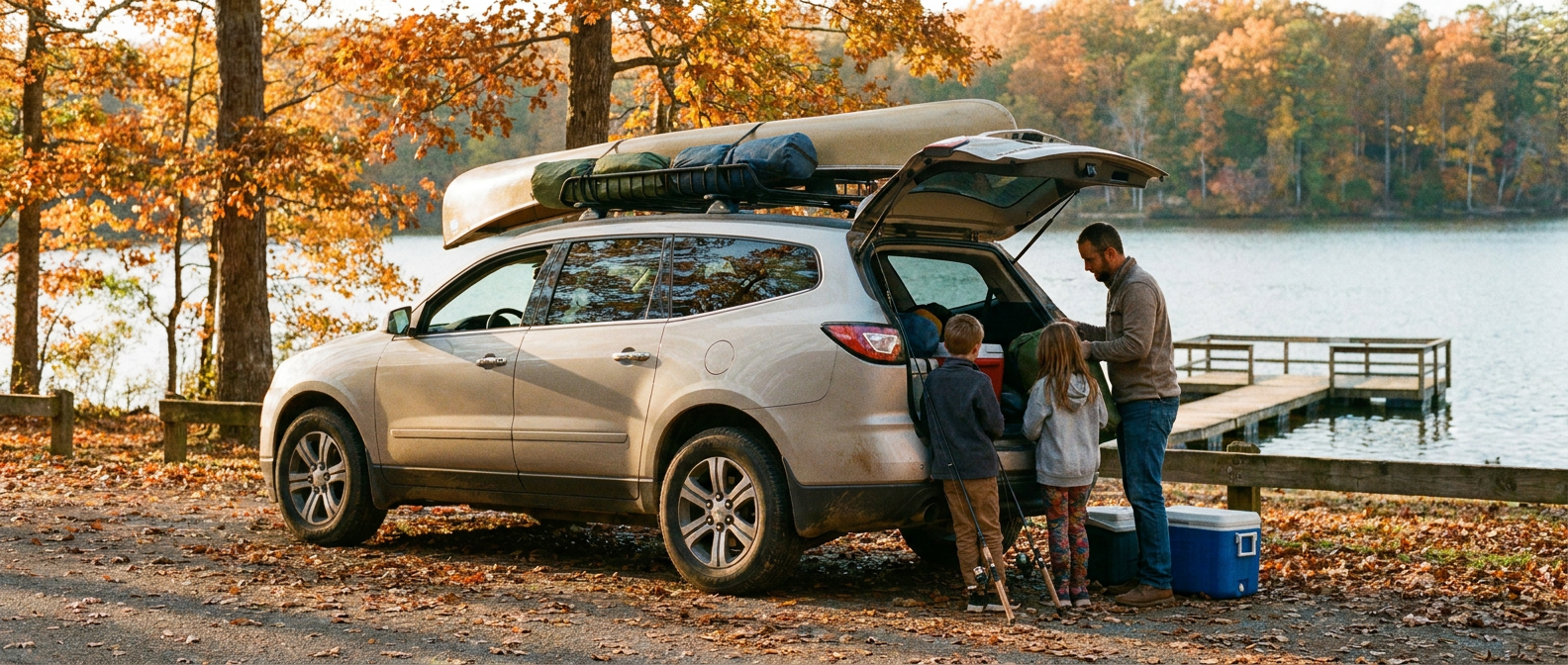
Used Chevrolet Traverse at a South Carolina lake recreation area in fall, family loading gear into the cargo area, autumn foliage in the background

Used Chevy SUVs by Model Year: Which Years Are Actually Worth It for Fall Family Buyers Near Blythewood

If you're shopping for a used Chevrolet SUV this fall, the model year matters more than the badge on the tailgate suggests. A 2018 Traverse and a 2022 Traverse carry the same nameplate, but they're not the same purchase. Pick the right year and your family stays comfortable on the I-77 run between Blythewood and Winnsboro. Pick the wrong one and you're in a waiting room at the service center two months after you sign. Let's start with the short answer. For a compact family crossover, target a third-generation Equinox from 2021. That year carried just 75 documented NHTSA owner complaints and earned a five-star NHTSA crash rating. For three rows on a real budget, the 2022 Traverse had only one NHTSA recall on record. For full-size room and genuine towing, the 2020 Tahoe is the documented sweet spot in the fourth-gen lineup before fifth-generation pricing takes over. What's below explains each call. The short version Equinox sweet spot: 2021 (five-star NHTSA crash rating, 75 owner complaints on record) or 2023-2024 (lowest complaint volumes in the model's history). The 2017 earned a perfect 5/5 from Consumer Reports with zero recalls that year. Years to approach carefully (Equinox): 2010 through 2013, where NHTSA documented more than 1,000 complaints for the 2010 alone, centered on engine oil consumption in the 2.4-liter four-cylinder. Traverse sweet spot: 2022 (just one NHTSA recall, 76 complaints) or 2023 (two recalls, 62 complaints). Both represent a settled, mature second-generation platform. Years to approach carefully (Traverse): 2018 first-year builds (9-speed shifter complaints documented) and 2019 (358 NHTSA owner complaints, the highest of any second-gen year). Tahoe sweet spot: 2020 (one NHTSA recall, 38 complaints, Consumer Reports 5.0 reliability score for that model year). For fifth-gen room and cargo, the 2022 is the cleaner entry point over the 2021 launch year. Always verify: Run the VIN through NHTSA's free lookup tool to confirm every open recall is resolved before you buy anything. Which Model Years Are the Sweet Spots? The answer runs differently for each size class, so we'll break it down by the three Chevy SUV families that make the most sense for Fairfield County and Blythewood-area buyers, from compact to three-row mid-size to full-size. Model Sweet-Spot Years Years to Watch Main Documented Concern Equinox 2021, 2023-2024 2010-2013 Engine oil consumption; 2010 alone had 3 NHTSA recalls and 1,000-plus complaints Equinox 2017 2015 2015 carried documented complaints; 2017 = zero recalls, 5/5 Consumer Reports Traverse 2022-2023 2018, 2019 2018 first-year 9-speed shifter; 2019 = 358 NHTSA complaint reports Traverse 2016-2017 (1st gen) 2009-2012 (1st gen) Timing chain stretch and transmission wave-plate failures in early first-gen Tahoe 2019-2020 2015, 2021 early builds 2015 = 16 NHTSA recalls (nameplate record); 2021 = 292 complaints, 8 recalls Equinox: Third-Generation Is Where You Want to Be The third-generation Equinox launched for 2018 with a 1.5-liter turbocharged four-cylinder, and it cleaned up the powertrain concerns that had piled up across the second-gen years. We'd call that the meaningful break in the model's history. Within that third gen, the 2021 is our pick for families, and it's an easy one to stand behind. NHTSA data shows just 75 documented owner complaints for that year. Chevrolet added standard surround-vision cameras and rear collision alert as standard equipment on the 2021, and the five-star NHTSA crash rating holds. The 2021 carries four NHTSA recalls, which is modest and addressed under no-charge remedies. If your budget reaches to 2023 or 2024, those years carry even lower complaint volumes and represent a fully mature platform. The tradeoff is price, and you'll see it reflected in late-model Equinox examples with clean records that live up to their reputation. A word on the second-gen years, 2010 through 2013. NHTSA recorded more than 1,000 owner complaints for the 2010 Equinox alone, centered on engine oil consumption tied to the 2.4-liter four-cylinder. The 2010 also drew three separate NHTSA recalls covering the electrical system, powertrain, and a seat adjuster defect. Repairs ranged from piston-ring replacements to full engine replacements. That's documented, specific, and not a risk we'd recommend for a family's primary driver. Traverse: Skip the First Two Second-Gen Years, Aim for 2022 The second-generation Traverse arrived for 2018 with a size increase, a more refined interior, and a nine-speed automatic transmission. That first-year build came with documented shifter complaints. NHTSA's complaint file for the 2018 Traverse sits at 332 owner reports, and 2019 is the highest of any second-gen year at 358 complaints. The 2020 piled up eight NHTSA recalls outright, and that's not a number you ignore. The data turns sharply at 2021, where complaints dropped to 72. By 2022 you're looking at the cleanest single year in the second-generation run, just one NHTSA recall and 76 complaints. The 2023 follows close behind with 62 complaints and two recalls. See Traverse inventory at Wilson Chevrolet and look for 2022 examples with documented service history and recall completion records. Three rows, solid reliability data, and a platform that Chevrolet had four years to refine. That's a strong used-SUV combination. For buyers who need three rows but can't stretch to a 2022, the first-generation 2016 and 2017 Traverse are worth serious consideration. By that point in the production run, Chevrolet had addressed the timing chain and transmission wave-plate concerns of the early first-gen years. These won't have the modern driver-assistance suite of a 2022, but the core mechanicals are documented as solid. Team Observation: On late second-gen Traverses, we check the build date on the window sticker rather than leaning only on the model year label. A 2018 Traverse built late in the production year can differ from an early-production unit, because running changes landed after early complaints surfaced. It takes thirty seconds to check, and it'll tell you plenty. Find Out What Your Current SUV Is Worth Which Years Should You Watch Out For? Every nameplate has a few years where the documented record gives us pause, and the fair way to say it is that none of them are automatic dealbreakers, they're just years that ask for more homework and a closer inspection before you sign anything. Here are the specific ones. Equinox 2010-2013. The core issue was excessive oil consumption in the 2.4-liter four-cylinder. NHTSA complaint data for 2010 exceeds 1,000 reports, with similar volumes documented for 2011 and 2013. The 2010 alone drew three separate NHTSA recalls covering the electrical system and powertrain, a seat adjuster defect, and a defroster flaw. These aren't years to avoid based on reputation. They're years to approach carefully based on documented, specific mechanical patterns. Traverse 2018 and 2019. First-year redesign issues are common across every brand, and the second-gen Traverse nine-speed transmission drew consistent owner complaints from 2018 production. The 2019 logged 358 NHTSA complaints, the highest complaint volume of any second-gen Traverse year in NHTSA's database. If you're looking at 2018 or 2019 examples, a pre-purchase inspection from a qualified technician focused on the transmission is worth the investment before you commit. Tahoe 2015. The 2015 record is unambiguous. Per NHTSA records, the 2015 Chevrolet Tahoe accumulated 16 recalls, the highest recall count in the nameplate's modern history, covering airbag systems, power steering, brake boosters, and transmission concerns. A 2015 with full recall-completion documentation isn't impossible to vet, but it's a substantial amount of homework for a vehicle that old. The 2016 through 2020 years are meaningfully cleaner. Tahoe 2021 (early builds specifically). The fifth-generation Tahoe is a genuinely improved vehicle over the fourth-gen. Independent rear suspension, 25.5 cubic feet of cargo behind the third row (up from just 15.3 cubic feet in the outgoing fourth gen), and more third-row legroom. But NHTSA recorded 292 complaints and eight recalls for the 2021 model year, including a seat-belt buckle assembly recall covering third-row buckles. The buckle recall is a free fix per NHTSA records. Verify it's been completed before you purchase. Browse used inventory at Wilson Chevrolet to check what's currently available with year-specific details. Which Year Fits Which Family? The data narrows the field to a handful of strong years, but the winner for your household comes down to how you actually use the vehicle, the commute, the gear, the trailer behind the hitch. Match the year to the life, and you'll land on the right SUV. Two kids, a school schedule, and the I-77 corridor to Columbia five days a week. The Equinox is your vehicle. A 2021 with documented service history hits the reliability profile you need for a high-use daily driver. The EPA rates the front-wheel-drive 2021 Equinox 1.5-liter turbo at 26 miles per gallon on the highway, a number that shows up in your real budget when you're running that corridor regularly. If a 2021 is priced above your target, the 2017 with its verified zero-recall record is the best budget alternative in the third-gen range. Three kids, a dog, and weekend gear hauling to Lake Wateree State Recreation Area. You've got a three-row problem, and the 2022 Traverse solves it without the first- and second-year headaches. Seats up to eight, carries the gear, and represents a platform that NHTSA complaint data shows stabilizing in 2021 and settling further in 2022. Don't let moderate mileage scare you if the service records are complete, a 2022 Traverse with documented maintenance history and verified recall completion has plenty of useful life ahead. You're towing a boat, running full-family errands, and you're not apologizing for the size. A 2020 Tahoe is the honest answer, with one NHTSA recall on record. Consumer Reports gave it a 5.0 out of 5.0 reliability score for that model year. Fourth-gen towing capacity ran up to 8,600 pounds with the 5.3-liter V8. It's the final year of the fourth generation, a mature platform priced below the fifth-gen examples that carry the independent rear suspension upgrade. You want the fifth-gen Tahoe's cargo room and you're deciding between 2021 and 2022. Go 2022 if you can. The 2021 redesign is excellent, but the 2022 dropped from 292 NHTSA complaints to 124, and the third-row seat-belt buckle recall that covers 2021 and 2022 is documentable and resolvable. Verify it's been addressed, and the 2022 is a solid purchase. Check Tahoe availability at Wilson Chevrolet to see what's on the lot near Blythewood right now. Run the NHTSA VIN lookup on any used Chevy SUV before you buy. The lookup is free, takes two minutes, and shows every open recall outstanding on a specific vehicle. If a seller won't let you run it before you commit, that's worth noting. Frequently Asked Questions What is the most reliable used Chevy SUV for a family near Blythewood? For a compact family crossover, the 2021 Chevrolet Equinox stands out with 75 documented NHTSA owner complaints, a five-star NHTSA crash test rating, and standard surround-vision cameras and rear collision alert. For three-row family needs, a 2022 Traverse carried just one NHTSA recall and 76 complaints, the cleanest year of the entire second-generation run. Both represent platforms that Chevrolet had time to refine well past their initial production issues, and both are typically available as used examples in the Fairfield County and Columbia metro market. Which used Chevy Equinox years should I avoid? The 2010 through 2013 Equinox years carry the highest documented complaint volumes in the model's history. NHTSA recorded more than 1,000 owner complaints for the 2010 model year alone, tied to engine oil consumption in the 2.4-liter four-cylinder, and that year drew three separate NHTSA recalls. The 2013 also accumulated over 1,000 complaints and two recalls. If your budget points toward a second-generation Equinox, the 2016 or 2017 are the cleaner choices within that generation, the 2017 specifically earned a perfect five out of five from Consumer Reports with zero recalls that year. Is the 2021 Chevrolet Tahoe a good used buy? Yes, with one specific item to verify. The 2021 Tahoe launched the fifth generation with independent rear suspension, 25.5 cubic feet of cargo behind the third row (versus 15.3 cubic feet in the outgoing fourth-gen Tahoe), and genuinely usable third-row legroom. The tradeoff is that NHTSA recorded 292 owner complaints and eight recalls for the 2021 model year, including a third-row seat-belt buckle assembly recall. That recall is a free remedy per NHTSA records. Confirm it has been completed using the NHTSA VIN lookup before you purchase. For a more settled fifth-gen entry, the 2022 logged 124 NHTSA complaints, a meaningful improvement over the launch year. See Pre-Approval Options From Wilson Chevrolet Wilson Chevrolet 798 us hwy 321 N BUSINESS, Winnsboro, SC 29180 (803) 402-4233
2026 Chevrolet Silverado 1500 on a cold Winnsboro SC morning with hood open for battery inspection

Your Chevy's Battery Is Already in Trouble. It Just Hasn't Told You Yet.

Most battery failures on a cold Winnsboro morning weren't caused by the cold. Winnsboro's July heat, averaging 92 degrees F highs according to climate records, is what actually cooks a lead-acid battery from the inside out. By the time that first November frost settles in along I-77, your battery is already weakened. The cold just delivers the verdict. We watch this play out at our service center on US 321 when the seasons turn. We'd call it a verifiable pattern tied to the chemistry, grounded in how the battery behaves. Heat accelerates internal corrosion and plate degradation inside a battery, and cold then exposes the result by demanding more from a battery that can no longer deliver it. AAA's Car Doctor John Paul has stated it plainly. A car engine needs about 30% more energy to start when temperatures drop to freezing, and at zero degrees a battery delivers only half its rated capacity. That combination is why fall battery testing is the highest-value service your Chevy can get right now. Browse available Chevrolet Equinox models AAA confirms an engine needs about 30% more starting energy at 32 degrees F, and a battery delivers only 50% of its rated capacity at 0 degrees F. Winnsboro January lows average 30 degrees F. What Do the Battery Specs Actually Mean for Your Chevy? Cold Cranking Amps, or CCA, is the spec that matters most when it's 28 degrees and you're trying to get to work, though it's only half the story without reserve capacity and the right group size behind it. CCA measures how much current a battery can deliver at 0 degrees F for 30 seconds while holding a minimum voltage of 7.2 volts. More CCA, more reserve against the cold. Spec What It Means Why It Matters in Winnsboro CCA (Cold Cranking Amps) Current deliverable at 0 degrees F for 30 seconds Winnsboro January lows average 30 degrees F; any weakness shows here Reserve Capacity (RC) Minutes of backup power at a steady draw Covers heated seats, defrost, lights on cold start Group Size Physical tray fit (Group 48 for most modern Chevys) Wrong group = won't seat correctly or make full contact AGM vs. Flooded AGM is sealed, spill-proof, handles start-stop cycling Required for Equinox and other Chevys with auto start-stop Voltage at rest Should read 12.6V fully charged Below 12.4V with engine off means the battery is partially discharged Age Average service life is 3 to 5 years After 3 years, annual testing is the right call The 2026 Chevrolet Equinox, for example, uses a BCI Group 48 (H6) AGM battery with a 760 CCA rating. That's not a coincidence. Chevrolet specifies AGM because the Equinox runs a start-stop system, which cycles the battery far more frequently than a traditional setup. A standard flooded battery will work short term, but it won't hold up to the cycling demand. Replace an AGM-equipped Chevy with a conventional flooded battery and you've created a problem you won't feel at first, but you will feel on a cold morning six months later. Silverado owners, your truck carries a large-displacement engine that requires significant cranking power. The CCA requirement varies by engine family and cab configuration, so the right move is to have our service team verify the OEM spec for your exact build rather than assume a generic number. South Carolina's Summer Is the Real Battery Killer South Carolina's summer does more damage to your battery than any cold snap, even though the failure doesn't surface until a cold January morning, which is why winter takes the blame for harm that actually began under the hood back in July. The reckoning just happens to land in the cold months. Winnsboro summers aren't mild. July averages a high of 92 degrees F, and under the hood the temperature climbs far beyond ambient. Sustained heat accelerates two destructive processes inside a lead-acid battery. It speeds up water loss from the electrolyte, and it corrodes the internal lead plates. A battery that spent three Winnsboro summers under the hood of a Silverado 1500 working a job site carries invisible structural wear. The summer warmth masked it, because the chemical reaction ran just fine in heat. Then October comes. The mornings drop into the 40s. By December, Winnsboro's overnight lows are routinely in the low 30s, with the 2026 AccuWeather forecast showing December nights reaching into the low 20s. The battery that handled summer starts with zero drama now has to deliver 30% more power while chemistry is running slower than it ever did in July. Service tip: If your Chevy's battery is three years old or older and has spent its life in Fairfield County heat, test it now, in October, well before the cold arrives. A load test in our service center takes about 15 minutes and tells you whether you're carrying a liability into winter. Schedule a service appointment at Wilson Chevrolet So what does good battery maintenance for a Winnsboro Chevy look like? In plain terms, it comes down to a handful of steps. Load test the battery. A voltage reading alone doesn't reveal the full picture. A load test measures actual output under demand, which is what exposes a battery that reads 12.5V but can't sustain it under cranking load. Check the terminals. Corrosion on the posts creates resistance, which increases the effective load on an already-strained battery. A ten-minute fix, and it matters. Inspect the charging system. A weak alternator that undercharges the battery between short trips is the second most common reason a battery in good shape still fails. The alternator and battery need to be evaluated together, same appointment if you can swing it. Confirm you have the right battery type. If your Chevy has a start-stop system and someone previously installed a conventional flooded battery, that's worth correcting now. Know the age. If you don't know when the battery was replaced, the service team can read the date code stamped on the case. Schedule Your Battery Check Before the Cold Hits Who Actually Needs to Act Right Now? Battery testing isn't a universal emergency for every Chevy owner in Winnsboro, and we'd rather be straight with you than scare the whole county into the service lane, so here is who it actually matters for most. Testing is most urgent in a few specific situations, and being direct about them beats vague worry. Act now if any of these fit your situation. You own a Chevy that's three years old or older and the battery has never been load-tested. A 3-to-5-year service life is the typical range for a lead-acid battery in this climate. Three years won't be the failure point for most, though it's when annual testing shifts from optional to worthwhile. Your Chevy has a start-stop system (the Equinox and several other models do) and the battery was replaced at some point with a standard flooded unit. AGM is required for proper function and longevity in that application. You regularly make short trips, say, running into Ridgeway or Blythewood and back without much highway time. Short trips don't give the alternator enough run time to fully recharge the battery between cold starts, and that pattern compounds fast in fall and winter. Your battery was last replaced in summer and the installation happened to come after three or more previous summers on the same battery. The timing matters because you may be carrying a new battery that replaced a badly degraded predecessor, and the alternator or terminals that drove the old one into the ground may still need attention. If you're looking at a Tahoe for a growing family or replacing a work truck, a clean battery health record is part of how we prep vehicles on our lot before they leave. But for the Chevy you're already driving, the responsibility is yours to act on, and October is the month to do it. Frequently Asked Questions Why does my Chevy battery fail in winter if it was fine all summer? The summer heat, not the cold, does the structural damage inside a lead-acid battery by accelerating water loss from the electrolyte and corroding the internal lead plates. Cold mornings are simply when that hidden damage becomes a starting failure. At 32 degrees F, a battery loses roughly 20% of its capacity while the engine simultaneously demands about 30% more starting energy, per AAA. A battery weakened by a Winnsboro summer often can't bridge that gap. Does my Chevrolet Equinox need a special type of battery? Yes. The 2026 Equinox uses a BCI Group 48 AGM (Absorbent Glass Mat) battery rather than a standard flooded battery. The AGM chemistry is required because the Equinox's auto start-stop system cycles the battery far more often than a conventional engine setup does. Installing a flooded battery in an AGM-equipped Equinox will work initially but will wear out much faster, often before the end of a normal service interval. View Current Chevy Offers at Wilson Chevrolet Wilson Chevrolet 798 us hwy 321 N BUSINESS, Winnsboro, SC 29180 (803) 402-4233

2026 Chevrolet Silverado 1500 on a rural South Carolina two-lane highway near Winnsboro

How to Pick the Right Alignment Service for Your Chevy on US-321

In this article What Actually Matters When Choosing Your Alignment Service? Toe Is the Angle That Costs You the Most Tire Tread Road Type Shapes How Often You Actually Need a Check Match the Service to How You Actually Drive Feel your steering wheel sit at a slight angle while you roll straight down US-321, and you already know the feeling. A low-grade wrongness, nothing dramatic. Left alone, it quietly costs you tread every mile you ignore it. Alignment lives in the gap between "I'll get to it" and "why am I already replacing tires?" We'll give you the decision criteria our service center uses, matched to how Fairfield County drivers actually run their Chevys on the roads around here. Browse our 2026 Silverado 1500 inventory The short version Truck (Silverado 1500, Silverado 2500 HD, Colorado): Front-only alignment in most cases, the solid rear axle isn't adjustable. Get it checked after any hard pothole or railroad crossing hit, and at every second tire rotation. Unibody SUV (Equinox, Traverse, Trailblazer, Trax): Full four-wheel alignment. Independent rear suspension means all four corners need to be set. Don't skip the rear. Top trigger on US-321: Crowned pavement on rural sections and raised railroad crossings knock alignment faster than flat highway miles. If you run those stretches regularly, bump up your check interval. New tires = alignment check, no exceptions. Installing a fresh set on a misaligned vehicle just accelerates wear on the new rubber from day one. The one symptom that isn't alignment: A pull that appears only when you let go of the wheel on a crowned road. That's road crown, not misalignment. Feel for it on a flat surface first. What Actually Matters When Choosing Your Alignment Service? The question worth asking is which type your Chevy takes and what event should trigger the check, and the answer depends almost entirely on whether you're driving a body-on-frame truck or a unibody SUV, since those two layouts take different service. Three variables run the decision. Vehicle Type Alignment Type Needed Key Spec Checked Honest Tradeoff Silverado 1500 (body-on-frame) Front-end / two-wheel Caster, camber, toe (front axle only) Rear axle is solid and non-adjustable; saves time and cost, but all the correction happens up front Silverado 2500 HD (body-on-frame) Front-end / two-wheel Caster, camber, toe (front axle); rear thrust angle checked but rarely adjustable Same solid-axle limit; heavy loads and trailer tongue weight shift specs faster Colorado (mid-size truck) Four-wheel All four angles. Independent rear suspension on newer generation More thorough but takes longer; worth every minute for a truck that doubles as a daily driver Equinox / Trax / Trailblazer Four-wheel Camber, toe front and rear; caster front Unibody + independent rear = all four corners matter equally Traverse Four-wheel Same as above; 22-inch wheel option on higher trims amplifies any toe error Larger diameter means even small toe-out chews shoulder tread visibly fast Why this table matters on US-321 specifically: US-321 mixes crowned rural two-lane sections with railroad crossings at grade and gravel pull-offs near the lake access points. Crowned pavement creates a constant lateral load that mimics a mild pull, so you can misread a road-crown effect as a camber problem. Checking alignment on a flat, level lift is the one reliable way to separate the two. Toe Is the Angle That Costs You the Most Tire Tread Toe is the alignment angle that burns through tire tread fastest on most of the driving our customers do. Camber and caster both matter, but neither chews rubber the way a toe setting that has drifted out of spec will. We'll walk all three, starting with why. See the 2026 Equinox lineup Camber is the inward or outward tilt of the tire viewed head-on. Positive camber (top of the tire leaning out) wears the outer tread edge, and negative camber wears the inner edge. Factory tolerances are tight on a Silverado or Traverse. The GM service procedure for Silverado sets a front camber target of -0.5 degrees, with -0.3 to -0.7 acceptable. Drift a quarter-degree off spec and you can see uneven wear across a set of tires. Not a lot of room. Toe is the direction the wheels point when viewed from above. Toe-in means the fronts of the tires angle slightly toward each other, and toe-out is the opposite. Too much toe in either direction feathers the tread, a scrubbing pattern that runs diagonally across each tread block. You can feel it with your fingertips before you ever spot it at a glance. Caster is the forward/backward tilt of the steering axis viewed from the side. It mostly affects steering return and highway stability rather than tire wear directly. Unequal caster side-to-side makes the truck drift toward the side with less positive caster, the kind of pull that feels like alignment on a flat road but gets misdiagnosed on crowned pavement. Heads-up for Traverse drivers: The 2026 Traverse High Country runs 275/45R22 tires. A larger-diameter tire amplifies the effect of any toe error at the contact patch. If your Traverse is showing feathered wear at the shoulder, toe is the first thing to measure, not camber. Alignment Angle Primary Effect What Bad Looks Like on a Tire Toe Tire wear (most critical) Feathered or sawtooth pattern across tread blocks Camber Tire wear + cornering One-sided wear, inside or outside edge Caster Steering stability and return Pull to one side; not a direct wear angle unless extreme Road Type Shapes How Often You Actually Need a Check How often you need an alignment check depends less on a fixed mileage number and more on the roads you cover, so a mostly-highway driver and a daily US-321 driver land on noticeably different intervals even in the same truck. We'll break it down trigger by trigger. Mostly I-77 or flat highway miles: A check every 12,000 to 15,000 miles, or about once a year, is reasonable. Smooth highway at a steady speed puts very little lateral stress on suspension geometry. Regular rural US-321 mileage, the two-lane sections between Winnsboro and the county lines: The interval shortens. Crowned pavement and the occasional rough patch at grade crossings apply low-level but repeated lateral loading that drifts alignment over time. We'd check at every second tire rotation rather than wait for a symptom to show up. After a hard hit. Pothole, railroad crossing, curb strike: Check it right then. Don't wait for the next scheduled service. One hard impact at speed can knock toe out of spec immediately. After new tires: Always, no exceptions. Mount fresh tires on a misaligned vehicle and the new rubber falls into the same wear pattern as the old set from the first mile. The tires pay for the skipped service. After suspension work: Tie rod replacement, strut replacement, control arm bushing. Any of these change the geometry. Alignment goes on the same visit. Trigger Silverado / Colorado Equinox / Traverse / Trailblazer Annual interval (mostly highway) Once per year or 12,000 mi Once per year or 12,000 mi Regular rural US-321 use Every second tire rotation Every second tire rotation Hard pothole or railroad crossing hit Check immediately Check immediately New tire installation Always Always Suspension component replaced Same visit Same visit Schedule Your Alignment Check Match the Service to How You Actually Drive Matching the service to your driving comes down to three kinds of Fairfield County driving, and each one points to a different alignment type, from a front-end check on a part-time hauler to a full four-wheel set on an SUV that lives on crowned pavement. We'll take them one at a time. The I-77 commuter who also hauls on weekends: You're logging consistent highway miles with occasional payload. Highway miles are gentler on alignment than rural roads, but payload shifts the rear suspension geometry on a Silverado every time you load up. Caster and camber up front stay more stable, and what drifts is how the rear thrust angle presents after repeated heavy loads. A front-end check once a year, plus a rear thrust-angle inspection any time you're hauling regularly, keeps you dialed in. The US-321 daily driver in a Traverse or Equinox: You're putting unibody SUV geometry through crowned pavement every day. Four-wheel alignment isn't optional here. Skip the rear and you've skipped half the job. The rear independent suspension on these vehicles is adjustable, and it does drift on imperfect roads. Our team looks at rear toe first on unibody SUVs that have been running rural miles, because that's where the wear pattern shows up earliest. The Carolina Adventure World runner in a Colorado: Carolina Adventure World sits at the end of gravel access roads. Those roads put steering geometry through real lateral stress. If you're running unpaved terrain on top of your street miles, bumping your check interval to every 8,000 to 10,000 miles keeps the Colorado's independent suspension honest. The Colorado's four-wheel alignment covers adjustable rear angles, which the Silverado's solid rear axle doesn't have. See the 2026 Colorado Pros and Cons of Four-Wheel vs. Front-Only Alignment Pros Cons Four-wheel: addresses all four contact patches equally Takes more time and is typically more involved Four-wheel: necessary for any unibody or IRS vehicle Overkill for solid-rear-axle trucks (Silverado 1500, 2500 HD) Front-only: faster, covers the adjustable angles on body-on-frame trucks Misses rear thrust angle on trucks where rear geometry has shifted Both: provide a before/after printout showing actual angle measurements Neither fixes worn suspension components. Alignment reveals them, not resolves them Skip the printout and you're guessing. One thing we always tell customers is that the before-and-after sheet matters. A good alignment service hands you actual degree measurements. If you're handing over a truck for alignment and not getting a printed report, ask for one. A printed report is the one way to see whether the adjustment moved the needle, and whether the angles started inside spec or so far out that something mechanical needs attention first. Schedule your alignment check at Wilson Chevrolet Frequently Asked Questions Does a Chevrolet Silverado 1500 need a four-wheel alignment or just a front-end alignment? The Silverado 1500 has a solid rear axle, which means the rear geometry isn't adjustable in the same way an independent rear suspension is. In most cases, a front-end alignment addresses all the adjustable angles: caster, camber, and toe at the front axle, while a rear thrust-angle check confirms the rear axle is tracking straight. A full four-wheel procedure is the right call if there's been suspension damage or significant impact, but routine alignment service on a Silverado 1500 is primarily front-end work. That's different from an Equinox or Traverse, which use independent rear suspensions and genuinely need all four corners adjusted. How do I know if my steering pull is a road-crown effect or actual misalignment? Find a flat, straight road with no visible crown or camber; a parking lot lane or a freshly paved section works well. Drive it at low speed and gently remove your hands from the wheel for a second. If the vehicle tracks straight on the flat surface but pulls on US-321's rural sections, the crowned pavement is doing the work, not the alignment. If it pulls on the flat surface too, that's a real alignment (or inflation) issue. Check tire pressure first, as a single tire that is badly under-inflated can mimic an alignment pull, then bring it in for a check if the pull persists with pressures correct. Book Service at Wilson Chevrolet Wilson Chevrolet 798 us hwy 321 N BUSINESS, Winnsboro, SC 29180 (803) 402-4233

2026 Chevrolet Blazer loaded with camping gear at a fall lakeside campsite in South Carolina

Blazer vs. Trailblazer for Fall Weekend Travel: Which One Actually Fits Your Trip?

In this article What's the Real Difference Between the Blazer and Trailblazer? Does Cargo Space Actually Matter for an Overnight Trip? Towing: The Number That Actually Changes the Answer Getting to Lake Wateree: Why the Trip Route Matters So Which One Should You Pick? October in Fairfield County is worth the drive. The question we keep coming back to is which Chevy gets you there without making you regret the choice on Monday morning. The 2026 Blazer is the one for hauling serious cargo or pulling a trailer. Full stop. But if your fall weekends lean toward easy runs down I-77 with a couple of bags in back, the 2026 Trailblazer will do it more efficiently and cost less to fill up. On paper these two look related, and they share a bow-tie badge, but they're built for genuinely different trips. The short version The 2026 Blazer carries 64.2 cubic feet of cargo (seats folded) and can tow up to 4,500 lbs when properly equipped with the V6 and Trailering Package. That's the one for bigger gear hauls or pulling a boat trailer. The 2026 Trailblazer tops out at 1,000 lbs of towing and 54.4 cubic feet, but it returns up to 31 mpg combined (EPA estimate, 1.3L FWD). A Blazer with the 2.0L engine and AWD manages 24 mpg combined. The Trailblazer wins on fuel economy. The Blazer wins on space, power, and tow rating. For a trip to Lake Wateree State Park with four adults, full camping gear, and a small utility trailer: Blazer. For a low-key leaf-peeping run or a two-person overnight: Trailblazer handles it comfortably and keeps more money in your pocket on the fuel stop. Both 2026 models are in our inventory right now on US 321 in Winnsboro. What's the Real Difference Between the Blazer and Trailblazer? No, these aren't the same SUV in two sizes; the Blazer and Trailblazer ride on different platforms, run different engines, and aim at different buyers, which means the right pick comes down to what you're hauling and how far you plan to drive it. They just look like cousins. Start with the Blazer, a midsize two-row SUV. It stretches 191.9 inches long, rides on a 113-inch wheelbase, and tips the scales at roughly 3,918 lbs. The standard engine is a 2.0-liter turbocharged four-cylinder producing 228 horsepower and 258 lb-ft of torque. Step up to the RS trim and you add a 3.6-liter V6 making 308 horsepower and 270 lb-ft. That V6 unlocks the 4,500 lb tow rating (with the Trailering Package). With the four-cylinder and the Trailering Package you're rated to tow up to 3,250 lbs. Drop the package and both engines are rated at 1,500 lbs. Now the Trailblazer, a subcompact crossover. It measures 174.1 inches long, sits on a 103.9-inch wheelbase, and weighs around 3,029 lbs in base FWD trim. Power comes from turbocharged three-cylinders, either a 1.2-liter (137 hp, 162 lb-ft) or a 1.3-liter (155 hp, 174 lb-ft). Max tow rating tops out at 1,000 lbs with the right equipment. Think a kayak on a rack, not a jon boat on a trailer. The gap between them is real, and it shows up in every dimension that matters for a weekend trip. Spec 2026 Blazer 2026 Trailblazer Overall Length 191.9 in 174.1 in Cargo (seats up) 30.5 cu ft 25.3 cu ft Cargo (seats folded) 64.2 cu ft 54.4 cu ft Max Tow Rating 4,500 lbs (V6, Trailering Pkg) 1,000 lbs EPA Combined MPG (best) 25 mpg (2.0L FWD) 31 mpg (1.3L FWD) EPA Combined MPG (AWD) 24 mpg (2.0L AWD) 27 mpg (1.3L AWD) Horsepower (base engine) 228 hp 155 hp Ground Clearance 7.5 in (2LT/3LT); 7.6 in (RS AWD) Standard ride height The single deciding factor for a fall weekend trip: if you're pulling anything heavier than a kayak or need to fold the seats flat for serious gear, the Blazer is the only answer. If you're not towing and you're traveling with two people or a tight pack, the Trailblazer's 31 mpg combined changes the math on a 150-mile round trip. Does Cargo Space Actually Matter for an Overnight Trip? Yes, cargo space matters more on an overnight than you'd expect, because the Blazer out-measures the Trailblazer in every configuration, yet the Trailblazer still swallows plenty for a two-person run and hides a long-item trick that the bigger SUV simply can't pull off. The specifics tell the story. Behind the rear seats, the Blazer's 30.5 cubic feet (seats upright) already beats the Trailblazer's maximum of 25.3. Call that your daily carry number with four people aboard. Fold the Blazer's 60/40 split rear seat and you jump to 64.2 cubic feet. Fold the Trailblazer's rear seat and you land at 54.4. The difference works out to a real 9.8 cubic feet, roughly the volume of a large duffel bag plus a camp chair. For a Lake Wateree overnight with four adults, four sleeping bags, a cooler, and two folding chairs, you're going to feel that gap. A Trailblazer still handles a two-person trip without strain. It does have one clever trick, too, the fold-flat front passenger seat lets you carry items up to 8.5 feet long inside the cabin, which comes in handy for longer gear when you're traveling solo or with one other person. The Blazer's sliding rear seats earn a mention as well. Chevrolet built them to let you trade rear legroom for cargo depth or the reverse, which is handy if you're picking up passengers on the way home from the campground. *"The 2026 Chevy Trailblazer has an EPA-estimated 31 mpg combined with the available 1.3L Turbo engine and FWD."* . Chevrolet (chevrolet.com) The 31 mpg figure explains why the Trailblazer makes sense for plenty of fall day trips and quick overnights. A 75-mile drive from Winnsboro down I-77 to Columbia and back in a Trailblazer FWD burns noticeably less fuel than the same run in a Blazer 2.0L AWD at 24 mpg combined. Browse current inventory at Wilson Chevrolet to see which trims and configurations we have on the lot right now. Towing: The Number That Actually Changes the Answer Towing is where these two stop being comparable at all, and the spread is wide enough to settle the decision on its own, with the Trailblazer topping out at 1,000 lbs and a well-equipped Blazer climbing to 3,250 or even 4,500 lbs, a different class of trailer entirely. Pull up any comparison article and you'll read that the Trailblazer "can tow." Technically true. At its 1,000-lb ceiling, it handles a loaded kayak trailer or a small cargo carrier. But if your fall weekend involves an aluminum jon boat on a trailer, a pop-up camper, or a utility trailer loaded with firewood and ATV gear, the Trailblazer isn't your vehicle. It wasn't engineered for that load, and you'll feel it the moment you pull away. The Blazer, configured right, is a different conversation. Its 2.0-liter four-cylinder with the Trailering Package tows 3,250 lbs. Add the 3.6-liter V6 (standard on the RS, available on the 3LT) with the Trailering Package and that ceiling rises to 4,500 lbs. A 14-foot aluminum fishing boat with a small outboard runs 1,200 to 1,800 lbs rigged and ready. A small boat trailer adds another 200 to 400 lbs. The V6 Blazer handles that without breaking a sweat. The Trailblazer cannot. That said, the Blazer's tradeoff is a fair one. The V6 RS returns 21 mpg combined on AWD (EPA estimate). You're paying for capability in fuel every time you fill up, even when the trailer's sitting at home. If your boat-launch days fall in May and your fall weekends are gear-free, that's worth thinking about before you option up. Getting to Lake Wateree: Why the Trip Route Matters Fall is the right season for Lake Wateree State Park, and the route out there quietly shapes which SUV you'll be happier driving, since the park sits along 13,000-plus acres of water about 15 minutes from Winnsboro and the shoulder season brings milder weather, thinner crowds, and solid fishing and hiking. The 72 campsites at the park include spots with water and electrical hookups that accommodate larger RVs. Many are lakefront. The practical part is the road itself. From Winnsboro out to the park you'll cover a stretch of county road, and depending on your site, you may be backing into a spot near the lake on a grade. The Blazer's longer wheelbase (113 inches vs. 103.9) and heavier curb weight give it a more planted, settled feel when you're maneuvering with weight in back. The Trailblazer's shorter wheelbase and lighter weight make it easier to swing around tight campground loops. Both offer available AWD for any soft shoulder or grass launch area you run into. Neither of these is an off-road vehicle in the serious sense. Ground clearance on the Blazer runs 7.5 to 7.6 inches depending on trim, which is fine for unpaved campground roads and gravel. Just don't mistake it for a lifted trail rig. The Trailblazer sits in the same boat, sharing similar on-pavement ride height. If your fall weekend involves anything rougher than a gravel access road, you're looking at the wrong column of our lineup entirely. See Current Chevy Fall Offers So Which One Should You Pick? The answer gets straightforward once you're clear on your trip, and it splits cleanly down the middle, with the Blazer built for four people, real gear, and anything worth towing, while the Trailblazer rewards the lighter two-person weekend with better fuel numbers and an easier footprint in tight spots. Pick the Blazer if: You're running with four people and full gear. You're towing anything heavier than a kayak. You want the V6's 308 horsepower for confident I-77 merges with a loaded vehicle. You value having serious cargo capacity in reserve even on trips where you don't use all of it. The Blazer is the working weekend vehicle in this comparison. Pick the Trailblazer if: Your fall weekends are typically two people with a couple of bags. You drive I-77 often and fuel economy is a real consideration. You want a smaller footprint that's easier to maneuver in campground loops and tight parking at Winnsboro spots. You're not towing anything substantial. At 31 mpg combined (EPA estimate, 1.3L FWD), the Trailblazer is genuinely efficient for a subcompact crossover, and you'll notice that on a fall weekend running up to Charlotte or down to Columbia. Our honest read from what we carry on the lot is simple. The Blazer is the better vehicle for a family of four with real gear. Talk to our finance team if you want to walk through your options on either one before you decide. The Trailblazer is the smarter choice for a couple who weekend light. Neither one is the wrong pick for fall in Fairfield County. They're just wrong for each other's trip. Frequently Asked Questions Does the Chevrolet Blazer or Trailblazer get better gas mileage? The Trailblazer wins that comparison and it's not close. The EPA rates the 2026 Trailblazer at up to 31 mpg combined with the 1.3-liter engine and front-wheel drive, and up to 27 mpg combined with AWD. The 2026 Blazer with the 2.0-liter engine and front-wheel drive returns 25 mpg combined; the AWD version of that same engine drops to 24 mpg combined. If fuel economy is your priority for fall weekend driving, the Trailblazer is the clearer answer. The Blazer's tradeoff is more cargo space, more power, and a tow rating that the Trailblazer can't match. Can the Chevrolet Trailblazer tow a boat trailer? Only a very small one. The 2026 Trailblazer is rated for a maximum of 1,000 lbs when properly equipped. A lightweight kayak or a small cargo carrier fits within that range, but a fishing boat on a trailer is almost certainly beyond it. For anything resembling a real trailering job, the 2026 Blazer is the vehicle to consider. With the Trailering Package and the 2.0-liter engine it's rated for 3,250 lbs; add the 3.6-liter V6 and that ceiling goes to 4,500 lbs. If fall weekend trips involve a boat launch, shop the Blazer. Explore Financing Options Wilson Chevrolet 798 us hwy 321 N BUSINESS, Winnsboro, SC 29180 (803) 402-4233
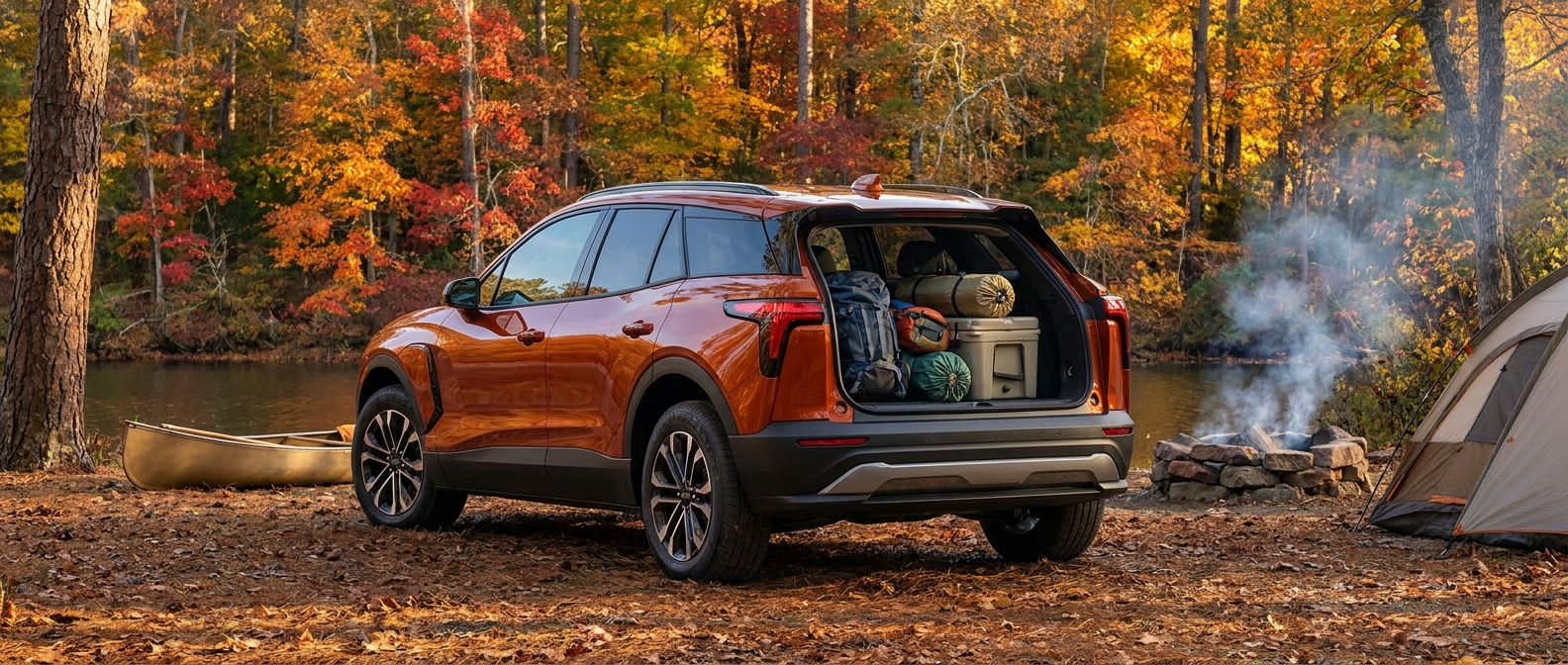
Used Chevrolet Silverado 1500 LT 4WD work truck on a red clay farm road near Winnsboro, SC

What's the Best Used Truck for Farm Work Under $40K?

Short answer: a 2016–2022 Chevrolet Silverado 1500 LT 4WD with the 5.3L V8. Model years 2016–2022 Trim LT Drivetrain 4WD Engine 5.3L V8 Mileage Under 100K Paperwork Service records It's the truck our service department at Wilson Chevrolet sees hold up best when it's worked hard every day. Why the Silverado It tows 9,300–11,000 lbs depending on configuration, and the 5.3L V8 is one of the most proven engines on the road. Our techs here in Winnsboro see them for maintenance, not major repairs. Parts are cheap and every shop in Fairfield County can work on one. A close runner-up is the Ram 1500 with the 5.7L HEMI, which rides a little smoother but gives up some bed payload to its coil-spring rear suspension. What to Check Before You Buy If the truck has the 8-speed automatic, it could develop a shudder on light acceleration, usually fixed with a transmission fluid service. On the test drive, feel how it shifts at low speed and ask when the fluid was last serviced. Beyond that: Frame rust. Look at the rear frame rails and bed mounts first. 4WD engagement. It should engage smoothly in both high and low. Hitch history. If it already has a gooseneck or fifth-wheel hitch, it towed heavy, so look harder at the brakes and rear differential. A 110,000-mile truck with a folder of service receipts beats a 70,000-mile truck with no history every time. The Bottom Line A 2016–2022 Silverado 1500 LT, 4WD, 5.3L V8, under 100,000 miles with service records: that's the farm truck to buy under $40K. Work-Ready Trucks on Our Lot in Winnsboro We've got work-ready trucks at Wilson Chevrolet right now. Come by and we'll put any of them on the lift so you can look underneath yourself before you decide. Start with the Silverado 1500s we have listed under $40K, or compare every other used truck in the same budget. Shop Silverado 1500s Under 40K Explore Other Trucks Under 40K Don't see the right one? Tell us what you're looking for and we'll help you find it. Have a truck to trade? Get your trade-in value online before you visit. Wilson Chevrolet, 798 US Hwy 321 N, Winnsboro, SC 29180 Call 803-402-4233

2026 Chevrolet Silverado 1500 on a Fairfield County, SC forest road during hunting season

A Hunting Season Day in Fairfield County: 4 Stops, One Chevy Truck

Fairfield County isn't just good deer country. It ranks sixth-highest in South Carolina by total deer hunters, according to SCDNR harvest data, and the terrain around Winnsboro earns that reputation the hard way. Red-clay two-tracks, creek bottoms that go soft overnight, and back gates that sit a long drive from the pavement on US 321. The right truck isn't an afterthought out here. It's the difference between a clean pack-out and a recovery call. We've built this plan for a full hunting-season day in Fairfield County, and it runs on two trucks our team at the Silverado 1500 knows well. One for the hunter who needs to tow a box blind or ATV trailer, and one for the hunter who wants to run tight forest cuts without grinding up a full-size. Pick your truck, pull this plan up before daylight, and go. What's the Route? Fairfield County sits in Game Zone 2 (per SCDNR), so the 2026-2027 gun season runs October 11 through January 1, and primitive weapons opened October 1 before that. You get a serious three-month window, and we've built this route to hold up on any Saturday from opening weekend through the December push. Stop Drive Time from Winnsboro What to Do What to Pack 1. Pre-dawn gear check, US 321 0 min (staging) Load up, confirm tags and orange, fuel up Cooler, blind bags, rifle/bow case, first aid kit 2. Private or WMA land access near Sumter National Forest 20-35 min Morning sit (archery Sept. 15-30; guns Oct. 11+) Stand/blind, grunt call, drag rope, scent control bag 3. Winnsboro town square / butcher drop 15-20 min from field Field dress pickup or butcher drop-off, resupply lunch Tagged deer, ice bags for cooler 4. Carolina Adventure World access road debrief 10-15 min from town Scout ATV trails for next trip; check side-by-side fits in bed Trail map, ATV tie-down straps The full loop runs roughly 60-80 miles depending on where you access the land. Both trucks handle it. You'll notice the differences at stops 2 and 4. The Four Stops, Broken Down Stop 1: Staging on US 321 Before First Light A five-minute systems check in the parking lot is easy to skip, and it's the kind of thing that costs you at the trailhead. Chevrolet lists 12 standard tie-down cleats (rated at 500 lbs each) in the Silverado 1500's Durabed, so load your ATV or box-blind frame and test the straps before dark instead of after you're parked at the gate. Five minutes before you leave matters. The Colorado is a better choice here if you're hunting solo or with one partner and don't need to tow. Its 2.7L TurboMax engine produces 430 lb-ft of torque (Chevrolet spec, all trims), and the Trail Boss trim rides on 9.5 inches of ground clearance, enough to clear the clay road ruts that show up after the first fall rain. Stop 2: The Morning Sit Near Sumter National Forest Sumter National Forest holds accessible public land within range of Fairfield County, and this is the stop where truck size starts to earn its keep. The two-tracks threading into WMA edges and forest buffer zones run narrow. Tight. A Crew Cab Silverado 1500 with a long bed gets you there, but you'll be watching mirrors the whole way. A Colorado (especially Trail Boss or Z71) fits those cuts more naturally and still pulls a loaded utility trailer up to 7,700 lbs when properly equipped, which covers a single ATV or a small hunting trailer without problem. There's a real tradeoff, though. The Colorado's short bed (61.7 inches) becomes a genuine constraint on a pack-out day. A field-dressed buck, a blind bag, two sets of gear, and a cooler will fill that bed fast. Know your kit before you commit. See Current Truck Specials Stop 3: Field Dress Pickup or Butcher Drop in Winnsboro Whether you dress in the field or take it straight to a processor, you're coming back through Winnsboro, and the Silverado 1500 earns its keep on this leg. Chevrolet rates the 2026 Silverado 1500 at up to 2,260 lbs of available payload (configuration-dependent, per the door-jamb label), so a full-size cooler loaded with ice and a deer won't push the truck's limits. The 5.3L EcoTec3 V8 with the trailering package handles up to 11,300 lbs, so if you're running a larger enclosed trailer with gear for a camp setup, that headroom is real. Tire pressure is the easy thing to let slide on a heavily loaded half-ton before a long season. Chevrolet builds a Tire Pressure Monitoring System into the Silverado lineup. Pressure drops with the cold, so check it before every loaded trip. Don't wait for the warning light. Timing note: Fairfield County's gun season under Game Zone 2 runs October 11 through January 1, 2027 on private land. Archery season ran September 15-30. If you're hunting a WMA in Fairfield County, the Broad River Waterfowl Management Area extends archery through October 31, per SCDNR. Confirm your specific WMA rules before the morning of. Stop 4: Carolina Adventure World Scout Run Why not head straight home after the butcher drop? The better use of daylight is scouting the next trip, and Carolina Adventure World sits on 2,600 acres with 100 miles of ATV and UTV trails, so it's a logical test loop if you want to see how your rig handles Piedmont off-road terrain before committing to a camp setup. The Silverado 2500 HD enters the conversation here. If your hunting camp involves a larger camper or a heavy duty enclosed trailer, the 2026 Silverado 2500 HD gets you up to 18,500 lbs of towing with the 6.6L gas V8, per Chevrolet specifications. That number reaches camp-trailer territory, more than a blind and a four-wheeler. The Colorado's off-road trims are genuinely capable for scouting, but if you're pulling serious weight into a base camp, the HD earns its designation. Tweak It to Your Crew Four stops cover one or two hunters cleanly, but the math shifts the moment you add people and gear to the day, so you'll want to size the truck to the crew you actually bring rather than to opening-morning optimism. A Crew Cab Silverado 1500 seats five adults comfortably and still leaves you the full bed, which keeps a whole family hunt on one vehicle, kids in the back seats and gear in the bed. A Colorado with a Trail Boss or Z71 trim is the right answer if you're hunting solo, running tight public-land cuts, and your trailer is a single ATV rather than a camp rig. One configuration our team wouldn't overlook is the Silverado 1500 with the 3.0L Duramax Diesel. Chevrolet rates it at 13,300 lbs towing and 495 lb-ft of torque. It also carries diesel efficiency on the highway, which matters on a long I-77 run up to a lease in the upper county. All that torque arrives low in the rev range, exactly what a loaded trailer needs on a wet clay grade. See what's on the lot this week by checking our inventory. We keep Silverados and Colorados stocked through hunting season for exactly this reason. Come look before the December push. Value Your Trade Before Hunting Season Ends Wilson Chevrolet 798 us hwy 321 N BUSINESS, Winnsboro, SC 29180 (803) 402-4233
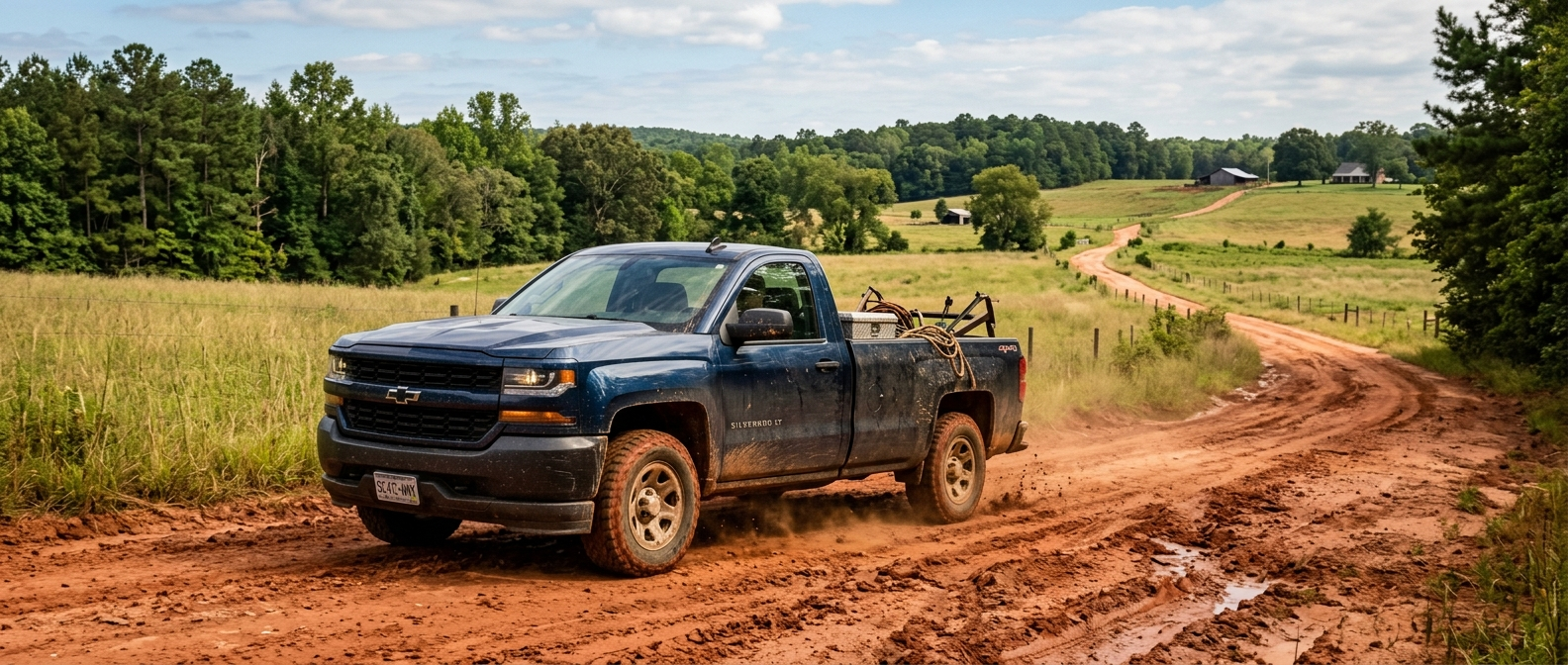
2026 Chevrolet Silverado 2500 HD towing an equipment trailer on a rural Fairfield County, SC highway near Ridgeway

Silverado 2500 HD Towing Guide for Equipment Owners Near Ridgeway, SC

In this article What's the Plan at a Glance? The Engine Decision Is Where Most Buyers Get It Wrong Hitch Type and the Max Trailering Package: Don't Leave Capacity on the Table Reading Your Door Sticker Before You Commit to a Load The Silverado 2500 HD as a Fairfield County Work Tool Moving equipment through Fairfield County comes down to one configuration call, and the 2026 Silverado 2500 HD is where you make it. Get the engine, hitch type, and package right, and this truck handles the loads that fill a working week around Ridgeway. Get it wrong, and you've paid for a heavy-duty truck set up like a light-duty one. Geography matters here. Fairfield County sits on roughly 700 square miles of working land, and the two-lane roads connecting a job site outside Ridgeway to I-77 aren't the straight, flat interstate hauls that national towing guides are written for. What's the Plan at a Glance? No two Silverado 2500 HD builds tow the same, because the engine, hitch type, and Max Trailering Package together set your actual rating, and the badge on the tailgate tells you far less than the equipment list does. Run the common load scenarios and the picture gets clear fast. Load Type Hitch Setup Engine Needed Key Payload Note Utility trailer, skid steer (under 14,000 lbs) Conventional ball hitch Gas 6.6L V8 gets you there Tongue weight counts against payload Heavy equipment, full tilt trailer (14,000-20,000 lbs) Conventional + Max Trailering Pkg Duramax diesel required Read your door sticker, not the brochure Gooseneck or 5th-wheel load (up to 22,050 lbs) Gooseneck/5th Wheel Prep Package Duramax diesel required Bed ball over rear axle; requires factory prep Mixed farm and construction, daily driver Either hitch type Diesel for headroom and torque Payload varies widely by cab and config The Engine Decision Is Where Most Buyers Get It Wrong Engine choice drives every other number on this truck, so decide it before hitch type or package, because a gas V8 and a Duramax diesel point you toward completely different towing ceilings and completely different ownership. Pick the engine first. Everything else follows from it. Chevrolet rates the 2026 Silverado 2500 HD's 6.6L gas V8 at 401 horsepower and 464 lb-ft of torque, with a conventional towing ceiling of up to 16,000 pounds when properly equipped. For plenty of utility-trailer and lighter equipment hauls around the county, that's a real working number. The tradeoff shows up at the top of the range, where you can't touch the gooseneck ratings that matter for heavier equipment loads and you carry no reserve when a trailer comes in near that cap. The 6.6L Duramax Turbo-Diesel V8 changes the conversation entirely. Chevrolet rates it at 470 horsepower and 975 lb-ft of torque, paired with the Allison 10-speed automatic. Conventional towing climbs to 20,000 pounds with the Max Trailering Package; gooseneck and fifth-wheel configurations reach up to 22,050 pounds when properly equipped. All 975 lb-ft of that torque arrives low in the rev range, which is exactly what a load on a grade rewards. We've watched diesel-equipped 2500 HDs pull equipment loads that lean on a gas engine a good deal harder. The Duramax just pulls flatter. If your loads stay under 10,000 pounds and you want a daily driver that's more fuel-efficient around town, the Silverado 1500 is worth a conversation first. But if your trailer regularly approaches or exceeds that threshold, the 2500 HD is the right platform and the diesel is the right engine inside it. Local note: The two-lane routes between Ridgeway and job sites across Fairfield County run mostly flat to gently rolling, but the on-ramp grades onto I-77 put a brief, real stress on any loaded rig. You don't want to learn on that ramp that you're sitting at the edge of your gas engine's torque curve. Hitch Type and the Max Trailering Package: Don't Leave Capacity on the Table Hitch type decides how much of that published capacity you can actually reach, and most generic towing guides skip right past it, which is how buyers end up thousands of pounds short of what their truck could pull. The equipment list is where the numbers live. Silverado 2500 HD trucks in our inventory come in several configurations, and the maximum published numbers require specific equipment. A conventional ball hitch on a rear receiver handles the majority of equipment trailers in the 6,000 to 16,000-pound range. For loads above that, or for anyone moving gooseneck trailers loaded with compactors, graders, or skid steers, the Gooseneck/Fifth Wheel Prep Package is what opens the door to the 22,050-pound rating. That package adds a bed-mounted ball positioned over the rear axle, which puts the tongue load at the truck's strongest structural point and delivers better stability on long pulls. One item is genuinely new for 2026. Chevrolet made the integrated trailer brake controller standard across every Silverado 2500 HD trim. It was an add-on before. That controller matters for anyone pulling a loaded equipment trailer, because a trailer brake controller is what keeps a heavy load from pushing the truck on a downgrade. It also satisfies a requirement some job sites and state regulations impose on commercial equipment moves. The 2026 Silverado 2500 HD integrates a trailer brake controller standard on every trim for the first time, removing a common oversight from equipment-hauling setups. Reading Your Door Sticker Before You Commit to a Load Your true towing number lives on a sticker, not in a brochure, because the maximum published figures come together only with a specific mix of cab style, bed length, drivetrain, engine, and package. Read the tire and loading information label on the driver's door jamb for the rating that applies to your truck. The Silverado 2500 HD's maximum payload varies by configuration, up to roughly 3,689 pounds in the best-equipped setup. Every pound of tongue weight from a trailer counts against that payload number. For a Fairfield County equipment owner, that means pulling a loaded gooseneck trailer where 15 to 20 percent of the trailer's gross weight rests on the ball. Work through that math before you load. Your door sticker is the authoritative number for your specific truck, and the published maximum is a ceiling the whole lineup can hit only under ideal conditions with optimal equipment. See Current Silverado HD Offers The Silverado 2500 HD as a Fairfield County Work Tool The I-77 corridor is what makes Winnsboro and Ridgeway practical for contractors and equipment operators who need to move loads between county job sites and still reach Columbia or Charlotte without burning half a day in transit. This 2500 HD fits that pattern because it's a real work truck, not a lifestyle truck wearing a work truck costume. Keeping the service schedule current matters more on a truck that earns its living than on one that sits in a driveway. Diesel maintenance intervals, DEF fluid, and the Allison transmission service schedule are all real commitments that pay back in reliability on heavy loads. Our service center team knows these trucks and the way they're used around here, and that familiarity shows up in the conversation when you bring one in. The Duramax diesel adds weight, a higher entry point on the trim sheet, and a maintenance profile unlike a gas engine's. If your towing needs are occasional and your loads stay comfortably under 14,000 pounds, the gas 6.6L V8 isn't a bad choice, and it's the more straightforward truck to own. But if you're moving equipment regularly and those loads push above 15,000 pounds, the diesel is the correct engine, and the added complexity buys you the torque and capacity that make a heavy load feel manageable. None of this is a sales pitch. The number on the spec sheet is real. Getting to it takes picking the right combination, knowing what your trailer actually weighs, and respecting what the door sticker says for your specific configuration. Come talk to our team at Wilson Chevrolet on US 321 in Winnsboro. We'll walk through the configuration that matches what you're actually pulling. Explore Financing Options Wilson Chevrolet 798 us hwy 321 N BUSINESS, Winnsboro, SC 29180 (803) 402-4233
Contact Us

Fill out this form below and we'll contact you shortly
*Required Fields