





School started July 30th in Fairfield County. You've already run registration, hauled supplies, and scrambled through that first week down US-321. Now you're standing in our lot at Wilson Chevrolet, wondering whether a 2026 Chevrolet Tahoe or a 2026 Suburban really fits a household this busy. The straight answer is simple. They're the same truck in almost every way that matters, except for 15 inches of length and one number that changes everything for a large family. So which number matters most? Cargo behind the third row. The Tahoe gives you 25.5 cubic feet with all three rows occupied. The Suburban gives you 41.5 cubic feet in the same configuration. That's the difference between fitting backpacks and gear bags, and having to choose between them. We built a one-Saturday itinerary through Fairfield County to show you exactly where those 15 inches show up in real life. Walk it stop by stop. What's the Route? Four stops, roughly south to north along the US-321 corridor and out to Lake Wateree. The whole plan lays out below. Stop Drive from Previous What You're Doing What to Pack 1. School drop-off, US-321 Start here After-school gear swap (sports bags, instruments) Cleats, backpacks, violin case 2. South Carolina Railroad Museum 5 min from US-321 schools Saturday outing, Fairfield County's anchor attraction Stroller or wagon, snack bag 3. Historic Town Clock and Court House 5 min across downtown Quick walk through Winnsboro's Robert Mills architecture Nothing extra (just your crew) 4. Lake Wateree State Recreation Area 25 min east on SC-200 Afternoon on 13,000+ acres of water and shoreline Kayak gear, cooler, towels, lifejackets Total round-trip driving runs roughly 60 miles. Call it a full Fairfield County Saturday. The Stops, One by One Stop 1: The School Gear Swap The 15-inch difference announces itself loudly right here. Fairfield Central High, Fairfield Middle, and the elementary campuses all cluster along the US-321 Bypass, less than a mile from our dealership. When three kids pile out and a fourth activity's worth of gear needs to load in, the Tahoe's 25.5 cubic feet behind the third row handles everyday backpacks fine. Add a tuba, a lacrosse stick bag, and cleats for two kids, and you're stacking things on laps. The 2026 Chevrolet Suburban starts that same stop with 41.5 cubic feet of trunk space and those seats still fully upright. That extra 16 cubic feet is real, not marketing. Gear stays off laps. One tradeoff is worth naming. The Suburban is 226.3 inches long. The Tahoe is 211.3 inches. If your garage is a standard 20-footer or your school's pickup lane involves a sharp exit turn, the Tahoe's shorter footprint is a genuine daily-life convenience, not a trivial footnote. See Current Chevrolet Offers Stop 2: South Carolina Railroad Museum Five minutes from the school loop, the Railroad Museum is Fairfield County's flagship attraction and a legitimately fun stop for kids of any age. You're not hauling cargo here (you're hauling people). Both the Tahoe and Suburban seat up to nine passengers and share identical front- and second-row dimensions, so rows one and two feel the same in either truck. The difference shows up in row three. Chevrolet lists 36.7 inches of third-row legroom in the Suburban versus 34.9 inches in the Tahoe. For younger kids that gap is irrelevant. For a teenager or a grandparent riding along for the day, 1.8 inches reads as the difference between "tolerable" and "actually fine." The 2026 Suburban's third row offers 36.7 inches of legroom versus the Tahoe's 34.9 inches, a real comfort gap for adult passengers on longer hauls. Stop 3: Historic Town Clock and Court House Stop 3 is a parking stop. The Town Clock and Court House sit in downtown Winnsboro. Downtown is tight, and both of these SUVs will make you look twice before you pull into a diagonal space. The Tahoe wins here, plain and simple, at 15 inches shorter. A shorter body pays off when you're parallel parking on a busy Main Street block or swinging a full-size SUV into a tight angle. If your week includes a lot of errand loops through Winnsboro or Columbia runs down I-77, the Tahoe's footprint is a genuine quality-of-life advantage. You'll feel it repeatedly. The Suburban isn't hard to drive. It just asks you to be a little more intentional about where you park. Timing note for Lake Wateree: South Carolina August afternoons are hot and humid. Plan your water time for 10 a.m. to 2 p.m. before peak heat, and bring shade. The South Carolina Railroad Museum typically opens at 10 a.m. on Saturdays (confirm current hours before you go). Tweak It to Your Crew Every family in Fairfield County uses these trucks differently, so the right pick depends less on the spec sheet and more on how many kids ride, how much gear rides with them, and where you park at the end of the day. The split breaks down along a few clear lines. Choose the Tahoe if: You run one school route with two or three kids and sports gear fits behind the third row without a Tetris session. Your garage is standard-depth or you navigate tight downtown Winnsboro parking regularly. You occasionally tow a boat or camper to Lake Wateree (Chevrolet rates it up to 8,400 pounds when properly equipped with the Max Trailering package and RWD, which is slightly more than the Suburban's 8,300-pound rating because the Tahoe is lighter). Your priority is a full-size Chevy that drives a little more like a normal-sized vehicle day-to-day. Choose the Suburban if: You have four or more kids and you're combining school runs with weekend activities without ever asking anyone to hold something. You carpool. You need third-row seats usable by adults regularly. You're planning road trips. Chevrolet gives the Suburban a 28-gallon fuel tank versus the Tahoe's 24 gallons, which adds meaningful range between stops when you're heading up I-77 toward Charlotte with a full load. You park in open lots at Lake Wateree, Carolina Adventure World, or the school's big pickup circle where extra length is never a problem. Both trucks run the same three powertrains. You get the standard 5.3L EcoTec3 V8 at 355 horsepower, an available 6.2L EcoTec3 V8 at 420 horsepower, and the available Duramax 3.0L turbo-diesel at 305 horsepower with 495 pound-feet of torque. The EPA rates the diesel Tahoe at 21 city and 28 highway (RWD), which is legitimately impressive for a body-on-frame SUV this size. Both share the 17.7-inch touchscreen, Google built-in, and USB ports in every row, so the tech feels identical no matter which body you pick. Our take, if you're on the fence, leans Suburban. A family that picks Tahoe for the shorter footprint rarely wishes it were longer. A family that picks Tahoe expecting the cargo to stretch far enough can end up wishing they'd sized up. The 15-inch difference looks small on a spec sheet. It does not look small when you're loading up for a Lake Wateree Saturday with four kids and their gear. Come sit in both. Walk to the back of each with all three rows up. Browse our current Tahoe and Suburban inventory and we'll get them both on the lot for you. We're right here on US-321 in Winnsboro. Explore financing options before you visit so you're ready to move when the right one shows up. Get Your Trade-In Value Wilson Chevrolet 798 us hwy 321 N BUSINESS, Winnsboro, SC 29180 (803) 402-4233
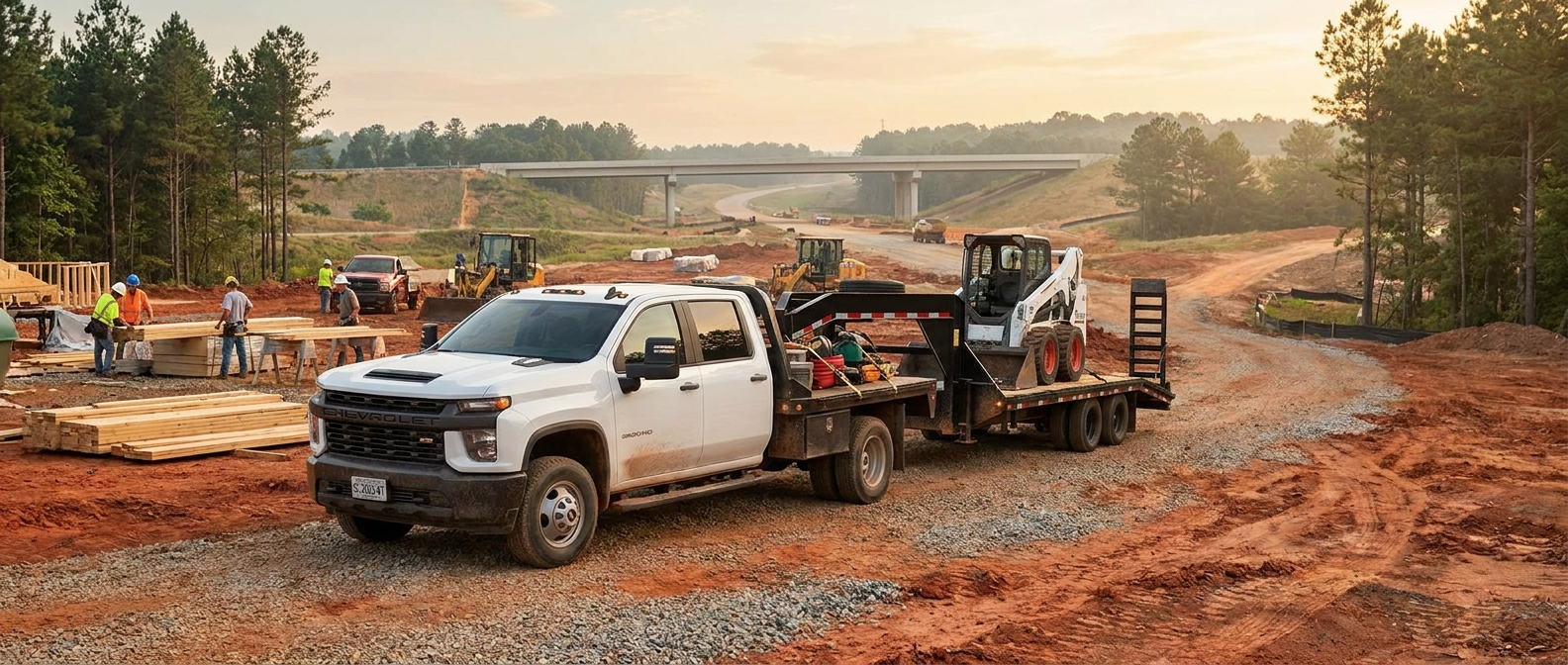
Does a Blythewood Construction Worker Need the Duramax (or Will Gas Do the Job)?
For jobsite work around here, the 2026 Silverado 2500HD is the right truck, and that part isn't really in doubt. The harder call is which engine fits your actual work pattern, and whether the 2026's new standard trailer brake controller changes how you should think about it. The short answer depends on what you pull. If you're pulling equipment trailers over 14,000 pounds week in and week out, or running I-77 south toward Columbia with a loaded gooseneck, the Duramax diesel earns its place. If your day is mostly in-town starts and stops, drop-offs at subdivisions off Blythewood Road, and loads under 12,000 pounds, the 6.6L gas V8 is a capable, lower-maintenance choice that most generic articles won't admit. For construction workers around Blythewood, the 2026 Silverado 2500HD's biggest practical change isn't the engine. It's that the integrated trailer brake controller is now standard on every trim, from Work Truck to High Country, for the first time. How Do the Two Engines Actually Work? The 2026 Silverado 2500HD runs two distinct powertrains, and the difference goes well beyond what you'll read on a spec sheet. Feature 6.6L Gas V8 6.6L Duramax Turbo-Diesel V8 Horsepower 401 hp 470 hp Torque 464 lb-ft 975 lb-ft Max Conventional Tow ~14,500 lbs 18,500 lbs Max Gooseneck Tow Not rated for gooseneck peak 22,070 lbs (with 5th Wheel/GN Prep) Payload (max) Up to 3,689 lbs (verify door sticker) Up to 3,689 lbs (verify door sticker) Transmission Allison 10-speed automatic Allison 10-speed automatic Best for Short hauls, jobsite variety, lower complexity Long pulls, heavy gooseneck loads, highway efficiency DEF/DPF maintenance No Yes Chevrolet lists both the gas and diesel at a maximum payload of up to 3,689 lbs, though your door-jamb sticker is the authoritative number for your specific build. Both engines pair to the Allison 10-speed automatic, and that's a genuine strength of this platform. The torque gap matters more than the payload. You get 975 lb-ft from the Duramax against 464 from the gas V8, and you feel that 511 lb-ft spread when you pull a loaded skid steer up a grade, or when you hold highway speed with a heavy trailer and the engine barely spins up. The Duramax delivers that torque low in the RPM range. Forum communities of 2500HD owners describe it as the difference between a diesel and a gas V8 on sustained pulls. The diesel pulls without drama, and the gas V8 gets the job done. You'll just hear it working harder. See which configurations we have on the lot at Wilson Chevrolet Which Engine Do You Actually Need Around Here? Which engine you need depends on your load profile, and around Blythewood the loads are anything but light right now. Scout Motors' manufacturing facility under construction in Blythewood has 500 construction workers already on the site, and a significant I-77 interchange groundbreaking ceremony was held in February to handle the project's traffic. There are 32 active development projects tracked in Blythewood right now. None of that is slow growth. It's a full construction season with real equipment moving up and down I-77. All of that context feeds straight into your engine decision. Let's sort out which engine fits. If your loads typically run under 12,000-13,000 pounds (a tandem utility trailer with a compact excavator, tools and materials for residential builds, or a landscape equipment trailer), the 6.6L gas V8 covers you. It handles approximately 14,500 lbs conventional, it doesn't require Diesel Exhaust Fluid, and an oil change is simpler and less expensive. For contractors doing short daily loops through Blythewood and back to Winnsboro, the gas engine earns its keep. If you're running gooseneck loads, heavy equipment trailers, or making regular highway runs down I-77 toward Columbia or up toward Charlotte, the Duramax changes the feel of the job. Eighteen thousand five hundred pounds conventional, 22,070 lbs with the 5th Wheel/Gooseneck Prep Package. Right there, the diesel's 975 lb-ft of torque stops being a bragging right and becomes a functional margin. The tradeoff here is real, and it's worth naming. Diesel adds maintenance complexity, including DEF fluid, DPF filter service, and higher service costs per interval. For a contractor whose truck mostly runs jobsite-to-jobsite in Richland County with loads under the gas threshold, that complexity doesn't buy you anything. For the operator pulling heavy iron consistently, it's worth every bit of it. View Current Silverado 2500HD Offers The 2026 Change That Actually Matters to You: Standard Trailer Brake Controller The standard trailer brake controller is the 2026 change that quietly reshapes the buying decision. For 2026, Chevrolet made the integrated trailer brake controller standard on every single Silverado 2500HD trim, from Work Truck through High Country. Before this year, it was a mid-to-upper trim feature or an add-on. Now the in-dash controller is factory-installed in every truck we sell. You'll have it on day one. In practice, that works simply. When you press the brake pedal, the system sends proportional brake-force signals directly to your trailer's electric brakes through the truck's own antilock brake electronics. It reads how hard you're stopping and applies the trailer brakes in proportion. It is not a fixed-gain separate box you dial in after the fact. For a construction worker hitching an equipment trailer often, the value isn't just convenience. You get consistent, calibrated trailer braking from a Work Truck spec without paying for a higher trim or buying an aftermarket Prodigy and running wiring. Term What It Means for You Integrated trailer brake controller Factory unit wired into the truck's ABS; controls trailer electric brakes proportionally DEF (Diesel Exhaust Fluid) Required additive for diesel emissions; must be kept topped up; additional service cost DPF (Diesel Particulate Filter) Exhaust filter that regenerates passively on highway runs; short-trip-only operation can cause issues Gooseneck Prep Package Factory-installed bed mounting points and wiring for 5th wheel or gooseneck hitches Allison 10-speed automatic Heavy-duty transmission used by both gas and diesel Silverado HD builds Durabed Silverado HD's steel cargo bed (83.5 cubic feet, 12 tie-down points rated at 500 lbs each) Not sure if you need the 2500HD or if the Silverado 1500 would cover it? What This Means for Your Next Work Truck Our team at Wilson Chevrolet is about 25 minutes up I-77 from Blythewood on US 321 in Winnsboro. Contractors, tradesmen, and fleet buyers all work through this same engine decision, and we're glad to talk it through. We'd frame it this way. The 2026 Silverado 2500HD is the right platform for the Blythewood construction market right now. For the majority of in-county work, the gas V8 is a capable, practical choice. The Duramax diesel is the right call the moment your load profile or your haul distances push past what the gas engine handles comfortably. The standard trailer brake controller means you're no longer forced up the trim ladder just to get proper trailer braking. For fleet buyers who want Work Truck functionality without the options cost, that's a genuine change. We'll walk through your specific trailer weights, your typical routes, and what cab and bed configuration matches your crew, or you can start with the link below. Either way, come out and see us. Frequently Asked Questions Does the 2026 Silverado 2500HD come with a trailer brake controller on the base Work Truck trim? Yes. For 2026, Chevrolet made the integrated trailer brake controller standard on every Silverado 2500HD trim, including the base Work Truck. The in-dash unit connects directly to the truck's antilock brake electronics and applies proportional braking force to your trailer's electric brakes based on how hard you press the brake pedal. Gas or Duramax diesel (which makes more sense for construction work around Blythewood)? It depends on your load profile. The 6.6L gas V8 (401 hp, 464 lb-ft of torque) handles conventional towing up to approximately 14,500 lbs and is the lower-maintenance option for shorter, in-county hauls. The 6.6L Duramax diesel (470 hp, 975 lb-ft) handles up to 18,500 lbs conventionally and 22,070 lbs gooseneck, and makes more sense if you're running heavy equipment trailers regularly or making frequent I-77 highway pulls. The diesel requires DEF fluid and higher-cost service intervals, so for lighter construction patterns, the gas engine is a honest, capable choice. Explore Financing for the Silverado 2500HD Wilson Chevrolet 798 us hwy 321 N BUSINESS, Winnsboro, SC 29180 (803) 402-4233
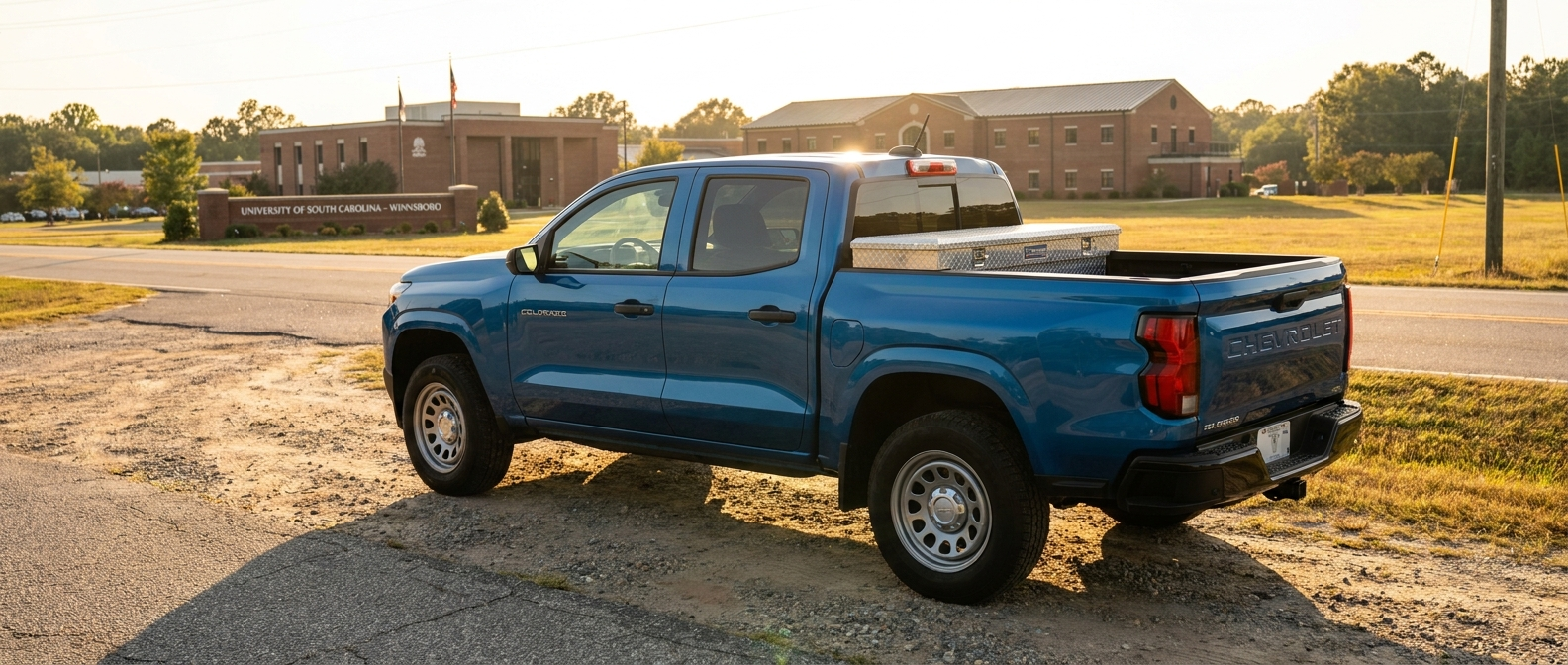
3 Best Chevrolet Trucks for Trade School Students Near Columbia
In this article The Ranking at a Glance The Colorado Work Truck: Right-Sized for a Student's Real Needs The Silverado 1500 Work Truck: When the Side Jobs Start Paying Silverado 1500 Double Cab: The Carpool and Off-Campus Living Pick Pros and Cons at a Glance The Bottom Line: Start With the Colorado, Grow Into the Silverado If you're starting an HVAC, welding, electrical, or construction program at a trade school near Columbia, a pickup truck isn't a lifestyle choice. It's a tool. You need a bed that swallows a compressor and a pipe cutter. You need a cab big enough for a passenger or two on a job-site run. And you need a commute down I-77 that doesn't drain your fuel budget before the semester is over. The good part is that Chevrolet makes three distinct trucks, and each one solves a different version of that problem. Our team at Wilson Chevrolet on US 321 in Winnsboro sees students from the Midlands Technical College Fairfield Campus come in asking the same question, and the answer depends on how much you haul, how far you commute, and whether you're already running a side job. The campus sits right here on our road at 1674 US 321 Business. The ranking below comes straight from what the specs actually support. The 2026 Chevrolet Colorado is our top pick for most trade-school students in this market. Read on for why. The Ranking at a Glance Rank Truck Best For Standout Spec 1 2026 Colorado WT / LT Daily commuter hauling tools and materials Up to 1,710 lb payload; 2.7L TurboMax, 310 hp 2 2026 Silverado 1500 Work Truck Students already running a side job or apprenticeship Up to 2,260 lb payload; up to 13,300 lb towing when properly equipped 3 2026 Silverado 1500 Double Cab Students carpooling or splitting housing near campus Full rear seating; same TurboMax engine, real backseat legroom The Colorado Work Truck: Right-Sized for a Student's Real Needs For most first-year trade students, the Colorado is the right-sized answer, and Chevrolet lists the 2026 Colorado's bed payload at up to 1,710 pounds in the WT and LT trims, enough for a full set of hand tools, a generator, PVC fittings, and your safety gear without sweating the math. The 2.7L TurboMax four-cylinder puts out 310 horsepower and 430 lb-ft of torque, and the 5-foot bed offers 41.9 cubic feet of cargo volume, a genuinely usable space for trade work. What's the catch? The Colorado's 5-foot bed runs tight for full sheets of plywood, so if your program regularly sends you home with 8-foot lumber or drywall, you'll be hanging a flag off the tailgate more than you'd like. That caveat aside, the Colorado is the truck we'd hand a student starting out. The midsize footprint fits a community-college parking lot without drama. The commute down I-77 from Winnsboro to Columbia and back is roughly 30 miles each way, and a Colorado in a lighter WT or LT configuration handles that more efficiently than a Silverado. Chevrolet carries forward the same TurboMax drivetrain for 2026, and prior EPA-rated figures on that engine in comparable configurations ran in the 18-20 mpg city range. That matters when you're making that run five days a week for two years. For a student not yet running formal job sites, this is the truck that doesn't overcorrect. The 2026 Silverado 1500 steps in when the workload outgrows the Colorado. The Silverado 1500 Work Truck: When the Side Jobs Start Paying The Silverado 1500 Work Truck is the honest step up once your side jobs outgrow a midsize bed, and it's the right call for a student spending weekends with a contractor and needing more payload than the Colorado can give, though it's more truck than a pure commuter needs. Some students start apprenticeships before graduating. The 2026 Silverado 1500 in a Work Truck configuration with the 2.7L TurboMax posts a maximum payload of up to 2,260 pounds in its lightest configured setup, per Chevrolet's manufacturer specs. When properly equipped with the Max Trailering Package, towing capacity reaches 13,300 pounds (a real jump over anything the Colorado offers). For a student doing HVAC installs or electrical rough-in on residential builds, hauling a full unit or pulling a material trailer on weekends is the difference between needing a second vehicle or not. The Silverado runs bigger than you need for most parking spots. It also costs more at the pump on the I-77 commute. Chevrolet lists the 2026 Silverado 1500's maximum payload at 2,260 lb and maximum towing at 13,300 lb when properly configured, per manufacturer specifications. The Work Truck trim keeps things sensible for a budget-minded buyer. A Regular Cab configuration is available, which trims the footprint a bit, and the standard 6.5-foot or 8-foot bed gives you genuine sheet-goods capacity the Colorado can't match. If you're splitting the truck between school Monday through Friday and a paying apprenticeship on weekends, the Silverado 1500 WT earns its keep in both roles. Buying caution: Payload and tow ratings on any Silverado 1500 shift a lot by cab, bed, drivetrain, and option package. The number that matters is the one on your specific truck's door-jamb sticker, not the maximum advertised figure. Our team will walk you through the build sheet before you sign anything, so you know exactly what your truck is rated for. Silverado 1500 Double Cab: The Carpool and Off-Campus Living Pick The Silverado 1500 Double Cab is the pick for moving people as well as tools, since a lot of students near Columbia share rides, share housing, or bring a coworker to job-site visits, and the Colorado's rear seat gets tight for adults over a 45-minute commute. The generic listicle never covers that side of the trade-school truck situation. The Silverado 1500 Double Cab solves it. You get full rear-seat legroom, four proper doors, and the same engine family as the Work Truck. It's the right configuration for a student who carpools or expects to add passengers on apprenticeship runs. Every 2026 Silverado 1500 comes standard with Chevy Safety Assist, which includes automatic emergency braking, lane-keep assist, and forward collision alert, according to Chevrolet. That helps when you're commuting in the pre-dawn dark an early trade-school morning schedule tends to demand. The tradeoff here is the footprint. The Double Cab with a standard bed is a full-size truck in every parking-lot sense of the word. This isn't a campus grocery run, it's a commitment. But if you need it, you need it. And for a student planning to run their own crew within five years, the Double Cab is the truck you grow into rather than out of. Browse our current Silverado 1500 inventory to see what Double Cab configurations we have on the lot right now. Pros and Cons at a Glance Pros Cons Colorado: right-sized for parking and commuting Colorado's 5-ft bed struggles with full sheets of lumber Silverado 1500 WT: payload and towing for apprenticeship work Silverado WT drinks more fuel on a long I-77 daily commute Double Cab: genuine rear seating for carpools and coworkers Double Cab footprint is a real parking challenge at busy campuses TurboMax engine standard across all three (310 hp / 430 lb-ft) Full payload and tow numbers require specific configurations (check the door sticker) All three eligible for financing through our team A first-truck buyer should expect to budget for a toolbox and tie-down hardware See Current Truck Specials The Bottom Line: Start With the Colorado, Grow Into the Silverado For the student commuting from Winnsboro down I-77 to a Midlands Tech or Columbia-area campus and starting an HVAC or electrical or welding program, the 2026 Colorado Work Truck or LT is the right call for a truck that handles tools, gear, and a real commute without breaking the bank on fuel. It's capable enough for what you need right now, it fits the parking situation, and it won't punish you at the pump five days a week. When the side jobs grow, the apprenticeship gets serious, and the payload starts mattering, the Silverado 1500 Work Truck is the next step. And if you're regularly hauling people alongside your tools, the Double Cab configuration is the one that keeps everybody comfortable through a long semester. Our team on US 321 in Winnsboro can help you sort through the configurations, check what's on the lot, and find the right financing path. Trade-school students are building real careers out here. That deserves a truck built for the actual job. Explore financing options for your next Chevy truck Get Pre-Qualified for Truck Financing Wilson Chevrolet 798 us hwy 321 N BUSINESS, Winnsboro, SC 29180 (803) 402-4233
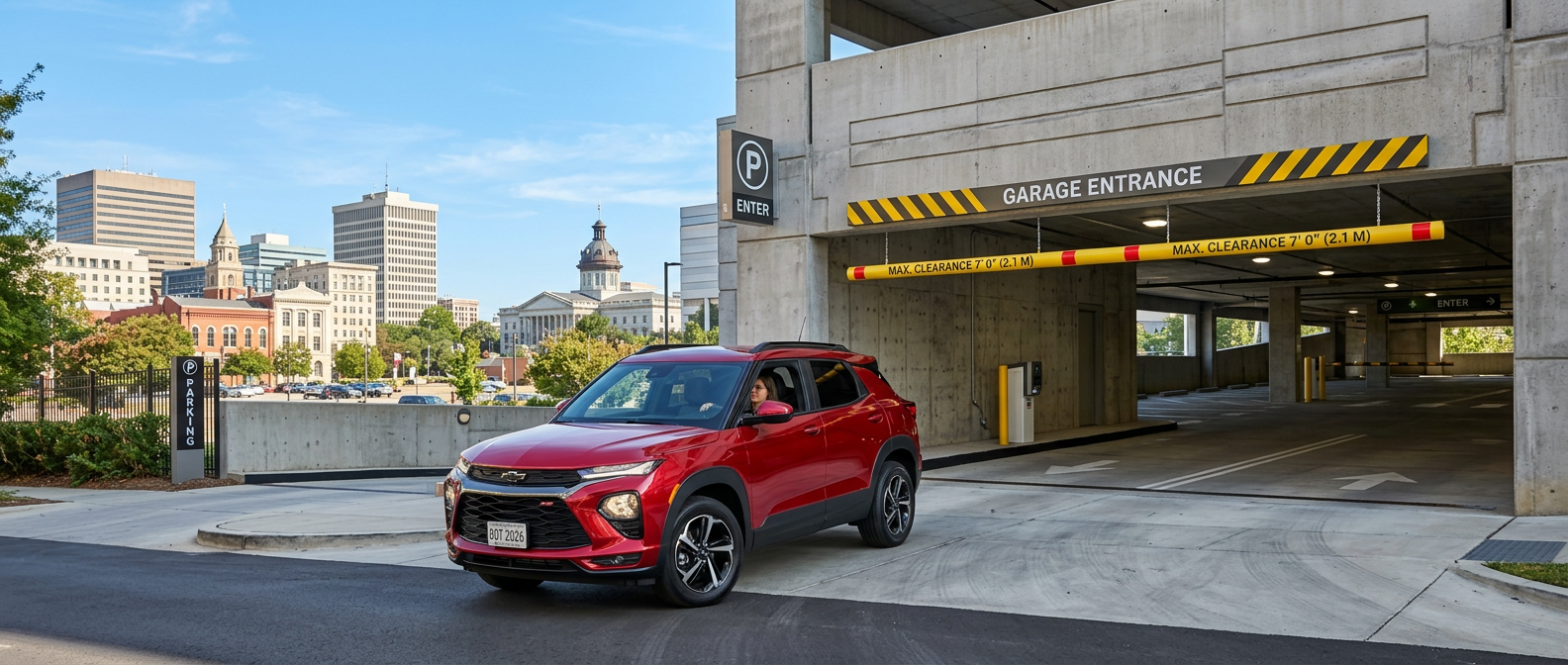
Your Parking Playbook for the University of South Carolina (and Why the Trailblazer Wins It)
The 2026 Chevrolet Trailblazer measures 64 to 66 inches tall depending on drivetrain, and that single number is the reason we wrote this. If you've ever eased a full-size SUV toward a 6-foot clearance bar with your shoulders up around your ears, or circled campus hoping a spot would open, you know the wrong vehicle can turn a day at USC into a headache. The Trailblazer clears every campus garage on record. Here's how to use that. Where Do You Park, and When? Where you park depends entirely on whether you're visiting campus on an ordinary weekday or showing up for a Gamecock football Saturday, and those are two completely different animals, one solved by a parking garage and the other by an open-air lot and a smart exit plan you set before kickoff. The table below breaks down the real options, the Trailblazer's fit at each, and the one thing you should do before you leave the house. Arrive By Park Here Clearance / Fit Note Key Tip Weekday, any time Pendleton Street Garage (1501 Pendleton St.) 6'10" clearance; Trailblazer clears easily at 64 to 66 inches Hourly metered on levels 1A, 1B, 2A; enter from Pickens St. side Weekday, any time Bull Street Garage, Gate 3 (611 Bull St.) 8'0" clearance; no issue Hourly parking at Gate 3; central to main campus Weekday, any time Blossom Street Garage (1300 Blossom St.) 6'0" clearance; Trailblazer's 64 to 66 inches fits, but it's the tightest on campus Permit-only for students and faculty; check visitor availability Game day (football) LMC Fairgrounds lots on George Rogers Blvd. Open-air surface lot; no height limit Gates open 5 to 6 hours before kickoff; first-come Game day (football) Pre-purchased Athletics Dept. single-game spots Open-air; no height limit Pre-purchase strongly recommended; limited spaces sell out Game day (football) Private surface lots near Williams-Brice Open-air; no height limit Arrive early; expect a day-use fee; cash often preferred A note on the Blossom Street Garage: at exactly 6 feet of clearance, it's the tightest structure on the USC Columbia campus. The Trailblazer's 64 to 66 inch roofline fits, but only just. Carrying a roof rack or a cargo box changes the math, so skip it and use Bull Street or Pendleton instead. Maneuvering on Campus (and on Game Day) Getting around campus is easy on most weekdays and a genuine puzzle on game day, so it helps to treat the two as separate problems, one you solve with a quick garage run and one you solve with an early arrival and a planned exit long before the final whistle. On a regular weekday, getting in and out of the Pendleton Street Garage is genuinely straightforward. You come off I-77 South onto SC-277, follow Bull Street until it dead-ends at Pendleton, turn left, and the garage entrance on Pickens Street is one block up. On the same weekday run, The Chevy Trax handles it if you're shopping something even smaller, though the Trailblazer at 174.1 inches long sits well within the comfortable range for a multi-deck structure. Game day near Williams-Brice is a different conversation entirely. For the 2026 Gamecock football season, USC Athletics confirmed road changes. The three lanes of George Rogers Boulevard closest to the stadium close between Key Road and Bluff Road, and traffic runs westbound only in that stretch. So your exit strategy matters as much as your entry. Following that road pattern, we've seen that SUVs parked in the Fairgrounds lots on the west side of Assembly Street get a much cleaner post-game exit than those squeezed into street-side spots near the stadium itself. In a packed surface lot, the Trailblazer's 71.2-inch width (excluding mirrors) is a real practical ally. It fits a standard 8.5 to 9 foot parking stall without the door-ding anxiety that comes with a full-size three-row. Insider parking tip: The Pendleton Street Garage offers hourly meter parking on levels 1A, 1B, and 2A. On weekends with no conflicting campus event, USC parking enforcement still runs seven days a week, all year. Check the ParkUSC app (from USC Parking and Transportation Services) before you arrive. It shows lot availability in real time and can save you a lap around campus. Etiquette tip: In any USC campus garage, pull forward to the painted line. Compact SUVs like the Trailblazer often stop short of the stall line because the bumper clears the wheel stop easily. Pull all the way up. It gives the car behind you room to enter the row and keeps the garage flowing during busy class-change windows. Next step: Want to see the 2026 Trailblazer in person before the fall semester starts? Stop by Wilson Chevrolet on US 321 in Winnsboro. We're a short hop down I-77 from the Columbia metro, and we can get you behind the wheel without the campus parking drama. See Our Current Trailblazer Offers Your Pre-Trip Checklist for Any USC Columbia Visit You've already got the parking strategy sorted, so the only job left is ticking a short checklist before you pull out of Winnsboro or wherever you're starting from on I-77, the part that's easy to skip in a hurry and also the part that quietly turns a smooth USC day into a stressful one. Before you leave: Confirm your parking zone. USC enforces permits and meter zones 24 hours a day, seven days a week, including holidays. There's no grace for "I was only going to be five minutes." Download the ParkUSC app. It shows real-time lot availability across all campus garages and surface lots, plus shuttle routes. Browse our Trailblazer inventory before your trip to lock in a trim that fits your budget and your usual crew. Pre-purchase game-day parking. For Gamecock football, USC Athletics recommends buying single-game spaces through the official Athletics portal before you arrive. The Fairgrounds lots on George Rogers Boulevard open five hours before kickoff (no earlier than 8 a.m.), and spots in the premium Gamecock Park section go fast. Know the clearance number. The tightest USC campus garage is Blossom Street at 6'0". The Trailblazer's Chevrolet-listed height of 64 to 66 inches means it fits. If you've added a cargo carrier or roof rack, measure first. Plan your exit before kickoff. With three lanes of George Rogers Blvd. closed on game day in 2026, westbound-only traffic is the rule near the stadium. Decide which way you're heading home (toward I-77 North for Winnsboro, or another route) and map it before the final whistle. Give yourself time. A study of USC's own parking situation found the university was adding more than 1,500 spaces to address demand. That expansion helps, though a campus with 35,000-plus enrolled students and the majority living off campus stays busy on any given morning. Leave the big rig at home. The Trailblazer is purpose-sized for exactly this environment. A vehicle in the subcompact-SUV class fits metered stalls, handles tight garage ramps, and moves through the pedestrian-heavy streets around the Horseshoe without drama. Go enjoy it. Explore Financing Options Wilson Chevrolet 798 us hwy 321 N BUSINESS, Winnsboro, SC 29180 (803) 402-4233
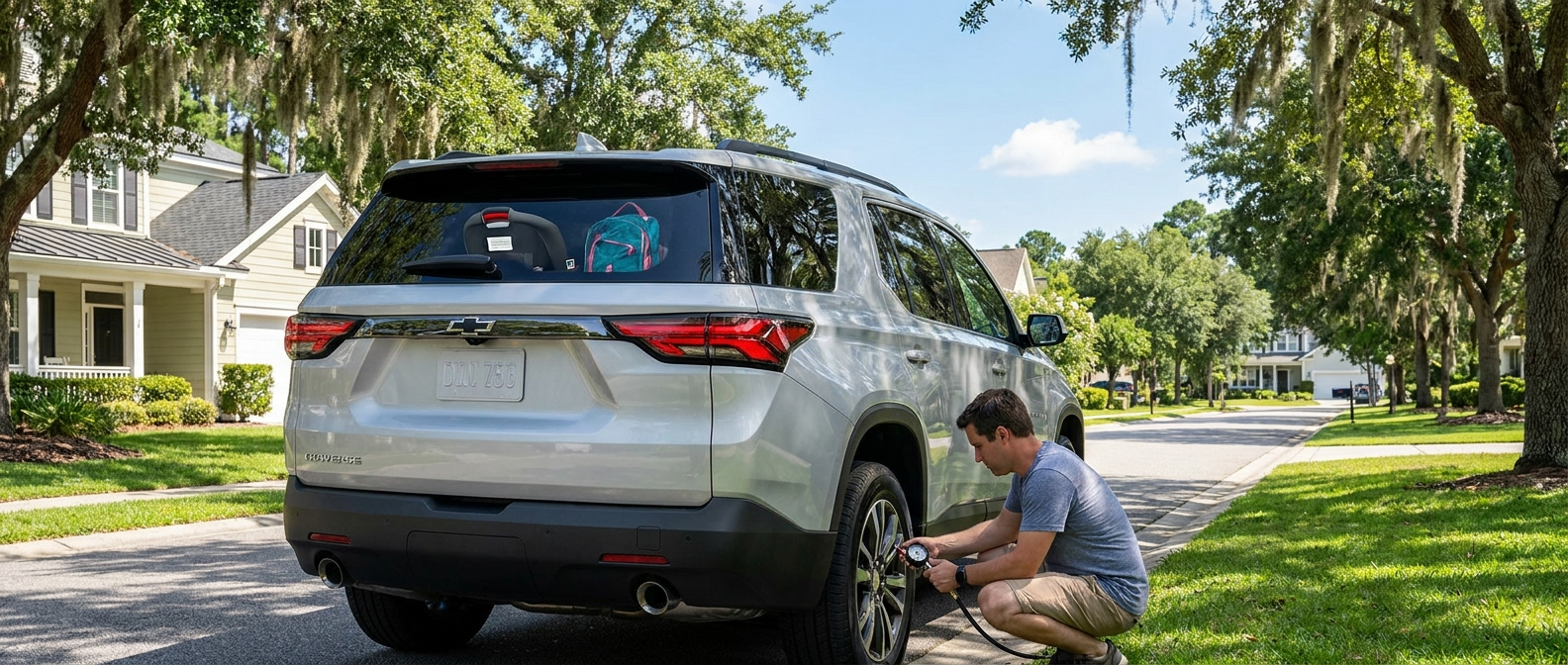
Hauling Kids and Backpacks All Year: Your Chevrolet Tire Check Guide for Winnsboro Parents
The first week of school is a bad time to learn your tires were losing pressure all summer. Here's the fast version. Check your Chevy's cold tire pressure before 8 a.m., match it to the number on the driver's door placard, and run a quick tread test while you're crouched down there. That two-minute stop keeps you clear of the August trap, heat that makes tires look fine on a noon gauge even when they weren't aired up right at dawn. The Chevrolet Traverse hauls car seats, sports bags, and a full Fairfield County carpool. It earns tires set to the number that's genuinely right for it. Will Your Tires Handle the School-Year Load? Your Chevy's tires will handle the school-year load fine as long as you set them cold and confirm the figure, because August in Winnsboro is rough on rubber, with afternoon highs pushing into the mid-90s and pavement running hotter still. The physics is straightforward. Tire pressure rises roughly 1 PSI for every 10 degrees Fahrenheit of temperature gain, which means a tire you air up at 7 a.m. can read 4 to 6 PSI higher by the time you're doing afternoon pickup after driving I-77 in stop-and-go heat. None of that is a problem on its own. The trap catches parents who check at noon, see a number that looks fine, and figure the tires were right all along. They might not have been. For Chevy's family lineup, the table below gives you the real numbers. Chevrolet lists these as cold-tire targets, meaning the vehicle has been parked for at least three hours and driven less than a mile since sitting. Check your specific trim's door-jamb placard to confirm your exact figure. Chevy Model / Trim OEM Tire Size Recommended Cold PSI Check Method Fits the School-Run Job? Traverse LS 245/70R17 35 PSI (confirm placard) Cold gauge before 8 a.m. Yes Traverse LT 255/65R18 or 255/55R20 35 PSI (confirm placard) Cold gauge before 8 a.m. Yes Traverse LTZ / RS / High Country 255/55R20 or 275/45R22 35 PSI (confirm placard) Cold gauge before 8 a.m. Yes Equinox (most trims) Varies by trim 35 PSI (confirm placard) Cold gauge before 8 a.m. Yes Tahoe (family hauler) Varies by trim Confirm placard Cold gauge before 8 a.m. Yes (larger load means more pressure to get right) Trailblazer Varies by trim Confirm placard Cold gauge before 8 a.m. Yes *Chevrolet lists 35 PSI as the most common cold-tire target across its family SUV lineup. Your door-jamb placard is the authoritative source for your specific vehicle. Never read pressure from a hot tire and use that number to set inflation.* The TPMS warning light on your Chevy doesn't activate until pressure drops roughly 25% below the recommended spec (per FMVSS No. 138). Your tires can be meaningfully short on air before that light ever blinks. How to Load the Check Correctly (Before the Bell Rings) Doing this right takes three tools and about four minutes, and the one rule that makes or breaks it is timing, because a gauge read cold before the first drive tells the truth while a reading taken after I-77 heat runs high and fools you. In our experience, the numbers that mislead people are the ones pulled after the car has been driven. Do it cold, every time. Step 1: Time it. Check pressure before the first drive of the day, ideally before 8 a.m. in August. Once you've been on the road, heat from the engine bay, road friction, and ambient air all push the reading up. Step 2: Grab a real gauge. Your Traverse and most Chevys have a Tire Pressure Monitoring System (TPMS), but Chevrolet engineers built that system to warn you at the dangerous end. It won't fine-tune anything for you. A quality dial or digital gauge (a small investment at any auto parts store) gives you the actual PSI to work with. NHTSA notes that only 19 percent of drivers properly inflate their tires. Step 3: Check all five. Four tires plus the spare. The spare is the one every parent forgets about until they're pulled over on US 321 in a thunderstorm. Step 4: Match the placard, not the tire sidewall. The number stamped on the sidewall is the tire's maximum capacity, not your vehicle's recommended operating pressure. Open the driver's door and look for the sticker on the door jamb. That number is the one that matters. Step 5: Do the quarter test on tread. Insert a quarter into the tread groove, Washington's head going in first. If you can see the top of Washington's head, you're at approximately 4/32" of tread depth, which is the early-warning zone for wet-weather stopping. September in Fairfield County means afternoon thunderstorms. Better to catch borderline tread this week than during the first week of school. Tip from the service center: If your TPMS light came on briefly during a hot afternoon drive and then went off on its own overnight, the system may have triggered on a heat-expanded reading, not a leak. But don't ignore it. Bring it in. A sensor that cycles on and off is telling you the cold pressure was marginal in the first place. Check pressure before 8 a.m. on a day the car sat overnight Confirm target PSI from the driver's door-jamb placard Inflate or deflate to match the cold-tire target Repeat for all four tires plus the spare Insert a quarter tread-first into the shallowest-looking groove; flag it if you see Washington's head Inspect each sidewall for cracks, bulges, or embedded debris Check that the TPMS system is functional (no persistent amber light) Chevrolet Equinox owners: the same cold-check logic applies, and the 35 PSI target is the same baseline. Tire size changes by trim, so always use the placard. The Job Done: What You've Actually Accomplished Run this check the right way and you've handled a five-minute job that's easy to skip, and the payoff is real, because per NHTSA data, 511 people died in tire-related crashes in 2024. None of that is meant to scare you. Think of it as putting a five-minute driveway check in its proper place. Loaded with backpacks, a booster seat, and after-school gear, a Chevy Traverse or Tahoe is carrying real weight. Tires underinflated by 25% or more wear faster along the outer edges, reduce wet-weather traction, and extend stopping distances in a way you won't notice until a school-zone moment demands everything the tire has. South Carolina's back-to-school schedule drops right in the hottest, wettest stretch of the year. The last thing you want is to learn your tires were marginal in the middle of it. Get the check done this week. If tread depth is near the 4/32" threshold or the cold pressure doesn't hold overnight, our service center on US 321 can handle a rotation, inspection, or swap before the first bell. By the Wilson Chevrolet Team | August 2026 Schedule a Tire Inspection at Wilson Chevrolet Wilson Chevrolet 798 us hwy 321 N BUSINESS, Winnsboro, SC 29180 (803) 402-4233
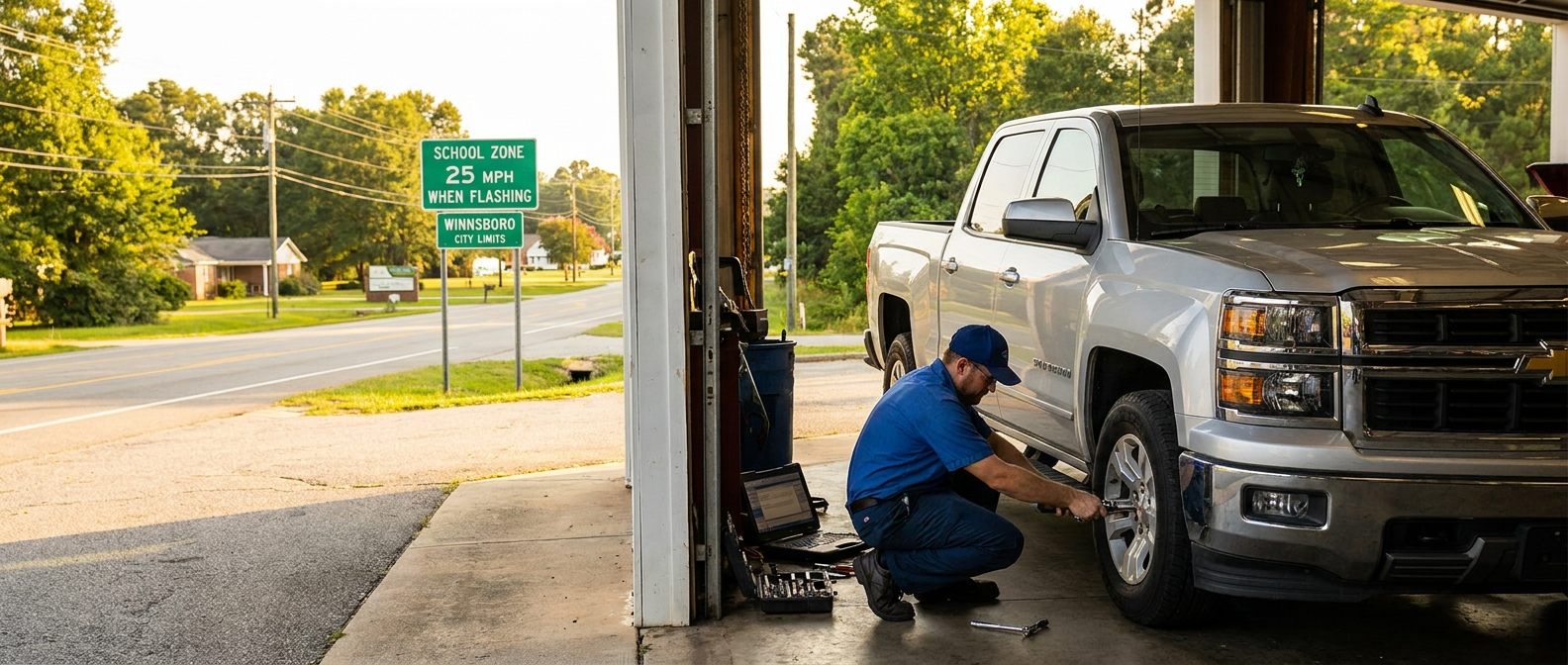
Your Chevrolet's Brakes Are Working Harder Right Now Than They Were in July
In this article What Do the Brake Specs Actually Mean for Your Chevrolet? Stop-and-Go School Traffic and What It Does to Your Pads and Rotors What a Full Chevrolet Brake Inspection Actually Covers Who Needs a Brake Inspection Right Now? School in Fairfield County started July 30, and US-321 through Winnsboro shifted almost overnight from a relatively open summer corridor to a stop-and-go school-zone commute, twice a day, five days a week. Brake pads don't care what the calendar says, but your driving pattern absolutely changes how fast they wear. Stop-and-go traffic with frequent hard stops is one of the most demanding cycles a brake system faces. Chevrolet's own service documentation states that brake wear indicators are set to alert at approximately 2 mm of pad friction material remaining, and that pads should be replaced at or before reaching that threshold (a measurement you never see until the squeal starts). We're on US-321 N Business ourselves here at Wilson Chevrolet, so we see what this road does to vehicles. In this guide we break down exactly what a Chevrolet brake inspection covers, how stop-and-go school traffic loads your system, and which signs mean it's time to book a service appointment before a minor wear issue becomes a rotor problem. What Do the Brake Specs Actually Mean for Your Chevrolet? Chevrolet Certified Service documentation calls out 2 mm of remaining friction material as the replacement threshold for brake pads, which is thinner than two stacked pennies, and since most pads start life between 10 mm and 12 mm thick, by the time the wear indicator squeals you've used roughly 80 percent of what you had. That's late in the game. So the number is worth knowing before the noise starts. Brake Component New Condition Service Alert Threshold Chevrolet Action Brake pads (friction material) ~10-12 mm thick 2 mm remaining Replace immediately (per Chevrolet Certified Service) Brake rotors Stamped nominal thickness on casting Min. thickness stamped on rotor (typically 2-3 mm less than new) Replace before reaching minimum; do not resurface below it Brake fluid Clear to light amber Dark, cloudy, or moisture-contaminated Exchange recommended when condition warrants Wear indicator tabs Retracted Contact with rotor surface Audible squeal (schedule service promptly) Rotors are marked the same way. Chevrolet stamps the minimum acceptable thickness right into the rotor casting. Once a rotor is worn or machined below that mark, it can't safely dissipate the heat a full stop generates, and heat is the enemy of consistent braking. Why does that matter right now? Because heat builds fastest in exactly the kind of driving US-321 sees during school drop-off and pickup: repeated moderate-to-hard stops from 25-35 mph, short distances between stops, and an engine that doesn't hold the sustained highway speed needed to let things cool between applications. This is a brake-unfriendly cycle, and it compounds across five mornings and five afternoons every week. Stop-and-Go School Traffic and What It Does to Your Pads and Rotors Highway miles are actually easier on your brakes than a stop-and-go commute, because you're using the pedal less often, more gradually, and from lower relative speeds in many situations. A Silverado 1500 owner who puts 15,000 miles a year on mostly I-77 highway runs may have pads that outlast a neighbor doing the same mileage on a school-zone route with a full truck bed. Stop-and-go traffic changes the math in three specific ways. More brake applications per mile. A school-zone corridor with crosswalks, bus stops, and signal lights means far more pedal applications per mile than open-road driving. More applications equals more friction, more heat, and faster pad wear. Sustained heat buildup. Short stops don't allow rotors to shed heat between applications the way a long highway run does. Heat that stays in the rotor speeds up both pad glazing and rotor warping. Heavier-loaded vehicles. Families running carpool aren't driving with an empty vehicle. Chevrolet's own guidance notes that driving habits and vehicle load conditions directly influence how quickly brake components wear (there's no universal mileage interval because conditions vary that much). A Tahoe carrying six passengers to school and back weighs meaningfully more fully loaded than empty. The brake system stops whatever mass you give it. Service tip. Chevrolet's Multipoint Inspection includes a brake check at every visit, not just at scheduled maintenance milestones. If you're due for an oil change, that inspection is already built in, an easy way to get eyes on pad thickness without booking a separate appointment. Between service visits, here's what to listen and feel for. A high-pitched squeal during normal braking (wear indicator contacting the rotor) Grinding or metal-on-metal scraping (pad material fully worn, backing plate contacting rotor) Pulsation or vibration through the brake pedal (warped or unevenly worn rotor) A soft or spongy pedal feel (air in the brake lines or degraded brake fluid) The vehicle pulling to one side under braking (uneven pad wear or a sticking caliper) Any one of those is a reason to schedule service. A squeal is a warning. A grind means damage is happening as you drive. What a Full Chevrolet Brake Inspection Actually Covers A proper Chevrolet brake inspection covers more than a glance through the wheel spokes, because per Chevrolet Certified Service a trained technician checks front and rear brake pads (or shoes on drum-equipped rear axles), rotors, hoses, and calipers for wear, and also inspects the fluid lines for cracks and leaks. Six distinct systems get evaluated in a single service visit. Pad thickness (measured, not estimated) Rotor condition (thickness, surface scoring, heat spotting, and lateral runout) Caliper operation (checking that pistons retract properly and slides aren't seized) Brake hoses and hard lines (looking for cracks, bulges, or seepage) Brake fluid condition (color and moisture content affect how the fluid performs under heat) Wear indicators (confirming the mechanical alert tabs are functional) A Traverse running three-row family carpool load and a Silverado towing on weekends put different demands on those six systems, but the checklist doesn't change. What our team finds tells you which components need work now, which ones need watching, and which ones are fine until the next visit. Brake service isn't a fixed-schedule item the way an oil change is. There's no single mileage number that covers every driver's situation, and Chevrolet's own guidance says exactly that. A driver doing a lot of stop-and-go school-zone miles in August in Winnsboro may need pads sooner than the neighbor who drives the same Silverado mostly on I-77 between here and Columbia. Driving pattern matters more than the odometer. Schedule a Brake Inspection Who Needs a Brake Inspection Right Now? If you haven't had a brake check since spring, the answer is probably you, and here's how to self-triage before you call us. A quick honest read of your own driving usually points the way. Fairfield County's school year kicked off July 30. If you've been running school drop-offs since then, you've already put your pads through roughly two weeks of the most demanding daily cycle they'll see all year. None of that is a scare tactic. It's just what the math looks like when you add up two school runs a day on a stop-and-go stretch like US-321. You're a good candidate for a brake inspection now if any of these fit. You haven't had brakes inspected in the last 12 months You're hearing intermittent squealing during light braking Your vehicle pulls slightly left or right when you stop You've added regular carpool duty to your weekly routine since late July Your pedal feels less firm than it did six months ago The vehicles in our area that show the most varied brake wear tend to be full-size trucks and three-row SUVs (Silverados, Tahoes, Traverses), because they're doing double duty as daily commuters and weekend haulers. Heavy use across two very different driving profiles adds up. Our service center can tell you where you stand in one appointment. We're straightforward about one thing. Not every inspection ends with a parts recommendation. Sometimes pads measure at 6 mm and you've got months ahead of you. Knowing that is worth something too. Frequently Asked Questions What triggers the brake squeal on my Chevrolet, and should I ignore it? The squeal is almost always your wear indicator doing its job. Chevrolet builds metal tabs into the brake pads that contact the rotor surface when friction material reaches approximately 2 mm of remaining thickness. That contact creates the high-pitched sound. It's a designed alert, not a random noise, and you shouldn't ignore it. Continuing to drive on pads past that point means the metal backing plate will eventually contact the rotor directly, turning a pad replacement into a rotor replacement as well. Does stop-and-go school traffic really wear brakes faster than highway driving? Yes, and the difference is real. Chevrolet's service guidance explicitly states there is no fixed mileage interval for brake service because wear depends on driving habits and conditions. Stop-and-go driving with frequent moderate-to-hard stops generates more heat cycles per mile than sustained highway speeds, and heat is the primary driver of accelerated pad and rotor wear. School-zone routes with crosswalks, bus stops, and traffic signals are one of the higher-wear driving patterns your brake system encounters. Schedule a Brake Inspection Wilson Chevrolet 798 us hwy 321 N BUSINESS, Winnsboro, SC 29180 (803) 402-4233
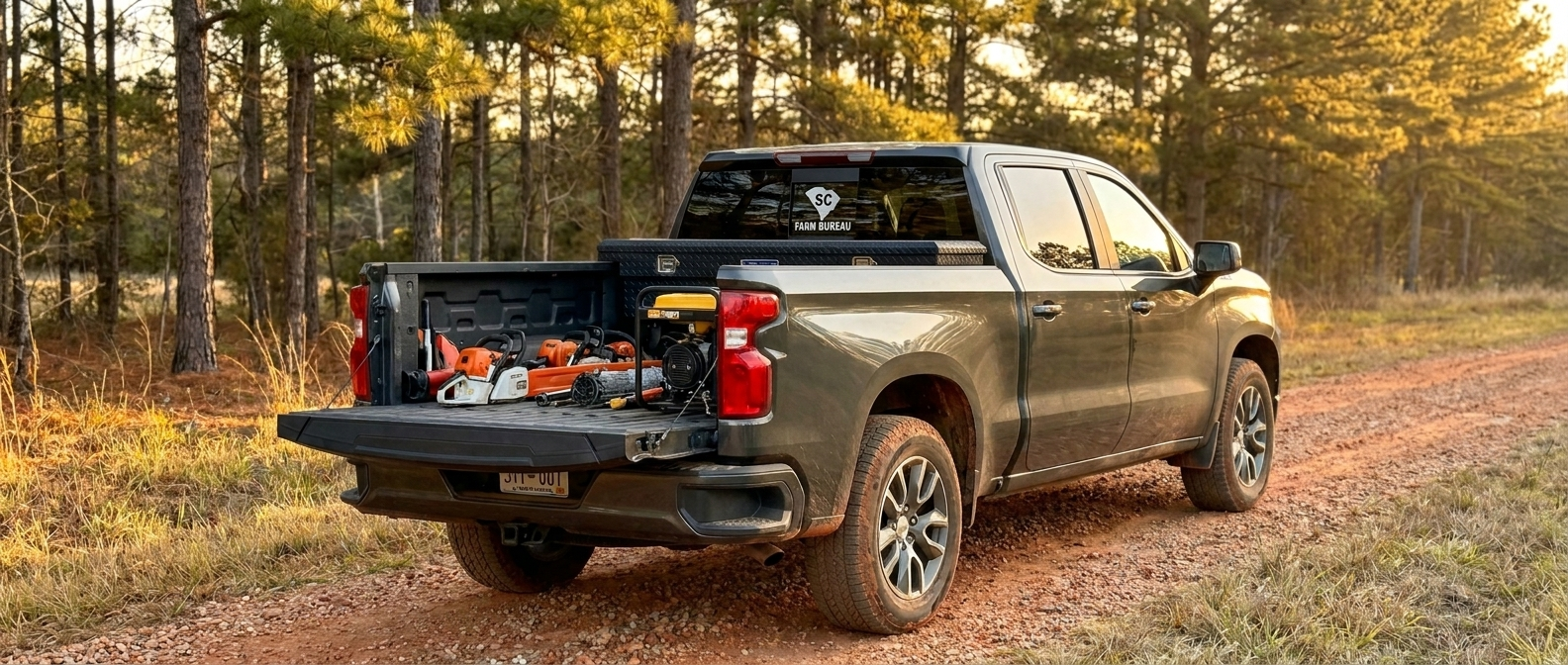
Your 2026 Silverado Worked Hard All Summer. Here's What It Needs Before Fall.
In this article What Do You Actually Get at Each Trim Tier, and What Does It Cost You in Maintenance? The Heat Did Real Work on Your Fluids Smart-Buy Value: Matching Maintenance Investment to Real Work Demand The 2026 Silverado Tier That Actually Fits Your Fall Workload South Carolina's Midlands don't ease into summer. They hit hard and stay there. By the time August rolls around in Winnsboro, your Silverado 1500 has spent months hauling under 90-plus-degree heat, idling in humidity that feels like a wet blanket, and pulling enough dust and pollen through to choke a filter twice over. Most fall-prep checklists miss that reality, because they're written for drivers getting ready for cold. We're not getting ready for cold. We're recovering from heat. The bottom line is simple. A Silverado that rolls into fall unchecked, with heat-stressed fluids, a battery that barely survived August, and coolant that last saw fresh service two years ago, is a truck that'll let you down during the work push when you need it most. Which services matter most depends heavily on which trim and engine you're running, and that's what this guide sorts out. What Do You Actually Get at Each Trim Tier, and What Does It Cost You in Maintenance? Silverado 2500 HD owners and light-duty 1500 drivers sit in genuinely different maintenance categories, and even inside the 1500 lineup the four available engines shift your fall service priorities considerably, so the short answer is that what you get at each tier also decides what you owe it come fall. Let's break the tiers down by what you're actually managing under the hood. Trim Tier Engine What You Actually Get Key Fall Maintenance Priority Who It's For Work Truck / Custom 2.7L TurboMax (310 hp, 430 lb-ft) Highest payload at 2,260 lbs, 8-speed auto, rugged work focus Intercooler inspection; turbo boost hose check after summer heat cycles Tradespeople, small-fleet operators, bed haulers LT / RST / Trail Boss 2.7L TurboMax or 5.3L V8 Step up in comfort tech; Trail Boss adds 2-inch lift and Z71 hardware 5.3L: lifter oil passages; ensure no sludge from summer idling; TurboMax: same turbo check Daily-driver work truck; Carolina Adventure World weekend warriors LTZ / High Country 5.3L EcoTec3 V8 (355 hp, 383 lb-ft) standard; 6.2L V8 optional Leather, heated/ventilated seats, Bose audio, Super Cruise on High Country 5.3L DFM cylinder deactivation system: clean oil is non-negotiable after hot months Families that tow plus professionals who want comfort and capability Any trim (diesel option) 3.0L Duramax (305 hp, 495 lb-ft) 28 MPG highway (EPA, 2WD), 13,300 lbs max towing, class-exclusive diesel torque Diesel exhaust fluid (DEF) level and quality; fuel filter service critical before heavy fall towing High-mileage haulers; I-77 corridor commuters with trailers One caveat is worth flagging here, because the Duramax diesel is the towing headline but it's also the most demanding on fluid maintenance intervals. If you've run hard I-77 miles all summer and haven't touched the fuel filter, don't wait. The Heat Did Real Work on Your Fluids South Carolina summers do far more than warm your engine bay, and over a full summer of relentless heat they cook the corrosion inhibitors right out of your coolant, so the fluid can still test fine on color while the protection it was mixed to deliver has quietly faded. The National Weather Service confirms that South Carolina Midlands high temperatures run in the 80s through September before cold fronts finally show up more often as fall progresses. Call it four-plus solid months of heat stress on your cooling system. Chevrolet lists the 2026 Silverado 1500's 5.3L EcoTec3 V8 at 355 horsepower and 383 lb-ft of torque (those numbers assume clean, correctly-mixed coolant protecting the system at the operating extremes it was designed for). When a Silverado rolls in after a South Carolina summer, our service team works down a short list. We check for coolant that's slowly lost its corrosion inhibitors, the kind that tests fine on color but fails a test strip. We look at belts for the surface cracking that heat cycling leaves behind. And we run a battery load test, because a unit can technically hold a charge and still fall short under cranking load. A four-year-old battery that barely survived July is unlikely to deliver in October. Temperatures drop just as internal resistance climbs, and cranking gets harder. So if your coolant hasn't been serviced in the last two years or 30,000 miles, whichever came first, fall is the right window. Not next spring. Now, before you're pulling a trailer to the deer camp off US 321 and the temperature gauge tells you something you didn't want to hear on a Friday afternoon. Schedule Your Pre-Fall Service Appointment Smart-Buy Value: Matching Maintenance Investment to Real Work Demand Our service center team sees the same pattern hold steady across every trim level, and it comes down to owners who treat service as a planned work-season cost and budget for it well before the fall push begins. That said, not every truck needs the same fall service investment. Sort it out by how you put the truck to work. You're a bed-load hauler, not a heavy tower. If your TurboMax-equipped WT or Custom trim spends its work days with tools in the bed and never sees a trailer, your fall priorities stay simple. Think oil and filter, tire pressure and tread depth, brake inspection, air filter. The 2.7L TurboMax's 430 lb-ft of torque arrives low in the RPM range, which means it's working less hard than you'd expect under moderate bed loads. Keep the oil clean and the turbo plumbing tight, and it'll hold up fine. You tow a boat, a trailer, or a camper regularly. The 5.3L V8 is the workhorse of the lineup and earns that reputation, but its Dynamic Fuel Management cylinder deactivation system runs oil-sensitive. Degraded oil from a summer of stop-start hauling in humid air is exactly the scenario where DFM passages need attention. Get your oil changed before fall towing season starts. Waiting until after is how those passages gum up. You're running the diesel on long hauls or heavy commercial loads. The 3.0L Duramax earns its place with an EPA-rated 28 MPG highway in 2WD and 13,300 lbs of max towing when properly equipped. But its diesel-specific needs, from DEF quality to the fuel filter to the exhaust system, aren't maintenance you get to defer. We treat the diesel fuel filter the way an owner should treat tires. Don't wait to see the problem before you act. Service reality check. Tires that passed inspection in May have taken an extra summer of heat-accelerated wear by August. Winnsboro's farm roads, the gravel pull-offs around Lake Wateree, and US 321 pavement all put uneven stress on tread that won't always show up at a glance. If you're towing at or near capacity this fall, have your tires load-rated and inspected before you hook up the trailer. Thinking about trading up before fall? See what your current Silverado is worth before the work season starts (well-maintained trucks hold their value, and a service record going into an appraisal makes a real difference). The 2026 Silverado Tier That Actually Fits Your Fall Workload Browse our current Silverado inventory if you're weighing a move before the work season, but if you're staying with the truck you already own, which is often the right call, the honest read on how each tier fits Fairfield County's fall work reality comes down to how you load and tow it. TurboMax tiers, from WT through RST, are the right trucks for owners whose fall means payload and moderate towing. Chevrolet lists 2,260 lbs of max payload when properly equipped, and that's a real number for a work truck that lives in the bed. Step up to the 5.3L tiers if you tow trailers regularly and want the V8's character with a manageable fuel cost. And if you genuinely put 20,000-plus miles a year on your truck running the I-77 corridor or pulling heavy commercial loads, the diesel's 495 lb-ft of torque and 28 MPG highway rating are hard to argue with on operating economics. Just budget for the maintenance it demands in return. The honest tradeoff on the 6.2L V8 runs like this. It delivers the highest gas-engine output at 420 horsepower and 460 lb-ft of torque, and it shares the 13,300-lb max towing ceiling with the diesel when properly equipped, but it returns the worst fuel economy of the gas engines. For most Fairfield County work, the 5.3L closes most of that gap with a better daily fuel cost. Fall is when a well-maintained truck separates itself from one that's been coasting. We'd rather talk through what your truck needs now than see it stranded on I-77 in October. Frequently Asked Questions What fall maintenance does a 2026 Silverado actually need in South Carolina? Because South Carolina Midlands summers run hot and humid well into September (the National Weather Service confirms Midlands high temperatures stay in the 80s through September), the real fall-prep priorities are heat-recovery focused rather than cold-weather focused. That means a coolant system check, battery load test, air filter and cabin air filter inspection, belt condition check, and an oil change timed to the start of fall work demand rather than based on a calendar date alone. Diesel Silverado owners should also verify DEF levels and fuel filter condition before heavy towing season begins. Does the 2.7L TurboMax hold up as well as the 5.3L V8 for fall work use? It depends entirely on what "work" means for your truck. Chevrolet lists the TurboMax at 310 horsepower and 430 lb-ft of torque, with a max payload of up to 2,260 lbs when properly configured (that's actually higher payload than the 5.3L V8 in comparable configurations because of the four-cylinder's lighter weight). For bed-load work with moderate towing, the TurboMax holds up well and is generally simpler to service. The 5.3L V8 (355 hp, 383 lb-ft) has the edge in sustained heavy towing over long distances and has a longer real-world track record in demanding commercial use. Our team's practical read: if you're towing over 8,000 lbs with any regularity, the V8 is the more relaxed long-term choice. Under that threshold, the TurboMax earns its place. View Current Silverado Offers Wilson Chevrolet 798 us hwy 321 N BUSINESS, Winnsboro, SC 29180 (803) 402-4233
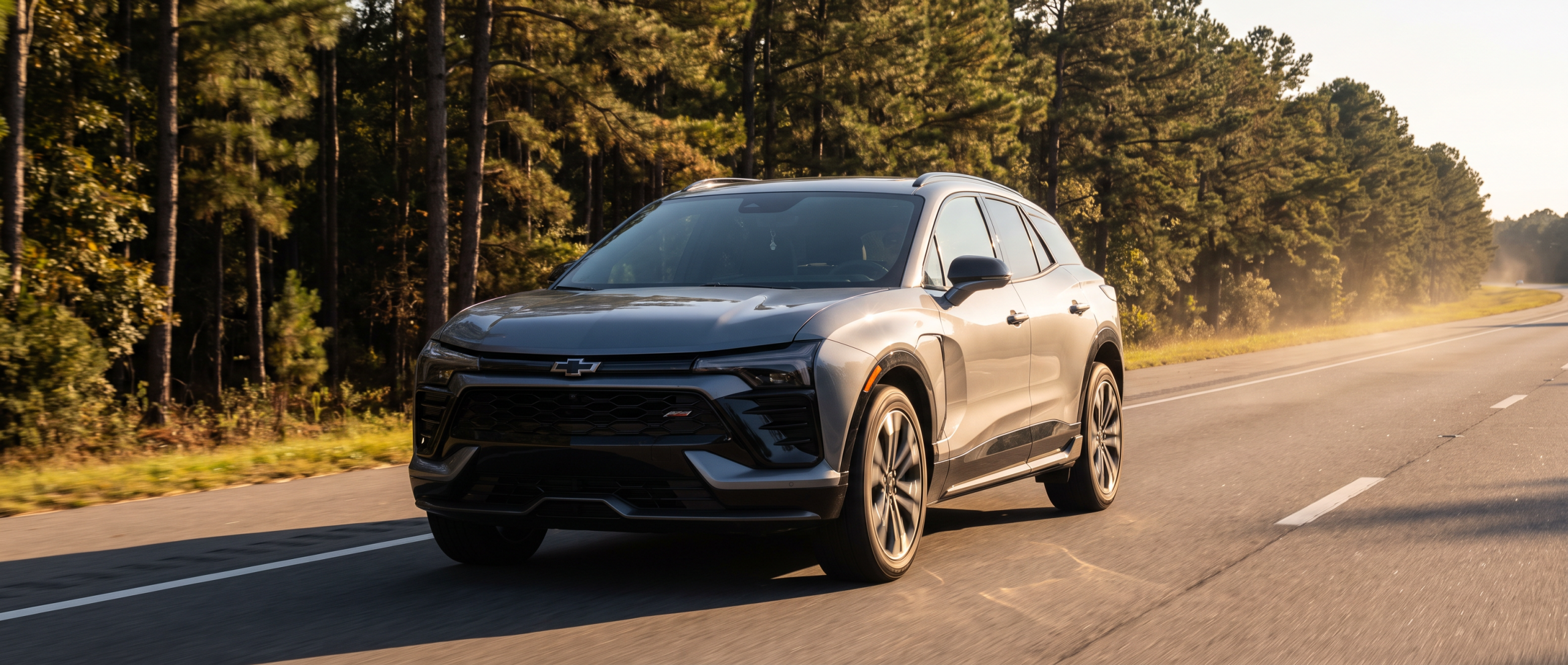
Your I-77 Commute Deserves a Cabin That Earns It: The 2026 Chevrolet Blazer
In this article What's the Plan at a Glance? The Climate System Is the Real Story on an August Morning The Seat and Ride Quality Won't Grind You Down The Tech Makes the Drive Feel Shorter Why the Blazer Fits This Specific Commute The 2026 Chevrolet Blazer is a genuinely strong choice for the Winnsboro-to-Columbia run, and we'll tell you exactly why, including the one honest tradeoff you should know before you commit. That 33-mile stretch of I-77 south is mostly open freeway, but August in the Midlands isn't gentle. In our experience, the Blazer's cabin tech and climate system are built for exactly this kind of daily drive. By the Wilson Chevrolet Team | August 2026 What's the Plan at a Glance? The I-77 corridor between Winnsboro and Columbia is about as straightforward as South Carolina commutes get, roughly 33 miles of mostly open freeway, with a couple of construction stretches near Blythewood that can thicken the weekday-morning pace before it opens back up. Below you'll see where the Blazer's features earn their keep on each leg. Commute Leg What Happens Here Relevant Blazer Feature Best Time to Use It Winnsboro departure 90-degree mornings June-Sep; cold starts Oct-Mar Remote Start with climate pre-set (standard) 10 min before you walk out US 321 to I-77 on-ramp Stop-and-go at merge point Available adaptive cruise with low-speed hold Morning peak, Mon-Fri I-77 S mid-run (Ridgeway to Blythewood) Open highway, road noise a factor 18-inch LT wheels for ride compliance; cabin insulation Full commute Blythewood interchange Construction congestion, lane changes Standard blind-spot warning (3LT+); forward collision alert Morning peak Columbia arrival / return Summer heat baking a parked cabin Remote Start pre-cool; available surround-view camera End of workday The Climate System Is the Real Story on an August Morning South Carolina in August isn't subtle, and the Blazer meets it head-on with dual-zone automatic climate control that Chevrolet lists as standard equipment on every 2026 trim, so the comfort win is real before you ever touch an options sheet. The driver and passenger each set their own temperature independently, and that matters when one of you is in business attire and the other is in jeans. Pre-cool it before you walk out. Remote start is standard across the full 2026 Blazer lineup, and you can drop the cabin temperature on a 90-plus-degree Winnsboro afternoon before you've touched the door handle. The same system pre-warms the cabin on cold Fairfield County mornings, and RS trims extend that to a heated steering wheel as well. Ventilated front seats are where we owe you some straight talk. They're available, not standard, and they come as an optional upgrade on upper-trim configurations. If you're commuting in dress clothes, that option is worth a specific conversation when you come in. The standard heated fronts, though, are genuinely useful from November through February when Winnsboro mornings dip into the 30s. Browse the 2026 Blazer trims we currently have in stock The Seat and Ride Quality Won't Grind You Down Comfort on a 33-mile freeway run comes down less to a features list and more to what's still comfortable by month three, and the Blazer covers those fundamentals without asking you to climb the trim ladder for them. The 2026 Blazer's driver seat is an eight-way power-adjustable unit with power lumbar control, standard across the lineup. The front passenger gets six-way power adjustment. Useful if a carpool partner rides shotgun. The LT trims run on 18-inch wheels. Compared with the RS trim, which steps up to 20- or 21-inch wheels and its own sport-tuned suspension, the LT delivers a more compliant ride on the rougher sections of I-77 south of Ridgeway. The RS isn't uncomfortable. But if daily mileage is your goal rather than a spirited weekend run, the LT's chassis setup is the more practical match for this corridor. Insider note: The Blythewood stretch of I-77 has had periodic morning lane closures for ongoing work. Adaptive cruise with low-speed follow is available but not standard on the base 2LT. Confirm it's on the specific trim you're considering. On a pinched interstate on-ramp, the difference is noticeable. The Tech Makes the Drive Feel Shorter Forty minutes each way adds up fast, so the tech that matters most on this run is the tech that fades into the background, and the Blazer's 10.2-inch touchscreen delivers exactly that with wireless Apple CarPlay and Android Auto standard on every trim. You'll set your phone down and your podcast or navigation is already live. The RS trim and upper-package LT configurations add a wireless charging pad, which means your phone arrives in Columbia with more battery than it left Winnsboro with. No cable, no fumble at 6:30 a.m. Available Bose eight-speaker audio with a subwoofer is a genuine upgrade for a long-run commute. The system isn't standard, but if you spend 80 minutes a day in this vehicle, audio quality is worth thinking about. Next step: Want to hear how the Bose setup actually sounds at highway speed, or sit in the seat and check the lumbar? Swing by our lot on US 321 in Winnsboro. We'll pull a Blazer around and let you find out for yourself. See Current Blazer Offers Why the Blazer Fits This Specific Commute The Blazer fits this commute because it settles into the drive better than a smaller crossover would, and the tradeoff you accept for that shows up at the fuel pump, which is the one honest note worth sounding before you commit. The EPA rates the FWD 2026 Blazer with the 2.0-liter turbo four-cylinder at 22 mpg city and 29 mpg highway. That's competitive for a midsize SUV, but it's not a hybrid number. If fuel economy is your singular deciding factor, a smaller crossover will edge it on paper. What the Blazer returns is a cabin that's a half-class larger than compact alternatives, 31 cubic feet of cargo space behind the rear seats (64.2 with the second row folded), and a road presence on I-77 that feels settled. The Midlands weather swings matter here. From August humidity to January frost, you're dealing with real seasonal variation, and the Blazer's standard remote start, standard dual-zone climate, and standard heated fronts cover all of it without pushing you up to a luxury trim level. The Chevrolet Equinox is smaller, slightly more efficient, and worth a look if the commute is truly your only use case. If you need three rows for weekend family duty, the Chevrolet Traverse steps up, and you'll feel the extra space. The Blazer splits the difference. Two rows, a midsize footprint, and a cabin that earns you something on the days the drive runs long. You'll find us on US 321 in Winnsboro. That commute starts right here. Value Your Trade-In Wilson Chevrolet 798 us hwy 321 N BUSINESS, Winnsboro, SC 29180 (803) 402-4233
Chevrolet Equinox vs. Trailblazer for Young Families in Fairfield County
In this article What's the Real Difference Between These Two? Does Cargo Space Actually Change Daily Life on the I-77 Commute? Rear-Seat Reality for Car-Seat Families Fuel Economy: The Honest Tradeoff So Which Should You Pick? The Trailblazer wins on fuel economy, and the Equinox wins on rear-seat space and cargo room. For a growing Fairfield County family running the I-77 corridor to Columbia every day, that second point carries a lot more weight than the first. The short version The 2026 Equinox carries nearly 5 extra cubic feet of cargo behind the second row (29.8 vs. 25.3 cu ft), a stroller's worth of difference. The Trailblazer's 1.3L FWD earns an EPA-rated 31 mpg combined; the Equinox FWD is rated 26 combined. Real savings on the commute, but a tighter rear seat. One car seat and a lean kit? The Trailblazer works. Two car seats and a double stroller? Get the Equinox. The Equinox tows up to 1,500 lbs with the AWD Trailering Package; the Trailblazer tops out at 1,000 lbs. Both carry Chevrolet's standard Safety Assist suite, so neither shortchanges you on active-safety tech. What's the Real Difference Between These Two? On paper these two look close, and the spec sheets encourage that read, but in the ways that matter most to a family they're not, and the gap shows up the moment you start loading car seats, strollers, and a week's worth of gear. The 2026 Equinox is Chevrolet's mid-size compact SUV (183.2 inches long, a full 1.5L turbocharged four-cylinder, and a rear cabin built to absorb a family's weekly chaos). The Trailblazer is a subcompact, so it's shorter, lighter, and powered by three-cylinder engines (a 1.2L standard, a 1.3L available) that are tuned for efficiency first. Both seat five. Past that headcount, the resemblance thins out. What Matters to Families 2026 Equinox 2026 Trailblazer Cargo (seats up) 29.8 cu ft 25.3 cu ft Cargo (seats folded) 63.5 cu ft 54.4 cu ft EPA combined MPG (FWD) 26 mpg 31 mpg (1.3L) Max towing 1,500 lbs (AWD w/ pkg) 1,000 lbs AWD available? Yes (LT, RS, ACTIV) Yes (all AWD trims) Horsepower 175 hp 137-155 hp NHTSA overall rating Not yet published (2026) 5 stars Chevrolet lists the Equinox at 29.8 cubic feet of cargo behind the second row, and the Trailblazer comes in at 25.3. The 4.5-cubic-foot difference is exactly what a mid-size stroller occupies, so it's no rounding error you can wave off. The single deciding factor for most Fairfield County families: how many car seats are you running, and do you still need to fit the stroller? Does Cargo Space Actually Change Daily Life on the I-77 Commute? It does, and for families here the reason is specific to this area, because a Winnsboro household running I-77 into Columbia every morning isn't packing for a quick errand, it's packing for a full day away from home. Think about the actual load a family carries. A daycare drop, a work bag, a diaper bag, groceries on the way home, and probably a soccer ball or swim bag wedged in somewhere. The roughly 25-to-30-minute run of I-77 south to Columbia is straightforward interstate driving, and it rewards a vehicle that's built for the whole day. The 2026 Trailblazer has an available hands-free liftgate and can fold the front passenger seat completely flat (Chevrolet lists the max pass-through at 8.5 feet), which helps when you've got one long item to haul. We think that's a smart touch for its class. But the base cargo footprint is subcompact-class, and if you've ever wrestled a convertible stroller into a smaller-than-expected trunk with a toddler on your hip, you know the 4.5-cubic-foot gap isn't academic. The Equinox also has an under-floor rear cargo compartment (a place to stash a first-aid kit or a charging cable out of sight) that the Trailblazer doesn't match. Browse our current Chevy inventory to see what's sitting on the lot right now. See Current Chevy Offers Rear-Seat Reality for Car-Seat Families The Trailblazer is roomier inside than its footprint suggests, and for one child that's plenty, but it stops being enough the moment you drop two rear-facing seats into the second row and still want space for the folks up front. The Trailblazer's rear seat is a known tight point. Owners flag it, and the subcompact classification means rear legroom runs short once you've set forward-facing convertible seats where they need to go. The Equinox measures 183.2 inches of overall length on a 107.5-inch wheelbase, while the Trailblazer runs 174 inches on a 108.3-inch wheelbase. On the Equinox that extra body length turns into more usable second-row room for real child-seat hardware, and it helps car seats far more than tall adults. Our honest read runs like this. If you've got one infant in a bucket seat and a couple of years before you're stacking gear, the Trailblazer makes a totally capable family starter. Add a second car seat, though, and the Equinox shifts from the bigger, more expensive option to the sensible pick. Per the IIHS, 2026 Trailblazer models built after February 2026 received changes to the side structure and thorax side airbag to improve occupant safety in side impact crashes. Fuel Economy: The Honest Tradeoff The EPA rates the 2026 Trailblazer's 1.3L FWD at 31 mpg combined and the 2026 Equinox FWD at 26 mpg combined, so yes, the Trailblazer takes the efficiency contest by a real 5-mpg margin, and on a daily I-77 run of 50 or 60 miles round-trip that adds up across a year. We won't pretend otherwise. Is MPG the only number a young family in Fairfield County should chase? We don't think so, because the Equinox AWD with the available Trailering Package tows up to 1,500 pounds. It comes in handy if you ever pull a small trailer to Lake Wateree for a weekend, or haul a jet ski for the first time with kids in the back. The Trailblazer's tow rating is 1,000 pounds, and while both are equipped, the Equinox gives you more room to grow into that capability. AWD Trailblazer buyers should know the math changes here, and it's a closer call than the FWD numbers suggest. The EPA rates the AWD version (1.3L, 9-speed automatic) at 26 city / 29 highway / 27 combined, almost identical to the Equinox AWD figure of 25 city / 29 highway / 26 combined. Choose AWD on either vehicle and the MPG argument largely fades. So Which Should You Pick? The Trailblazer is the right answer if you're running one car seat, watching the budget, and treating the daily commute as your main case, since it's efficient, nicely equipped, and small enough to make Winnsboro parking and tight Columbia lots easier to manage. The Equinox is the right answer if you're at two car seats, you haul gear regularly, or you just want to quit playing trunk-Tetris every time you leave the house. Bigger, yes, and every extra cube earns its keep. The 2026 Equinox's Chevy Safety Assist suite comes standard across all trims (automatic emergency braking, lane keep assist, rear cross-traffic alert), the same as the Trailblazer, so you're not giving up safety tech to get the room. The buyer profiles break down roughly like this, and you'll probably spot yourself in one row. Your Situation Better Pick One car seat, solo commuter, MPG is primary concern Trailblazer Two car seats, stroller still in use Equinox Occasional Lake Wateree weekend hauls Equinox (AWD + tow pkg) Tight on budget, first new SUV Trailblazer Growing family, next vehicle you want to "age into" Equinox Mostly Columbia-area errands, smaller parking Trailblazer Our team at Wilson Chevrolet sees a consistent pattern in what Fairfield County families decide. Buyers with kids under two years old frequently revisit within 18 months and trade into the Equinox once the second car seat arrives. If you're already headed there, it might be worth acting sooner. You can skip the step. Frequently Asked Questions Is the Trailblazer big enough for two car seats? It can fit two car seats, but it's tight. The Trailblazer is a subcompact SUV, and once you've installed two rear-facing or convertible seats, the remaining rear-seat space for adults or cargo access narrows noticeably. Families with two car seats in regular use consistently report the Equinox as the more comfortable long-term fit. Does the Equinox get better gas mileage than the Trailblazer? No. The EPA rates the 2026 Trailblazer 1.3L FWD at 31 mpg combined, compared to 26 mpg combined for the 2026 Equinox FWD. However, if you opt for AWD on either model, the gap nearly closes: the Trailblazer AWD is rated at 27 combined and the Equinox AWD at 26 combined. What's the key difference for families with multiple kids? The 4.5-cubic-foot cargo advantage of the Equinox (29.8 vs. 25.3 cu ft behind the second row) is the size of a mid-size stroller. Combined with more rear-seat legroom for car seats, the Equinox becomes the practical choice once you're running two seats and a stroller regularly. FAQ: Is the Trailblazer big enough for two car seats? It can fit two car seats, but it's tight. The Trailblazer is a subcompact SUV, and once you've installed two rear-facing or convertible seats, the remaining rear-seat space for adults or cargo access narrows noticeably. Families with two car seats in regular use consistently report the Equinox as the more comfortable long-term fit. Does the Equinox get better gas mileage than the Trailblazer? No. The EPA rates the 2026 Trailblazer 1.3L FWD at 31 mpg combined, compared to 26 mpg combined for the 2026 Equinox FWD. However, if you opt for AWD on either model, the gap nearly closes: the Trailblazer AWD is rated at 27 combined and the Equinox AWD at 26 combined. What's the key difference for families with multiple kids? The 4.5-cubic-foot cargo advantage of the Equinox (29.8 vs. 25.3 cu ft behind the second row) is the size of a mid-size stroller. Combined with more rear-seat legroom for car seats, the Equinox becomes the practical choice once you're running two seats and a stroller regularly. Audit change log (blockers only): Location Blocker Original Fix applied Section "What's the Real Difference" body, sentence 1 R6_ascii (em-dash) em-dash introducing the "183.2 inches long" list Recast as a parenthetical: "(183.2 inches long, a full 1.5L turbocharged four-cylinder, and a rear cabin built to absorb a family's weekly chaos)" Section "Does Cargo Space" opening sentence R6_ascii / R6_ddash (em-dash in prose) "It does" plus em-dash plus "and here's why" (fix was documented but never actually applied to the body) Split into two sentences: "It does. Here's why that's a Fairfield County-specific answer, not a generic one." Section "Rear-Seat Reality" paragraph 2 R6_ascii (em-dash) "owners consistently flag it" plus em-dash plus "and the subcompact" Recast as a parenthetical: "(owners consistently flag it, and the subcompact classification...)" Section "Fuel Economy" paragraph 2 R6_ascii (em-dash) "1,500 pounds" plus em-dash plus "useful if you're ever" Recast as a parenthetical: "1,500 pounds (useful if you're ever...)" Section "So Which" paragraph 2, sentence 3 R6_ascii (em-dash) "(automatic emergency braking, lane keep assist, rear cross-traffic alert)" plus em-dash plus "the same as" Removed the dash; recast with comma: "(automatic emergency braking, lane keep assist, rear cross-traffic alert), the same as the Trailblazer." Audit change-log table cells R6_ddash_table / R6_ascii Prior log quoted the original em-dashes and ellipses verbatim, placing non-ASCII glyphs in table cells Rewrote each affected cell to describe the dash in words ("em-dash") and replaced ellipsis glyphs with ASCII "...", keeping the table structure All em-dash and ellipsis characters in the body and in this change log have been converted to ASCII. No double-hyphen dash sequences remain in the prose. No other changes were made. Explore Financing Options Wilson Chevrolet 798 us hwy 321 N BUSINESS, Winnsboro, SC 29180 (803) 402-4233
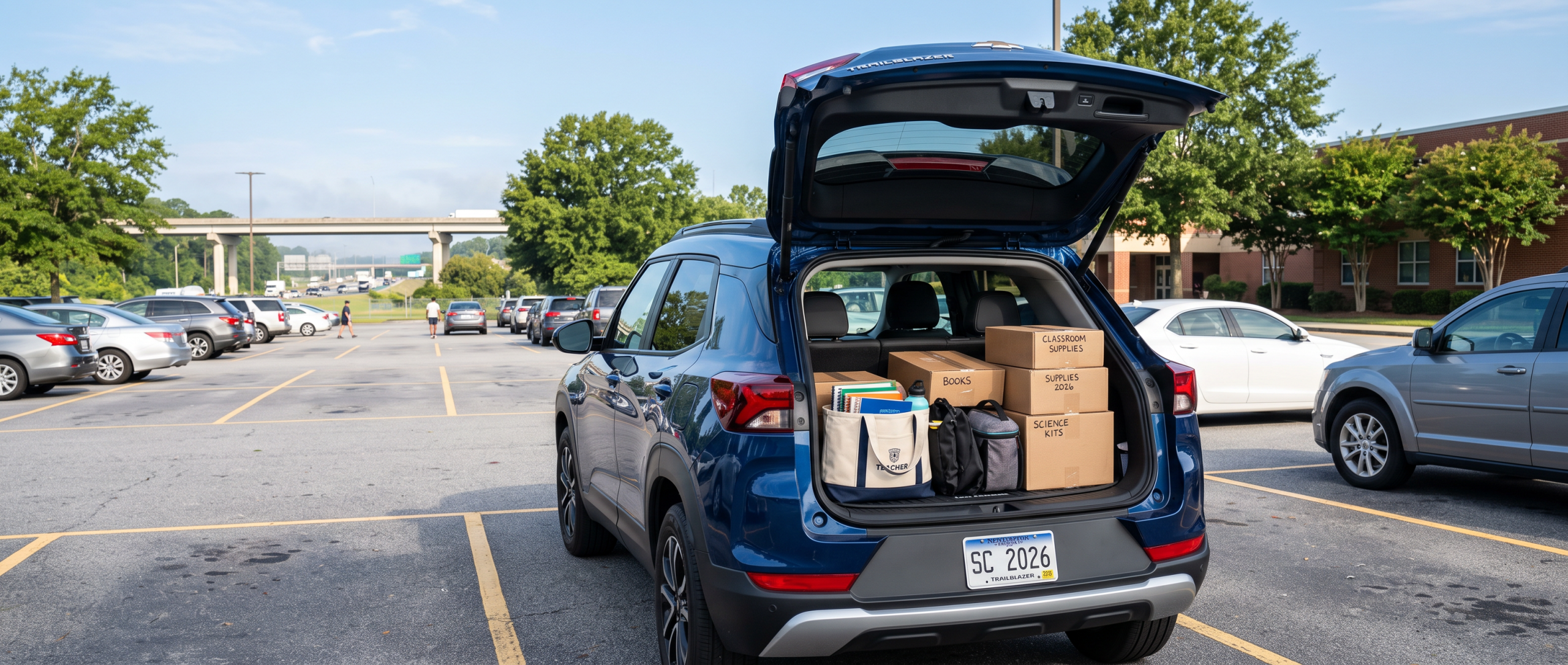
How to Pick the Right Chevrolet for Teachers in Winnsboro and Blythewood
In this article What Actually Matters When You're Picking a Teacher's Vehicle? Fuel Economy Is the Number That Compounds All Year Cargo Space: Where the Three Models Actually Differ Match the Vehicle to How You Actually Drive Teachers in Fairfield County and Blythewood don't shop for a car the usual way. You're thinking about crates of science kits, oversized poster boards, that Friday afternoon run down I-77 to pick up supplies from Columbia, and whether you can get through a full week of commuting without a second glance at the gas gauge. The variables that decide your next vehicle come down to cargo flexibility, daily fuel cost, and whether the safety tech on board keeps you sharp at 7 a.m. when school starts. Our team at Wilson Chevrolet watches this play out every August. The kindergarten teacher, the shop teacher, and the varsity soccer coach aren't shopping for the same vehicle, and a teacher's life on the lot looks different from one subject to the next. This guide maps three verified 2026 Chevrolet models to three real teaching profiles, with the actual numbers behind each pick. The short version Light carrier / solo commuter: The 2026 Trax earns 30 mpg combined (EPA-estimated) and fits 25.6 cubic feet of cargo behind the rear seats. Best for teachers whose supplies stay light and whose commute runs the I-77 corridor daily. Medium carrier / after-school activities: The 2026 Trailblazer with AWD and the 1.3L engine bumps cargo to 54.4 cubic feet folded and adds traction on wet Fairfield County back roads. The honest tradeoff is the AWD drops you to 26/29 mpg city/highway (EPA). Heavy carrier / coaching teacher: The 2026 Traverse carries up to 97.6 cubic feet (seats folded) and tows up to 5,000 pounds when equipped. Fuel economy drops to 20 city / 26 highway on FWD. It's the right call only when your cargo list is genuinely long. Every 2026 model on this list comes standard with Chevy Safety Assist, which includes Automatic Emergency Braking and Lane Keep Assist. What Actually Matters When You're Picking a Teacher's Vehicle? Cargo access, fuel economy across roughly 180 school days, and standard safety tech separate a good teacher vehicle from a frustrating one, and horsepower or trim colors, for all their brochure appeal, don't settle whether the car fits your teaching week. Everything else is secondary. Below is the decision and spec comparison by Chevrolet model, using verified figures from Chevrolet and EPA ratings: Model Best For Cargo (seats up / folded) EPA Combined MPG Key Tradeoff 2026 Trax Solo commuter, light supply load 25.6 / 54.1 cu ft 30 mpg (FWD) No AWD available 2026 Trailblazer Medium load, after-school activities 25.3 / 54.4 cu ft 27 mpg (AWD) AWD requires 1.3L engine upgrade 2026 Traverse Coaching teacher, heavy gear or towing 22.9 / 97.6 cu ft 22 mpg (FWD) Larger footprint, lower mpg Treat this table as your starting point, and don't stop there. The sections below break down where each model earns its place and where it comes up short. Fuel Economy Is the Number That Compounds All Year Fuel economy is the number that steadily adds up across a school year, since a teacher commuting five days a week from Blythewood to Winnsboro covers roughly 50 miles round-trip on I-77, so any single tank feels minor until the gallons stack up over 180 days. Add it up and you're near 9,000 miles in a school year from the commute alone, before any supply runs or field trips. The EPA rates the 2026 Trax at 28 city / 32 highway / 30 combined mpg, and it wins this category cleanly. Over that 9,000-mile school year, the Trax's efficiency gap versus the Traverse (EPA-rated at 20 city / 26 highway / 22 combined on FWD) adds up to meaningful gallons, and it's worth running that math before you buy, since a teacher's salary is finite and visible. The Trailblazer with the 1.3L turbo and AWD comes in at 26 city / 29 highway per EPA ratings, a reasonable middle. You're not bleeding fuel on the I-77 run, and you pick up traction for those wet county roads off SC 34 on a January morning. AWD on the Trailblazer won't turn heads, though it quietly earns its keep. The EPA rates the 2026 Trax at 30 mpg combined, the 2026 Trailblazer AWD at 27 mpg combined, and the 2026 Traverse FWD at 22 mpg combined. Over a 180-day school year commute, that gap compounds into real gallons. Supply-run reality check: The Trax's 25.6 cubic feet behind the rear seats (Chevrolet-listed) handles a week's worth of classroom supplies with room to spare. Once you're loading 4-foot art project boards or folded display tables, you'll want the rear seats down in either the Trax or Trailblazer. Both fold to roughly 54 cubic feet. The Traverse sidesteps that problem entirely, with 97.6 cubic feet in a class of its own. See Current Chevy Specials for Teachers Cargo Space: Where the Three Models Actually Differ Cargo is where these three models genuinely part ways, and it tends to be the first thing worth sorting out, because the Trax and Trailblazer look far apart in the brochure yet sit closer together than you'd guess. Both offer roughly 25 cubic feet behind the rear seats and roughly 54 cubic feet folded. The 60/40 split rear seat on the Trax lets you fold one side for a long item and still carry a passenger, useful without being magic. Step up to the Traverse and you're in a different league. With up to 97.6 cubic feet of total cargo volume (third row and second row folded), it's built for the PE teacher, the band director, or the coach who doubles as a teacher and drives equipment to Blythewood-McCants competitions on Friday afternoons. The third row also means you can carpool colleagues or shuttle student volunteers without asking them to sit on a supply crate. The tradeoff with the Traverse is size. At 204.5 inches long and 87.9 inches wide (Chevrolet dimensions), it won't slide neatly into every school parking lot, and teachers at older buildings with tighter lots will feel it. The coaching teacher's case for the Traverse gets stronger when towing enters the picture. Chevrolet lists the 2026 Traverse at up to 5,000 pounds towing capacity when properly equipped. A loaded equipment trailer for a track meet fits inside that window. None of the smaller models come close, and you'll feel that the day you hitch a trailer. When hauling equipment off I-77 is a regular part of September through May rather than an occasional trip, the Traverse is the right call. Pros Cons Trax Best mpg of the three, compact for tight lots, good cargo for the size No AWD, smaller cabin for larger loads Trailblazer AWD available, highway mpg stays strong, compact footprint AWD requires 1.3L engine, rear legroom can feel snug Traverse Largest cargo volume, towing capable, 3-row flexibility Lower mpg, larger footprint, more than most solo teachers need Match the Vehicle to How You Actually Drive Matching the vehicle to your actual week is where this gets simple, and the Trax is the answer for a tight-lot commuter running five days on I-77 with a couple of tote bags and a rolling cart of supplies, provided the load stays light. It doesn't need to do more than that, and it does exactly that well. FWD-only is the single limitation here. Wet leaves on a November morning in Winnsboro are manageable. A genuine ice event, rare as they are in Fairfield County, isn't where you want to test it. The Trailblazer with AWD and the 1.3L engine is the pick for teachers with more varied schedules. After-school clubs, off-site professional development in Columbia, early morning arrivals when the roads haven't dried yet. The 155 horsepower and 174 lb-ft of torque (Chevrolet-listed for the 1.3L AWD configuration) give you a little more confidence merging onto I-77 with a full load. Worth a look if your teaching life doesn't end at 3:30 p.m. The Traverse is the coaching teacher's vehicle. Full stop. If you're hauling equipment, carpooling athletes, or occasionally towing, the mpg tradeoff is real but it's earned. Trying to make a Trax do that job is the wrong answer, and we'd tell you that, smaller sale or not. Every model in this comparison comes standard with Chevy Safety Assist, which bundles Automatic Emergency Braking, Forward Collision Alert, Lane Keep Assist with Lane Departure Warning, and IntelliBeam automatic high beams. You'll notice it on the pre-dawn drives that come with morning duty and early-season athletic practice schedules. Frequently Asked Questions Which 2026 Chevrolet gets the best fuel economy for a teacher commuting in Winnsboro or Blythewood? The 2026 Trax earns the best fuel economy of the three models covered here. The EPA rates it at 28 mpg city, 32 mpg highway, and 30 mpg combined. That's relevant for teachers commuting daily on I-77 between Winnsboro and Blythewood, where highway miles dominate the school-year drive. The Trailblazer AWD follows at 26 city / 29 highway per EPA ratings, and the Traverse FWD comes in at 20 city / 26 highway. Does a teacher really need AWD in Fairfield County, South Carolina? Probably not for most of the school year. Fairfield County winters are mild, and I-77 stays clear after most weather events. The case for AWD on the Trailblazer is less about snow and more about wet county roads and early-morning moisture on rural routes off SC 34. If your commute is all highway and parking lots, FWD on the Trax is fine. If you're driving to after-school activities on unpaved or poorly-drained roads, the Trailblazer's AWD option gives you a real confidence margin for a modest efficiency tradeoff. Explore Financing Options Wilson Chevrolet 798 us hwy 321 N BUSINESS, Winnsboro, SC 29180 (803) 402-4233
Your Used Chevrolet Malibu Smells Like Burning Oil Before You Even Drive It Off the Lot (Unless You Know Which Year to Buy)
In this article What's Actually Going On with the Malibu's Model-Year Divide? The Two Recalls That Matter Most for a Budget Buyer The Sweet Spot Years and Why They Fit the I-77 Commute DIY Checks vs. Bringing It to Our Service Team We'll admit the title is an exaggeration. Barely. Students come through our service center at Wilson Chevrolet having bought a used Malibu on excitement and a low sticker price, then learn they picked one of the recall-heavy early years of the seventh generation. The Malibu really is a smart commuter sedan for students running the I-77 corridor to Midlands Technical College. It's comfortable, it sips fuel, and used copies are plentiful right now because Chevrolet discontinued the nameplate after the 2025 model year. Not every year is created equal, though. Look at a few things before you sign anything. What's Actually Going On with the Malibu's Model-Year Divide? The seventh-generation Chevrolet Malibu (2016-2025) is the one you'll find on every used lot in Fairfield County and the Columbia area right now, and most of it is a smart buy, but the label hides a real spread, because Chevrolet made meaningful mechanical and safety changes across that span and NHTSA opened recalls on specific years. So knowing those years cold before you shop pays off. Here's the quick diagnostic table. Model Years What Changed Key Recalls (NHTSA-documented) Buyer Verdict 2016-2018 Launch years, 1.5T + optional 2.0T, Android Auto/CarPlay wired Per NHTSA, 9 recalls on 2016 alone; PPS airbag calibration defect (2016-2018) Proceed with caution; verify all recall work is completed 2019-2020 New CVT (smoother than prior transmission), revised front end Rear seat belt retractor recall covers 2016-2021; verify closure Solid choice IF recalls are closed 2021 Wireless Apple CarPlay and Android Auto added standard Rear seat belt retractor recall, driver seat frame weld recall (per NHTSA) Good tech year; confirm both recalls resolved 2022-2023 AEB with pedestrian detection became standard (2023); front impact bar weld recall Per NHTSA campaign 22V923000: front impact bar may not be properly welded to the frame rail Be careful here (get a pre-purchase inspection) 2024-2025 Final production years; rear park assist added 2024; AEB standard Fewest open recalls in the generation Sweet spot for used buyers The EPA rates the 2024 Chevrolet Malibu at 27 city / 35 highway with the 1.5-liter turbocharged four-cylinder. Those numbers matter for a student who's making a 30-mile run from Winnsboro down I-77 to MTC's Airport or Beltline campus most mornings. The Two Recalls That Matter Most for a Budget Buyer Two recalls in this generation deserve your full attention before money changes hands, and both are fixable, but only one is a quick tighten while the other can end with GM buying the car back, so the year you pick decides how much homework you'll owe yourself. Browse our pre-owned inventory before you commit to any private-party car, and use NHTSA.gov to check the VIN of any Malibu you're considering. Rear seat belt retractor (2016-2021 Malibus). Per NHTSA, the rear seat belt retractors on these years may have been improperly secured with loose or missing fasteners. An unsecured retractor won't function correctly in a crash. The remedy is a dealer inspection and tightening, free of charge. It's a quick fix, but you need confirmation it was done. Front impact bar weld (2022-2023 Malibus). Per NHTSA campaign 22V923000, certain 2022-2023 Malibus have a front impact bar that may not be properly welded to the front frame rail. If the weld is defective, front crash sensors may not perform correctly. GM's stated remedy is an inspection, and if the defect is found, the vehicle is repurchased by GM. A repurchase is about as serious as a recall gets. A 2022 or 2023 Malibu is only a clean buy if you've got documentation showing the inspection was completed and the car passed. Skipping a pre-purchase inspection to save a little is tempting on a tight budget, and it's the wrong call here. A one-time inspection fee is cheap compared to discovering a structural safety issue after you've bought the car. Per NHTSA, the 2016 Chevrolet Malibu alone carries 9 documented recalls; the 2022-2023 model years have a separate front impact bar weld recall that may result in GM repurchasing the vehicle. Check before you buy: Every Malibu VIN can be searched free at NHTSA.gov. Pull the report and confirm each recall shows "remedy available" and "recall completed" on the vehicle history. If a seller can't produce documentation, ask the selling dealer to run the VIN before you agree to anything. The Sweet Spot Years and Why They Fit the I-77 Commute For an MTC commuter specifically, the 2019-2021 range (with recalls confirmed closed) and the 2024 model year tend to give the fewest surprises, and while no used car is a guarantee, those years line up with how the Malibu was actually built for steady highway miles. Our team sees it in the used Malibus that come through our service bays, and that's a pattern we'll stand behind. The 2019 update swapped the prior automatic transmission for a CVT paired to the 1.5-liter turbo. That pairing is tuned for steady-speed highway cruising, which is exactly what a 30-mile I-77 run looks like. Come 2021, wireless Apple CarPlay and Android Auto arrived as standard equipment, so you're not fumbling with a cable before class. The 2024 rounds out Chevy Safety Assist (automatic emergency braking with pedestrian detection, lane keep assist, forward collision warning) as standard across all trims, which helps in Columbia metro traffic once you get off the interstate. The Malibu asks one honest tradeoff of you, and it's front-wheel drive only. Every year, every trim. If you're planning to haul anything heavier than a backpack and a printer in the trunk, the Malibu's 15.7 cubic feet of cargo space is fine but not generous. And while 163 horsepower from the 1.5-liter turbo handles highway merges comfortably, this is no rocket. Call it a practical, efficient commuter, which is exactly what it was designed to be, and for a student running to West Columbia five days a week, it's the right tool. See our financing options if you'd like to talk about how used-vehicle financing works before you shop. DIY Checks vs. Bringing It to Our Service Team You can verify a good chunk of a used Malibu's condition yourself in the parking lot, and that saves you a service visit, but the structural items need a lift and a technician who knows what a clean weld looks like, so you'll want to plan on splitting the work. Things you can check yourself: Pull the free NHTSA VIN report and confirm recall status on every open recall for the year you're considering. Check the 8-inch infotainment touchscreen for responsiveness. Dead zones or lag can point to a previous liquid spill. Look at the CVT fluid on 2019 and newer models. It should be pinkish-red and not smell burnt, and a dark brown color or a burnt smell means the transmission has been stressed. Test wireless CarPlay/Android Auto on a 2021 or newer. If it won't pair, that module has often been replaced with an incompatible aftermarket unit. Check the rear seat belt buckles on 2016-2021 models by pulling firmly. They should lock solidly without any play. What our service center handles: The front impact bar weld inspection on 2022-2023 models is not a DIY job. The job needs a proper lift and a technician who knows what a complete weld should look like. We can also do a full pre-purchase inspection on any used Malibu you're considering, whether you bought it from us or found it on a private listing across Fairfield County, no judgment either way. We're straightforward about what we find. If a car isn't worth buying, we'll say so. Frequently Asked Questions Is a used Chevrolet Malibu a reliable choice for a student at Midlands Technical College? The 2019-2021 and 2024 Malibu years are generally reliable commuter cars once NHTSA recalls are verified as closed. The 1.5-liter turbocharged engine paired with a CVT is well-suited to steady highway driving on I-77 between Winnsboro and the Columbia area. The 2016-2018 years carry the most open recall exposure, including a Passenger Presence System airbag calibration defect documented by NHTSA, so those years require more due diligence before buying. What is the fuel economy of a used Chevrolet Malibu? The EPA rates the 2024 Chevrolet Malibu at 27 mpg city and 35 mpg highway with the standard 1.5-liter turbocharged four-cylinder engine. The 2023 model carries similar figures. For a commuter covering 60 miles round-trip to MTC campuses in West Columbia, that fuel economy translates to meaningful savings compared to less efficient used sedans in the same price range. Schedule a Pre-Purchase Inspection Wilson Chevrolet 798 us hwy 321 N BUSINESS, Winnsboro, SC 29180 (803) 402-4233
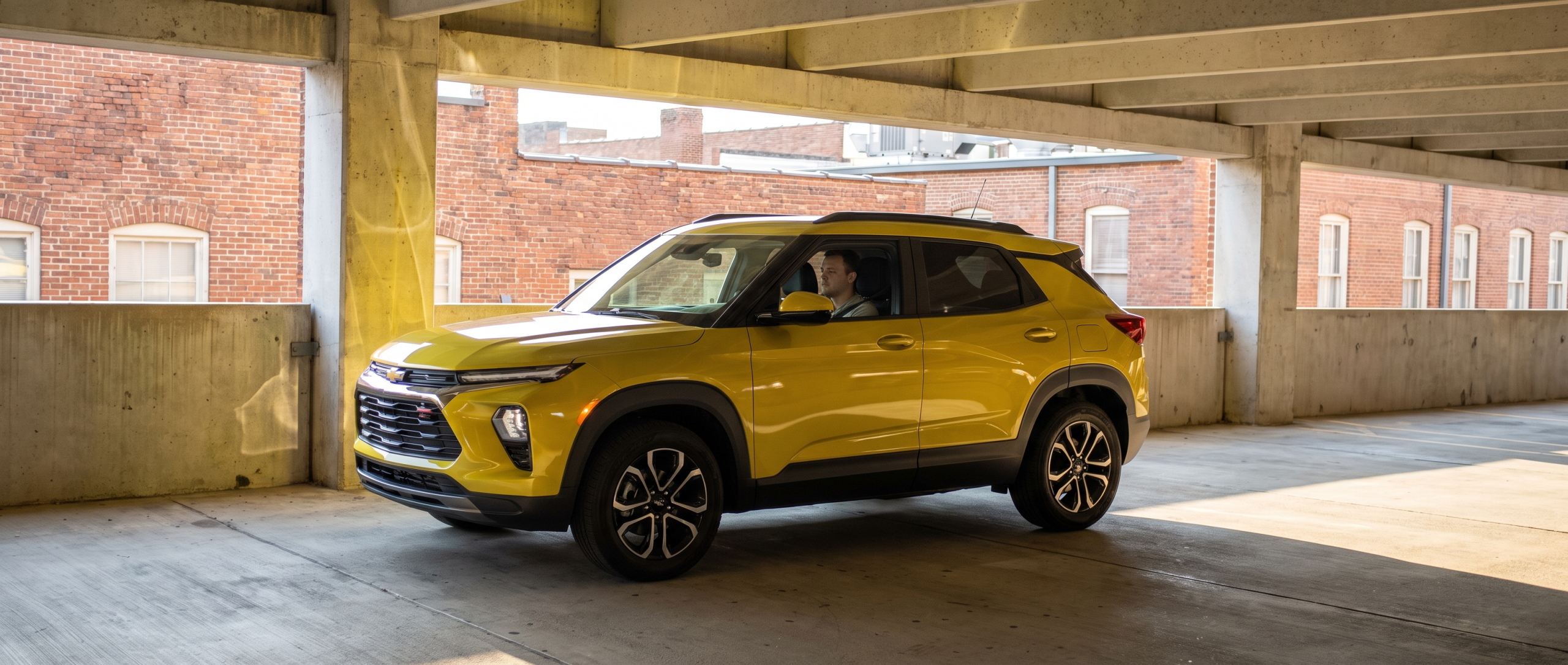
The I-77 Run to Columbia: Driving Your Trailblazer to USC Safely
The 2026 Chevrolet Trailblazer is a genuinely good fit for a Fairfield County student heading down to USC. It's compact enough for the Columbia campus and big enough to haul a semester's worth of gear. But a good fit doesn't mean you can point it south on I-77 and figure out the rest when you arrive. USC's campus parking rules will ticket or tow you without a second thought, and late-summer South Carolina throws afternoon thunderstorms at I-77 that new drivers aren't ready for. Know both before move-in weekend. The Do and Don't Table for This Drive The two conditions you're actually navigating here are an interstate leg and a dense urban campus. They ask different things of you and of the vehicle. Situation Do Don't I-77 S in afternoon rain Activate the Following Distance Indicator and add at least 4 seconds of gap to the car ahead Tailgate at highway speed; wet roads extend stopping distance sharply USC campus lot arrival Pull head-in to your space; USC parking regulations require it on every campus lot Pull through or back in; USC enforcement runs 24 hours a day, 7 days a week Campus parking permit Register your Trailblazer with USC Parking and Transportation Services before your first day Assume your Trailblazer is covered under a roommate's permit; it is not Tight campus garage turns Use the Rear Vision Camera and take the turn in a single, deliberate arc Overcorrect with multiple small inputs; the Trailblazer has a 37.3-foot turning diameter (manageable but not a sports car) Loading/unloading on move-in day Fold the rear seats for 54.4 cubic feet of flat cargo space Pack to the roofline and lose rearward visibility; use the HD Rear Vision Camera as your second set of eyes ParkUSC app Download the ParkUSC app before you leave Winnsboro; it guides you to your exact unloading zone Try to navigate the Columbia campus cold; the app saves real time on a congested move-in Saturday The One Technique That Actually Matters on I-77 The single skill worth drilling for this drive is following distance, and it earns its keep the moment the sky opens up. South Carolina's mid-summer thunderstorms can drop heavy rain in a 20-minute window with no warning, and I-77 between Winnsboro and the Blythewood interchange runs straight and fast enough that drivers underestimate how much a wet road changes things. Follow the gap. That's it. The 2026 Trailblazer's Chevy Safety Assist package includes a Following Distance Indicator as standard equipment on every trim. It shows the gap to the vehicle ahead as a number of seconds, in real time, right there in the driver's cluster. Keep your tires properly inflated before the semester starts. Chevrolet lists the Trailblazer's standard tire pressure monitoring system as part of the base package, and underinflated tires shorten wet-road stopping distances more than you'd think. FWD or AWD? The 1.3L turbo engine comes in both configurations, and your route decides it for you. The FWD version earns better fuel economy for flat Midlands roads (an easy win on a straight I-77 commute), while the AWD option delivers extra grip for drivers in regions that demand all-wheel traction. Talk through the trims with our finance team so you're choosing the drivetrain that fits your actual route. Before you merge onto I-77: Check the South Carolina 511 traffic system for any active incidents between Winnsboro and Blythewood. It's only about 33 miles, but a single lane closure near the Blythewood interchange will back traffic quickly. One Quick Recap Before You Head South The Trailblazer hands you solid tools for this specific drive. You'll get standard Chevy Safety Assist across every trim, an 11-inch touchscreen ready for navigation, and enough cargo capacity to handle move-in day without renting a truck. Do your USC permit paperwork before you leave home, download the ParkUSC app, and keep a legal following distance on I-77 when the sky turns gray. By the Wilson Chevrolet Team | August 2026 See Current Trailblazer Offers Wilson Chevrolet 798 us hwy 321 N BUSINESS, Winnsboro, SC 29180 (803) 402-4233