



Blog

Your Chevrolet's Brakes Are Working Harder Right Now Than They Were in July

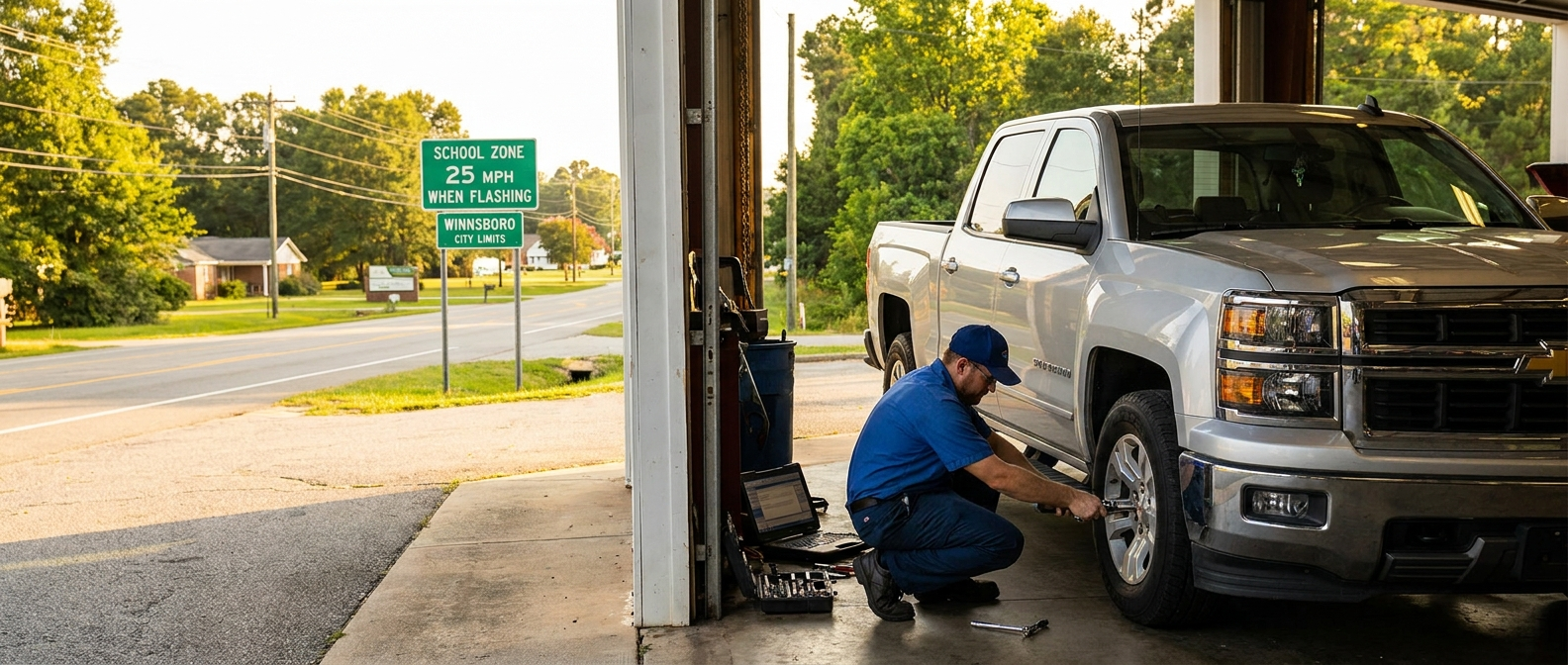
Chevrolet Silverado 1500 brake inspection at Wilson Chevrolet service center in Winnsboro SC on US-321

School in Fairfield County started July 30, and US-321 through Winnsboro shifted almost overnight from a relatively open summer corridor to a stop-and-go school-zone commute, twice a day, five days a week. Brake pads don't care what the calendar says, but your driving pattern absolutely changes how fast they wear. Stop-and-go traffic with frequent hard stops is one of the most demanding cycles a brake system faces.

Chevrolet's own service documentation states that brake wear indicators are set to alert at approximately 2 mm of pad friction material remaining, and that pads should be replaced at or before reaching that threshold (a measurement you never see until the squeal starts).

We're on US-321 N Business ourselves here at Wilson Chevrolet, so we see what this road does to vehicles. In this guide we break down exactly what a Chevrolet brake inspection covers, how stop-and-go school traffic loads your system, and which signs mean it's time to book a service appointment before a minor wear issue becomes a rotor problem.

What Do the Brake Specs Actually Mean for Your Chevrolet?

Chevrolet Certified Service documentation calls out 2 mm of remaining friction material as the replacement threshold for brake pads, which is thinner than two stacked pennies, and since most pads start life between 10 mm and 12 mm thick, by the time the wear indicator squeals you've used roughly 80 percent of what you had. That's late in the game. So the number is worth knowing before the noise starts.

Brake ComponentNew ConditionService Alert ThresholdChevrolet Action
Brake pads (friction material)~10-12 mm thick2 mm remainingReplace immediately (per Chevrolet Certified Service)
Brake rotorsStamped nominal thickness on castingMin. thickness stamped on rotor (typically 2-3 mm less than new)Replace before reaching minimum; do not resurface below it
Brake fluidClear to light amberDark, cloudy, or moisture-contaminatedExchange recommended when condition warrants
Wear indicator tabsRetractedContact with rotor surfaceAudible squeal (schedule service promptly)

Rotors are marked the same way. Chevrolet stamps the minimum acceptable thickness right into the rotor casting. Once a rotor is worn or machined below that mark, it can't safely dissipate the heat a full stop generates, and heat is the enemy of consistent braking.

Why does that matter right now? Because heat builds fastest in exactly the kind of driving US-321 sees during school drop-off and pickup: repeated moderate-to-hard stops from 25-35 mph, short distances between stops, and an engine that doesn't hold the sustained highway speed needed to let things cool between applications. This is a brake-unfriendly cycle, and it compounds across five mornings and five afternoons every week.

Stop-and-Go School Traffic and What It Does to Your Pads and Rotors

Highway miles are actually easier on your brakes than a stop-and-go commute, because you're using the pedal less often, more gradually, and from lower relative speeds in many situations. A Silverado 1500 owner who puts 15,000 miles a year on mostly I-77 highway runs may have pads that outlast a neighbor doing the same mileage on a school-zone route with a full truck bed.

Stop-and-go traffic changes the math in three specific ways.

  • More brake applications per mile. A school-zone corridor with crosswalks, bus stops, and signal lights means far more pedal applications per mile than open-road driving. More applications equals more friction, more heat, and faster pad wear.
  • Sustained heat buildup. Short stops don't allow rotors to shed heat between applications the way a long highway run does. Heat that stays in the rotor speeds up both pad glazing and rotor warping.
  • Heavier-loaded vehicles. Families running carpool aren't driving with an empty vehicle. Chevrolet's own guidance notes that driving habits and vehicle load conditions directly influence how quickly brake components wear (there's no universal mileage interval because conditions vary that much).

A Tahoe carrying six passengers to school and back weighs meaningfully more fully loaded than empty. The brake system stops whatever mass you give it.

Service tip. Chevrolet's Multipoint Inspection includes a brake check at every visit, not just at scheduled maintenance milestones. If you're due for an oil change, that inspection is already built in, an easy way to get eyes on pad thickness without booking a separate appointment.

Between service visits, here's what to listen and feel for.

  • A high-pitched squeal during normal braking (wear indicator contacting the rotor)
  • Grinding or metal-on-metal scraping (pad material fully worn, backing plate contacting rotor)
  • Pulsation or vibration through the brake pedal (warped or unevenly worn rotor)
  • A soft or spongy pedal feel (air in the brake lines or degraded brake fluid)
  • The vehicle pulling to one side under braking (uneven pad wear or a sticking caliper)

Any one of those is a reason to schedule service. A squeal is a warning. A grind means damage is happening as you drive.

What a Full Chevrolet Brake Inspection Actually Covers

A proper Chevrolet brake inspection covers more than a glance through the wheel spokes, because per Chevrolet Certified Service a trained technician checks front and rear brake pads (or shoes on drum-equipped rear axles), rotors, hoses, and calipers for wear, and also inspects the fluid lines for cracks and leaks.

Six distinct systems get evaluated in a single service visit.

  • Pad thickness (measured, not estimated)
  • Rotor condition (thickness, surface scoring, heat spotting, and lateral runout)
  • Caliper operation (checking that pistons retract properly and slides aren't seized)
  • Brake hoses and hard lines (looking for cracks, bulges, or seepage)
  • Brake fluid condition (color and moisture content affect how the fluid performs under heat)
  • Wear indicators (confirming the mechanical alert tabs are functional)

A Traverse running three-row family carpool load and a Silverado towing on weekends put different demands on those six systems, but the checklist doesn't change. What our team finds tells you which components need work now, which ones need watching, and which ones are fine until the next visit.

Brake service isn't a fixed-schedule item the way an oil change is. There's no single mileage number that covers every driver's situation, and Chevrolet's own guidance says exactly that. A driver doing a lot of stop-and-go school-zone miles in August in Winnsboro may need pads sooner than the neighbor who drives the same Silverado mostly on I-77 between here and Columbia. Driving pattern matters more than the odometer.

Schedule a Brake Inspection

Who Needs a Brake Inspection Right Now?

If you haven't had a brake check since spring, the answer is probably you, and here's how to self-triage before you call us. A quick honest read of your own driving usually points the way.

Fairfield County's school year kicked off July 30. If you've been running school drop-offs since then, you've already put your pads through roughly two weeks of the most demanding daily cycle they'll see all year. None of that is a scare tactic. It's just what the math looks like when you add up two school runs a day on a stop-and-go stretch like US-321.

You're a good candidate for a brake inspection now if any of these fit.

  • You haven't had brakes inspected in the last 12 months
  • You're hearing intermittent squealing during light braking
  • Your vehicle pulls slightly left or right when you stop
  • You've added regular carpool duty to your weekly routine since late July
  • Your pedal feels less firm than it did six months ago

The vehicles in our area that show the most varied brake wear tend to be full-size trucks and three-row SUVs (Silverados, Tahoes, Traverses), because they're doing double duty as daily commuters and weekend haulers. Heavy use across two very different driving profiles adds up. Our service center can tell you where you stand in one appointment.

We're straightforward about one thing. Not every inspection ends with a parts recommendation. Sometimes pads measure at 6 mm and you've got months ahead of you. Knowing that is worth something too.

Frequently Asked Questions

What triggers the brake squeal on my Chevrolet, and should I ignore it?

The squeal is almost always your wear indicator doing its job. Chevrolet builds metal tabs into the brake pads that contact the rotor surface when friction material reaches approximately 2 mm of remaining thickness. That contact creates the high-pitched sound. It's a designed alert, not a random noise, and you shouldn't ignore it. Continuing to drive on pads past that point means the metal backing plate will eventually contact the rotor directly, turning a pad replacement into a rotor replacement as well.

Does stop-and-go school traffic really wear brakes faster than highway driving?

Yes, and the difference is real. Chevrolet's service guidance explicitly states there is no fixed mileage interval for brake service because wear depends on driving habits and conditions. Stop-and-go driving with frequent moderate-to-hard stops generates more heat cycles per mile than sustained highway speeds, and heat is the primary driver of accelerated pad and rotor wear. School-zone routes with crosswalks, bus stops, and traffic signals are one of the higher-wear driving patterns your brake system encounters.

Wilson Chevrolet

798 us hwy 321 N BUSINESS, Winnsboro, SC 29180

(803) 402-4233

Recommended Posts

2026 Chevrolet Equinox EV plugged into a home charger on a cool November morning in Winnsboro, SC

How Far Will Your Equinox EV Really Go on a Cold Winnsboro Morning?

November in Fairfield County runs mild. Our overnight lows average around 39 degrees Fahrenheit this month, and some mornings dip into the upper 20s. We're not talking Minnesota. We're not talking summer either. For your 2026 Chevrolet Equinox EV, the chill is still enough to trim your range in ways worth understanding before you back out of the driveway. A fair expectation for a Winnsboro November morning is the 15 to 25 percent range-loss window, not the catastrophic 40-plus percent that polar-vortex headlines describe. With a full charge and the right habits, you'll still have well over 240 miles on most days. We'll walk you through it. How Far Will It Really Go When Temperatures Drop? The EPA rates the front-wheel-drive 2026 Equinox EV at 319 miles on a full charge, and that number is real on a mild 65-to-75-degree day, but cold weather changes the math, since the 85 kWh lithium-ion pack slows its reaction and delivers less power as temperatures fall. That number is real. On a 65-to-75-degree day. Cold changes the math. AAA's cold-weather EV research found that cold temperatures can cut range by up to 39 percent in deep winter conditions. Winnsboro's November mornings aren't that extreme. At the low-to-mid 30s to low 40s we see this time of year, you're looking at something closer to 15 to 25 percent. Those percentages play out differently across the Equinox EV's trim lineup. Configuration EPA Range (Full Charge) Estimated November Range (15-25% loss) Note FWD (LT1, LT2, RS) 319 mi Approx. 240-271 mi Most common local configuration AWD (RS, LT2 optional) 307 mi Approx. 230-261 mi Second motor adds traction, trims range FWD with preconditioning 319 mi Approx. 255-280 mi Grid energy warms battery before departure Cold battery, lots of cabin heat, short trips 319 mi Approx. 190-220 mi Worst-case scenario; avoidable with habits A couple of things worth keeping in mind. Short trips lose more, because the pack never warms up from driving before the cabin heater has already pulled a big chunk of energy. Longer runs down I-77 to Columbia are actually gentler on your percentage, since the battery warms as it works and highway cruising spends less of its energy on heat than a five-mile errand does. Where Do You Charge an Equinox EV Around Here? Home charging is where this vehicle makes the most sense for Fairfield County, and it pays to get that setup right before the cold settles in, because the 2026 Equinox EV adds roughly 34 miles of range per hour on a 240V Level 2 home charger and fills up overnight in around nine hours. Our service center can point you toward home charger installation resources if you're still running off the included Level 1 cord. For public charging on the I-77 corridor heading toward Columbia, the picture has improved considerably in 2026. Columbia's metro area has DC fast charging at several locations drivers from Winnsboro use regularly. Charging Stop Location / Corridor Connector Type DC Fast Speed Tesla Supercharger - Harbison Blvd Columbia via I-26/I-77, ~32 mi south NACS (adapter needed for Equinox EV CCS port) Up to 325 kW (stall dependent) Electrify America - Harbison Blvd Walmart Columbia, ~32 mi south CCS (native for Equinox EV) Up to 150+ kW ChargePoint network - Columbia area Multiple Columbia metro locations CCS, Level 2 varies Varies by site Level 2 - City of Columbia garages Downtown Columbia J1772 Level 2 only The Equinox EV uses a CCS connector as its native port. It can DC fast charge at up to 150 kW. On a 10-minute stop at a 150 kW station, Chevrolet rates that at approximately 70-77 miles of added range. That's a meaningful buffer if you're making the round trip to Columbia and back. The drive sits well inside one-charge range even on a cold morning. Winnsboro to Columbia is roughly 30 miles each way, so most days you're simply plugging in at home overnight and not thinking about public chargers at all. Cold-morning charging note: A battery that sat outside overnight in the low 30s will accept a DC fast charge more slowly than a warm one. If you're heading to a public fast charger from cold, give the battery time to warm up during the drive. The Equinox EV's thermal management system handles this automatically, and you'll see charge speeds climb as the pack reaches operating temperature. Charge to 90-100% the night before cold mornings, not the next morning in a rush Use the myChevrolet app or scheduled departure to precondition cabin and battery while still plugged in (20-30 minutes before you leave) Heated seats use far less energy than the full cabin heater. Lean on them first Slower highway speeds (65 vs 75 mph) make a real difference in cold-weather range If your trips are short, make home charging a nightly habit rather than a weekly one Plan It This Way for Winnsboro Winters A winter routine for the Equinox EV comes down to one dependable loop, and it keeps cold-weather ownership simple in Fairfield County, since you plug in every night and set a scheduled departure in the myChevrolet app so the car warms the cabin and battery on grid power before you unplug. The car uses grid power, not battery power, to reach its optimal operating temperature before you leave. Set the departure time and let preconditioning do the work. Preconditioning while plugged in saves an estimated 5 to 15 percent of your driving range compared to starting cold. On a 319-mile-rated vehicle, that's 16 to 48 miles you don't have to think about. The trade-off with EV ownership in a small town like Winnsboro is public charging access. Columbia has it. Winnsboro itself doesn't have dedicated DC fast infrastructure yet. For daily driving and most I-77 commutes, that never comes up. see our current Equinox EV inventory to match a range configuration to your actual daily miles. But if you regularly drive long routes without returning home overnight, that's a real planning consideration worth talking through with us. In our experience on the lot and in the service center, drivers coming from a truck or traditional SUV background tend to underestimate how thoroughly a home Level 2 charger changes the equation. A Silverado owner stops at the pump twice a week. An Equinox EV owner plugs in like a phone. You leave with a warm battery and a full charge. The cold stops mattering. Schedule a Pre-Winter EV Service Check Frequently Asked Questions Does cold weather permanently damage my Equinox EV's battery? No. Cold temperatures reduce available capacity temporarily, but they don't permanently damage a healthy lithium-ion battery. What you experience as reduced range on a 35-degree morning is the battery chemistry operating less efficiently in the cold, not degradation. The pack recovers its full rated capacity when temperatures rise. The habits that protect long-term battery health are avoiding repeated deep discharges and not DC fast charging a fully cold pack from zero every day. Neither of which is a typical usage pattern for a Winnsboro commuter. Should I charge to 100% the night before a cold day? For cold-morning driving, yes. Charging to 90 to 100 percent before a cold day is a sound practice. The 2026 Equinox EV's battery management system is designed to handle regular full charges. For everyday warm-weather driving, stopping at 80 to 90 percent slightly reduces long-term battery stress, but on a Winnsboro November morning when you want maximum available range, a full charge plus preconditioning is the right call. Is the Equinox EV a good fit for Fairfield County if I don't have a garage? It can work without a garage, with one important adjustment. Outdoor overnight parking in the low 30s means the battery starts cold, and you'll see more range loss than a garaged vehicle on the same morning. The workaround is consistent Level 2 home charging (even outdoors, a weatherproof outlet and a wall-mounted EVSE handle SC temperatures fine) and using the scheduled departure feature to precondition while plugged in. If you rely entirely on Level 1 (a standard 120V outlet), charging times stretch significantly and preconditioning becomes less practical. That's the honest answer, and it's a conversation worth having before you decide on a configuration. View Current Equinox EV Offers Wilson Chevrolet 798 us hwy 321 N BUSINESS, Winnsboro, SC 29180 (803) 402-4233

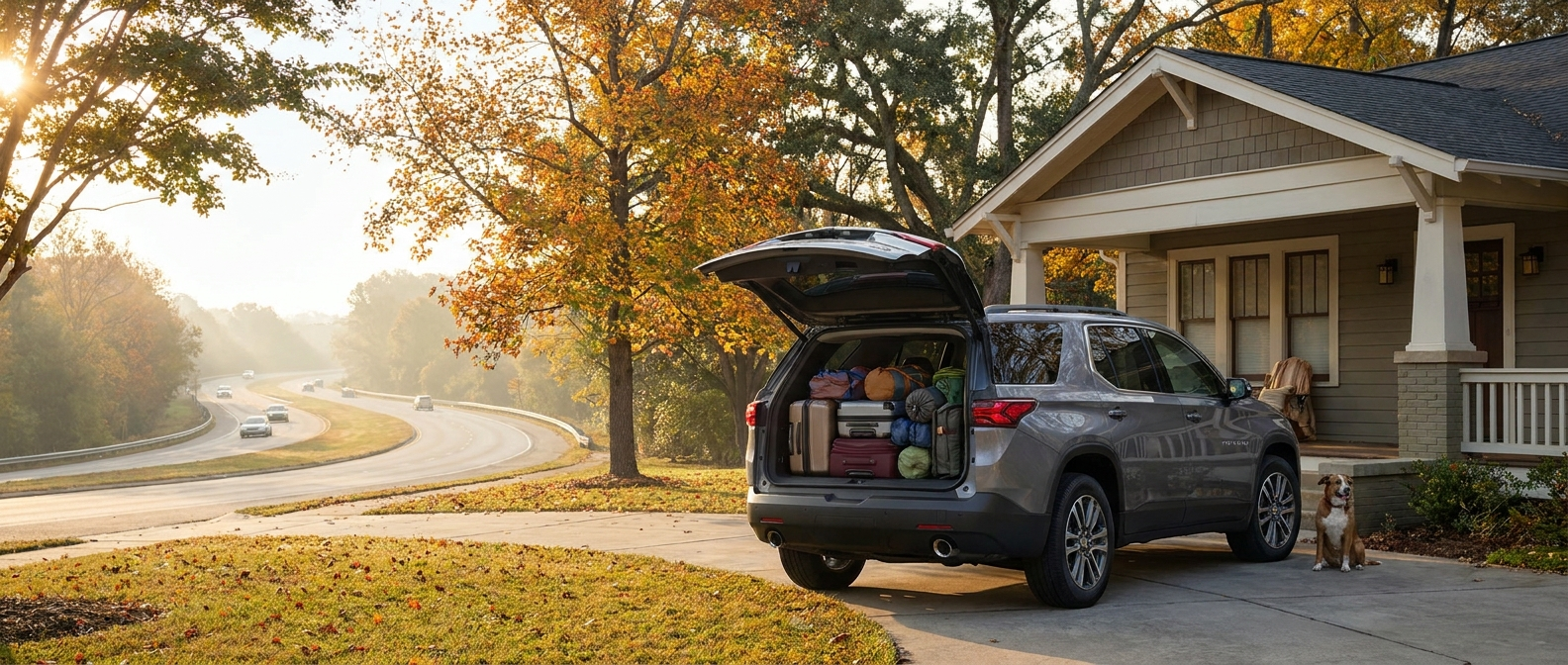
2026 Chevrolet Traverse packed for a Thanksgiving road trip in Winnsboro, SC

Your Chevrolet Thanksgiving Road Trip Service Checklist

In this article What Goes on the Checklist? Why These Items Actually Matter The Item / Why-It-Matters Table Print-and-Go Recap Thanksgiving week is the single busiest travel stretch of the year, and I-77 through Fairfield County carries a big piece of that traffic north toward Charlotte and south toward Columbia. A quick pre-trip service pass right now takes about an hour. A roadside breakdown on the Wednesday before Thanksgiving doesn't. So here's exactly what to run through before you go. Schedule your pre-trip service at Wilson Chevrolet before the holiday rush fills our service bays. What Goes on the Checklist? Work through every item below before you leave, and if any of them leave you unsure, bring the vehicle in so our team can run a multi-point inspection that covers the whole list. We'd rather catch a soft tire or a tired battery here than have you find it on the shoulder of the interstate. None of this takes long. The hard part is just doing it before you pack the car. Tires [ ] Check PSI cold (before the first drive of the day) against the placard on the driver's door jamb, NOT the sidewall number [ ] Look for uneven wear, sidewall cracking, or embedded objects [ ] Verify tread depth is above 4/32 inch (use the quarter test: if you can see above Washington's head, it's time for tires) [ ] Check the spare (pressure and condition) Engine Oil [ ] Check the Oil Life Monitor reading; if it's below 40%, change it before the trip [ ] Confirm the correct oil spec for your Chevy (see the why-it-matters table below) [ ] Look at the dipstick level and color; dark, gritty oil is overdue regardless of what the monitor says Battery [ ] Ask for a load test if the battery is 3 or more years old [ ] Inspect terminals for corrosion buildup [ ] Note how the engine cranks; a slow or labored start is a warning Brakes [ ] Listen for any squeal or grind on your last few drives [ ] Have pads measured if you're within your service window; Chevrolet advises replacement when pad thickness drops to 2mm [ ] Check that the parking brake engages and releases cleanly Fluids [ ] Engine coolant (at the cold fill line) [ ] Brake fluid (clear to light yellow; dark fluid means moisture contamination) [ ] Transmission fluid (level and color; bright red is good, dark brown is not) [ ] Windshield washer fluid (top off completely, especially for night highway driving) [ ] Power steering fluid if your vehicle has a hydraulic system Lights and Wipers [ ] Walk around and confirm: headlights (low and high), taillights, brake lights, turn signals, hazards [ ] Run the wipers; streaking in a November rain on a dark two-lane is exactly when you don't want to discover a cracked blade [ ] Test the rear defroster Emergency Kit [ ] Jumper cables or a jump-start pack [ ] Flashlight with fresh batteries [ ] Basic first-aid kit [ ] Phone charger and backup battery [ ] Blanket (November lows in the Midlands can dip into the 30s) [ ] Tire pressure gauge [ ] Vehicle registration, insurance card, and roadside assistance contact Why These Items Actually Matter Every item on that list earns its place through a real mechanism, not superstition, and a couple of them carry specifics worth slowing down for. You don't have to take our word on faith. Once you see what's happening under the hood and at the wheel, the reasons hold up on their own. Tires: The PSI Drop Is Physics, Not Bad Luck A loaded Traverse or a Silverado 1500 climbing I-77 with a full cab and cargo needs every PSI it's rated for, and cold weather quietly works against you here. Tire pressure drops approximately 1 PSI for every 10 degrees Fahrenheit the temperature falls. A loaded Traverse or a Silverado 1500 running low on pressure under all that weight is working harder than it should be. South Carolina's Midlands stays mild through most of November. But set your pressure on a 70-degree afternoon, leave on a 40-degree morning, and that's a 30-degree swing. You could be 3 PSI low before you even turn the key. The fix is simple. Check cold, use the door-jamb number, and top off the morning you leave. TPMS warning lights help, but per NHTSA, that light typically doesn't trigger until a tire is about 25 percent below the recommended PSI. That's a lot of miles on a low tire before the warning catches up to you. Quick note on the spare: it's easy to forget the fifth tire entirely. A spare does nothing for you at zero PSI. Oil: The Monitor Is Smart, But It Doesn't Know You're Hauling the Family Chevrolet's Oil Life Monitor is genuinely good technology, and it tracks engine speed, temperature, and operating conditions to calculate real oil degradation rather than counting down blind miles. Under normal driving, most 2026 Chevys are rated for up to a 7,500-mile oil change interval on the correct dexos1 full-synthetic oil. That number holds when your driving looks like the driving the system was built to read. Here's the tradeoff we see at our service center. The monitor is calibrated for how you normally drive. Load a Tahoe with five people and two weeks of luggage, run it at highway speed for four hours, and that's a harder thermal cycle than your daily commute. If your monitor reads below 40%, change the oil this week. Don't push it into a loaded highway run. Chevy Model / Engine Required Oil Spec Viscosity Silverado 1500 (5.3L or 6.2L EcoTec3 V8) dexos1 Gen 3 Full Synthetic SAE 0W-20 Silverado 1500 (2.7L TurboMax I4) dexos1 Gen 3 Full Synthetic SAE 5W-30 Traverse (2.5L Turbo, all 2026 trims) dexos1 Gen 3 Full Synthetic SAE 0W-20 Tahoe (5.3L EcoTec3 V8) dexos1 Gen 3 Full Synthetic SAE 0W-20 Colorado (2.7L Turbo) dexos1 Gen 3 Full Synthetic SAE 5W-30 Equinox / Trax / Trailblazer (1.2L / 1.5L Turbo) dexos1 Gen 3 Full Synthetic SAE 0W-20 Confirm your engine and trim in the owner's manual or on the door-jamb sticker. Don't approximate the spec. Brakes: Extra Weight Is Extra Work A fully loaded SUV needs more room to stop than an empty one, and that isn't a dramatic claim so much as plain physics playing out on a long descent. If you haven't had brakes inspected in the last 12 months or 15,000 miles, get it done now. Chevrolet advises replacement when brake pad material reaches 2mm of remaining thickness. Our service team checks that measurement as part of a standard multi-point inspection. Book a Pre-Trip Multi-Point Inspection Battery: Cold Start After a Warm Fall Is Exactly When They Fail A battery that ran fine all October can still buckle when the first real cold front drops temperatures into the low 30s overnight, because mild fall weather hides weak cells that only show under cold-start strain. A load test takes five minutes at our service center. If the battery is three or more years old, the test is worth doing. Replacing one now is a small inconvenience. A no-start in a Charlotte parking garage on Black Friday is a much bigger one. The Item / Why-It-Matters Table Checklist Item Why It Matters for a Holiday Trip Tire PSI (checked cold) 1 PSI drops per 10 degrees Fahrenheit temp fall; a morning cold front can leave you 3 PSI low before you leave the driveway Tire tread above 4/32 inch Wet pavement stopping distance increases significantly below this threshold Oil Life Monitor below 40% Loaded highway driving runs hotter than your commute; don't carry that stress into a long run Correct dexos1 oil spec Using the wrong viscosity can accelerate wear on turbo components Battery load test (3+ years old) Cold mornings expose weak cells that test fine in warm weather Brake pad check Extra passenger and cargo weight adds stopping demand; 2mm is the replacement threshold All lights functional Early-November sunsets mean you're almost certainly driving at least part of the trip in the dark Windshield washer fluid (full) Night highway spray from trucks ahead is relentless; a dry reservoir at 70 mph is a real visibility problem Spare tire at proper PSI A flat spare is useless; check it every time you check the other four Emergency kit stocked Even a well-serviced vehicle can have an unexpected issue; a kit means you're waiting comfortably, not stranded Print-and-Go Recap Pull this up before you leave the driveway, and run through it the morning of your departure rather than the night before the drive. Tires settle and temperatures shift overnight, so a morning pass catches what a bedtime check misses. The quick-check morning of: Tire PSI cold (all four plus the spare) Oil Life Monitor reading (if below 40%, see us first) All lights on (a 60-second walk-around catches a bulb before it's a problem) Washer fluid topped off Emergency kit in the vehicle The service appointments to book this week: Multi-point inspection if you haven't had one recently Oil and filter if the monitor is reading low Battery load test if the battery is 3 or more years old Brake inspection if you've heard any squeal or grind lately Our service center is open Monday through Friday, and the week before Thanksgiving fills up fast. Book early. By the Wilson Chevrolet Team | November 2026 Frequently Asked Questions How far in advance should I schedule Chevrolet service before a Thanksgiving road trip? Book at least five to seven days before Thanksgiving. The week of the holiday, service bays across the region fill quickly. Scheduling by mid-November gives our technicians time to source any parts you need and still get you on the road before Wednesday traffic peaks on I-77. Does the Chevrolet Oil Life Monitor tell me if I need an oil change before a long trip? The Oil Life Monitor tracks real driving conditions and is accurate for normal commuting, though it's calibrated for how you typically drive. A loaded family highway run is thermally harder on the oil than your everyday routine. Our team's guideline is simple. If the monitor reads below 40%, change the oil before the trip rather than banking on the remaining percentage to hold through extra demand. Book a Pre-Trip Multi-Point Inspection Wilson Chevrolet 798 us hwy 321 N BUSINESS, Winnsboro, SC 29180 (803) 402-4233

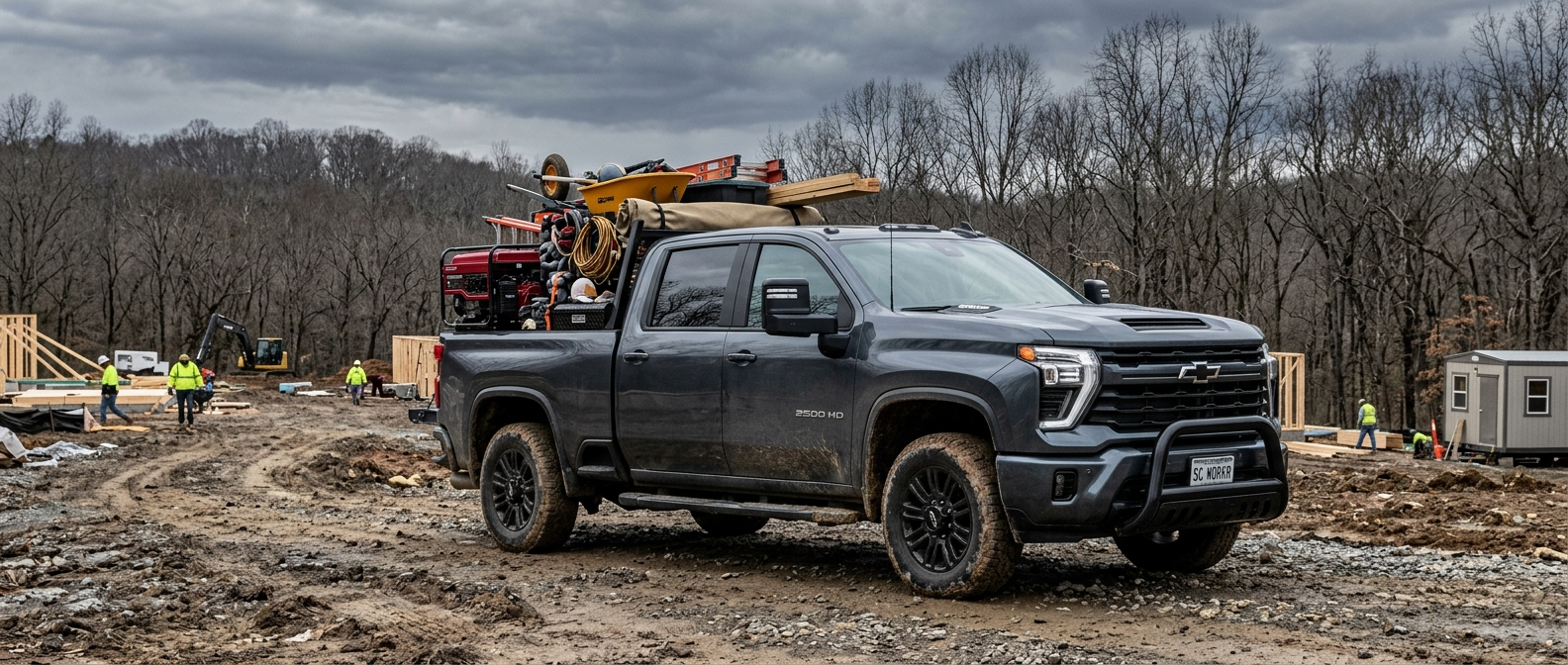
2026 Chevrolet Silverado 2500HD on a South Carolina job site loaded for work before winter

How to Set Up Your 2026 Silverado 2500HD for Heavy-Duty Work Before Winter

In this article What You Need Before You Start Setting Up Your Silverado 2500HD Step by Step Your Winter-Ready Silverado 2500HD Checklist A Note on the Tradeoff If you run a heavy workload out of Winnsboro or anywhere along the I-77 corridor, you know the window between now and hard winter is short, and you can't afford to fumble it. Fairfield County winters run on ice more than snow. The South Carolina State Climate Office's records for Winnsboro list eight documented ice storm events, and the northern Midlands counties sit right in the zone where ice accumulation runs heavier than it does down in Columbia. When that freezes overnight and your 2026 Silverado 2500HD has to be on a job site by 6 a.m., a truck that wasn't staged right becomes a problem you can't fix in the dark. Good news is a properly staged 2026 Silverado 2500HD runs genuinely overbuilt for what a South Carolina winter throws at it. Getting there takes about two hours of focused work and one service visit. The full sequence is below. The single most important step before winter is a Duramax diesel pre-flight: confirm oil viscosity, verify glow plug function, and check your diesel fuel system for water contamination before temperatures drop below freezing. What You Need Before You Start You won't need a heavy toolkit for this one, since most of the work is checking and configuring, but you'll still want a handful of items within reach before you start so you're not stopping halfway through to dig for a gauge or a bottle of additive. Have these on hand before you begin. Item Spec / Detail Why It Matters for the 2500HD Oil viscosity check SAE 15W-40 above 0 degrees F; SAE 5W-40 full synthetic below 0 degrees F Duramax 6.6L turbo-diesel holds 10 quarts; wrong viscosity starves the turbocharger on cold starts Battery load test Diesel cranking draws close to 500 amps cold vs ~350 amps warm Cold weather exposes a weak battery fast on a compression-ignition engine Diesel fuel anti-gel additive Winter-blend diesel typically available by November Diesel can gel between 10-15 degrees F; summer blend stored in tanks is the risk Trailer wiring check 7-way connector + any accessory camera cabling Corrosion in connectors causes false trailer brake faults Tire tread depth gauge Service limit is 2/32 in.; all-seasons perform best above 4/32 in. Fairfield County ice events put tread depth to real use Owner's manual or Trailering App In-Vehicle Trailering App available on the 2026 HD Pre-departure checklist lives here; use it Schedule a pre-winter service check with our team before you dive into this sequence. A trained tech can run the glow plug diagnostic and the battery load test in one visit, and those two items alone account for most winter cold-start failures on a diesel. Setting Up Your Silverado 2500HD Step by Step Our team runs this exact sequence from the service counter whenever a customer brings a 2500HD in ahead of winter, and it only pays off when you work the steps in order, so plan to go top to bottom and leave nothing for later. Work through it in order. Each step depends on the one before. Step 1: Confirm your engine oil viscosity for the temperature range ahead. Chevrolet specifies SAE 15W-40 for the Duramax 6.6L turbo-diesel above 0 degrees F, and SAE 5W-40 full synthetic once temperatures fall below 0 degrees F. Winnsboro's recorded low sits at -3 degrees F, so you're not dealing with a theoretical edge case. Run 15W-40 into a hard freeze and the oil thickens before it reaches the turbocharger on startup, which is right where the wear shows up. Check what's in the crankcase now. If you're within 1,000 miles of an oil change anyway, knock it out with the correct cold-weather viscosity and forget about it until spring. Step 2: Have your glow plugs and batteries load-tested. A diesel relies on compression heat to ignite its fuel, where a gas engine would use a spark. Glow plugs pre-heat the combustion chambers so that happens cleanly in cold air. The 2026 Silverado HD's ECM holds off cranking until the plugs reach target temperature, so a "Wait to Start" indicator in cold weather is nothing to worry about. A truck that cranks hard, runs rough, or throws glow plug fault codes (DTC P0671 through P0678) is a different story. Have the plugs tested before the cold sets in. Cold cranking a diesel draws close to 500 amps versus around 350 amps on a warm engine, so a battery that passed your last test might not survive a cold-morning one. A 720 cold-cranking-amp heavy-duty battery is specified on the Work Truck trim, so verify yours meets that rating. Step 3: Know the Duramax cold-start warm-up posture. Warm-up is the step that's easy to overdo and just as easy to skip, and both directions cause problems. Chevrolet's guidance for the 6.6L Duramax diesel calls for roughly two to three minutes of idle below freezing before you load it hard. Not thirty minutes. Not one. Two to three. Prolonged low-load idling can foul injectors over time, which does as much damage as skipping the warm-up altogether. Enable the elevated idle function on your 2500HD in sustained cold weather. Then ease into the first mile. The Duramax earns those extra minutes; the gas 6.6L V8 needs only thirty to sixty seconds. If you run a Silverado 1500 alongside the HD, remember the gas engine warm-up protocol is different and shorter, so don't put the diesel schedule on it. Step 4: Address your diesel fuel system for winter. Diesel fuel can gel between 10 and 15 degrees F depending on the blend. Most pumps at Winnsboro-area stations will be running winter-blend diesel by November, which carries a lower pour point. The risk hides in stored summer-blend fuel, the kind sitting in farm or job-site tanks that never turned over. If you pull from a bulk tank, treat it with a diesel anti-gel additive now. Check your primary and secondary fuel filters too. Water contamination in the fuel system is a common cause of hard starting that gets blamed on glow plugs. On these engines the filter heads are the first place water collects. If your filter hasn't been swapped in two service intervals, now's the time. Step 5: Verify your trailering setup and camera system. The 2026 Silverado 2500HD offers up to 14 available camera views through 8 available cameras, including Hitch View, Bed View, Transparent Trailer View, and Rear Vision Camera with Hitch Guidance. All of that is useless if your trailer connector is corroded in the 7-way socket. Cold contracts metal. A connector that made intermittent contact in October will fail in January, and when it goes, your Integrated Trailer Brake Controller loses communication with the trailer brakes. Unplug the 7-way connector now, inspect for green oxidation, and clean it with electrical contact cleaner (an inexpensive spray can from any parts counter). If the rubber seal is cracked, replace the socket. Browse our 2026 Silverado 2500HD inventory to see trims and available trailering packages if an upgrade before year end is on your mind. While you're at it, test every trailer light circuit. Pull up the In-Vehicle Trailering App on the 2026 HD's infotainment screen. It carries step-by-step pre-departure checklists and lets you build a custom trailer profile so the system knows what it's pulling. If you haven't set up a trailer profile yet, do it now while you're not in a hurry. Step 6: Check tires and tire pressure. Check your cold inflation pressures against the door jamb label, not the tire sidewall maximum. The 2026 Silverado 2500HD on 17-inch wheels is capped at 14,500 pounds of conventional towing regardless of engine, and that cap comes from tire load rating as much as the powertrain. Underinflation is the leading cause of tire failure on work trucks. Cold air contracts, so for every 10 degrees F drop in ambient temperature, tire pressure drops approximately 1 PSI. A tire that was at spec in September can read 3 to 4 PSI low by December. Then check tread depth. The South Carolina Department of Public Safety notes that even four-wheel-drive vehicles encounter trouble on icy roads, so don't assume the drivetrain compensates for worn rubber. Step 7: Configure your 4WD and traction systems before you need them. Fairfield County gets ice, not snowpack, which means you won't have days of warning. Confirm that your four-wheel-drive engages and disengages cleanly across all modes. Check that your Automatic Locking Rear Differential (standard on the Work Truck trim) activates as expected. If your 2500HD has StabiliTrak with Trailer Sway Control, verify that Electronic Stability Control is enabled, not in the driver-off mode you might have selected for a job-site task. The South Carolina Department of Public Safety specifically calls out ESC as a system that should stay on in winter conditions. Tip: The easiest step to get wrong is the Duramax warm-up. Two to three minutes below freezing, then ease into the first mile. That's it. Running the diesel at extended idle for thirty minutes before a cold-morning haul fouls injectors over time. Set a two-minute timer on your phone, let the system build oil pressure and bring the lower cylinders up to operating temperature, then move. The truck will tell you if it isn't ready. The 2026 Silverado 2500HD with the Duramax 6.6L turbo-diesel produces 975 lb-ft of torque and tows up to 20,000 pounds conventionally when properly equipped with the Max Trailering Package, but those numbers assume a fully serviced, correctly configured truck, not one carrying deferred maintenance into January. Your Winter-Ready Silverado 2500HD Checklist Keep this checklist somewhere you'll actually reach for it, because a proper winter setup only holds up when you run the same list every single fall, and leaning on memory at 5 a.m. is how the small items slip. Print this. Keep it in the console. Run through it every November. Hand this list to the service advisor when you check in. Step What to Check Status Engine oil Viscosity correct for expected low temps (15W-40 above 0 degrees F / 5W-40 below 0 degrees F) [ ] Glow plugs No fault codes P0671-P0678; plug wiring intact [ ] Batteries Load test passes at 720+ CCA rating; terminals clean [ ] Duramax warm-up 2-3 min below freezing before heavy load; elevated idle enabled [ ] Fuel filters Primary and secondary filters serviced; no water contamination [ ] Diesel fuel supply Winter-blend or treated with anti-gel additive [ ] 7-way trailer connector Clean, no oxidation, rubber seal intact [ ] Trailering App Trailer profile loaded; pre-departure checklist reviewed [ ] Trailer brake controller Communicates correctly with trailer; no fault codes [ ] Tire pressure Checked cold vs door-jamb spec [ ] Tire tread Above 4/32 in. on all corners [ ] 4WD engagement All modes engage and disengage cleanly [ ] ESC / StabiliTrak Enabled (not in driver-off mode) [ ] Run all of it and you've covered the full sequence. Two hours of your time now means the truck doesn't fail you at 5:30 a.m. in December when it's 28 degrees F on US 321 and you've got material to move before the ground freezes. Schedule Your Winter Service Check A Note on the Tradeoff We'll be straight with you on this one, because the 2026 Silverado 2500HD is more truck than a lot of jobs actually call for, and the right answer comes down to what you tow week to week and where you spend your miles. If your heaviest weekly tow is a tandem-axle landscape trailer under 8,000 pounds and you spend most of your time on paved roads, the Silverado 1500 does that job with better fuel economy and a lower running cost. The 2500HD earns its size when you're pulling loads above 10,000 pounds, running a fifth-wheel or gooseneck, or working in conditions that ask something more from the chassis and drivetrain. Fairfield County's agricultural and construction customers know exactly where that line falls. If you're on the right side of it, the HD is the right answer. By the Wilson Chevrolet Team | November 2026 Frequently Asked Questions Does the 2026 Silverado 2500HD Duramax diesel need extra warm-up time in winter? Yes, specifically below freezing. Chevrolet's guidance for the 6.6L Duramax diesel is approximately two to three minutes of idle below freezing before heavy-load operation. The gas 6.6L V8 in the same truck needs only thirty to sixty seconds. The difference comes from diesel physics: the engine ignites fuel through compression heat rather than spark, and glow plugs pre-heat the combustion chambers. The ECM holds off cranking until plugs reach target temperature, so a "Wait to Start" indicator in cold weather is normal and expected. Keep warm-up to two to three minutes; extended idling beyond that can foul injectors over time. What is the conventional towing capacity of the 2026 Silverado 2500HD with the Duramax? When properly equipped with the Duramax 6.6L Turbo-Diesel V8 and the Max Trailering Package, the 2026 Silverado 2500HD tows up to 20,000 pounds with a conventional hitch. On a gooseneck or fifth-wheel hitch, that figure rises to 22,050 pounds. The gas 6.6L V8 version tops out at approximately 16,000 pounds conventional. Those ratings assume a correctly configured and properly serviced truck; deferred maintenance on fuel filters, glow plugs, or batteries reduces real-world reliability at high loads, especially in cold weather. View Current Silverado HD Offers Wilson Chevrolet 798 us hwy 321 N BUSINESS, Winnsboro, SC 29180 (803) 402-4233