





Blog

Fairfield County Roads: How the Trailblazer's Standard Safety Tech Works for New Drivers

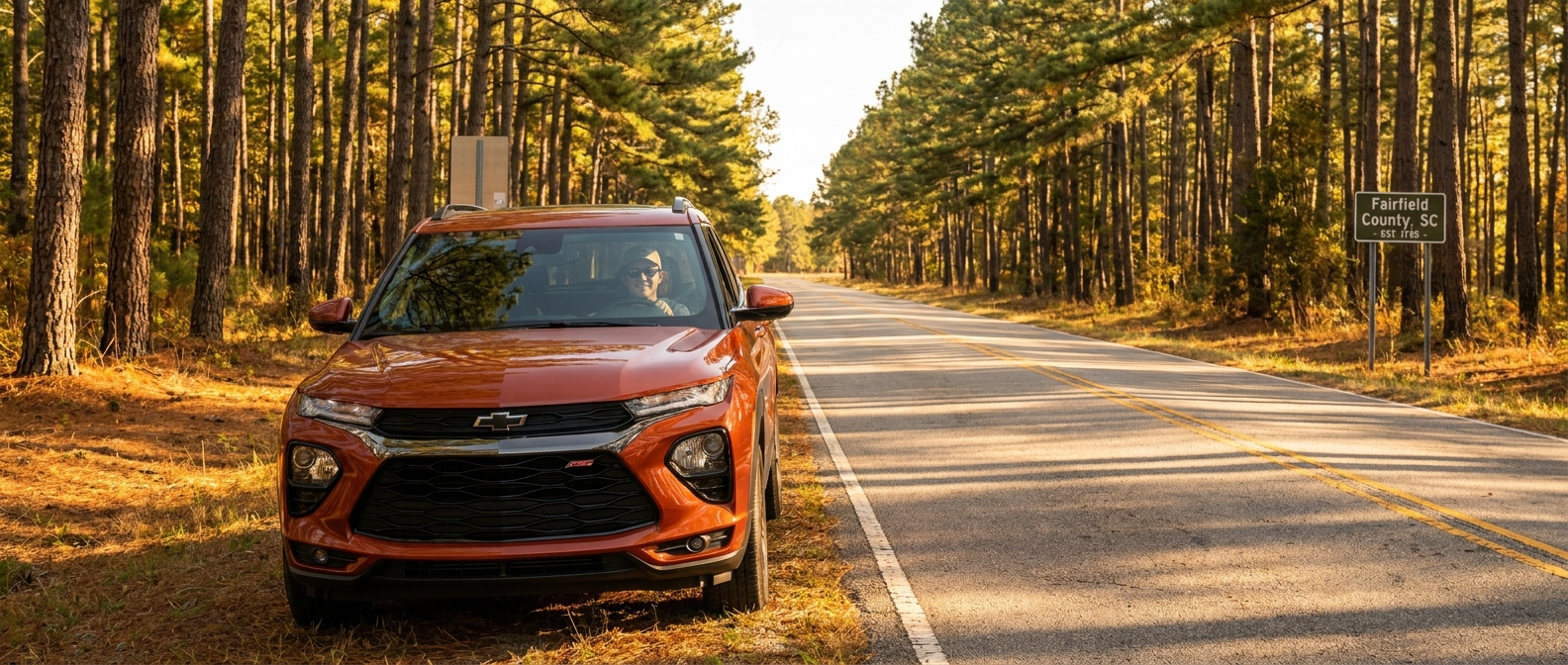
2026 Chevrolet Trailblazer on a rural Fairfield County SC road, ideal safety tech for new drivers

South Carolina now requires new teen drivers to hold a beginner's permit for at least 180 days before advancing to a restricted license. Six months of supervised time on the road ends right when they start driving alone. The 2026 Chevrolet Trailblazer earns your attention because every safety system that matters for a new driver comes standard on every trim. No package upgrades required.

Browse the 2026 Trailblazer at Wilson Chevrolet

A fair question before buying is which Chevy has Teen Driver built in. For the Trailblazer, all of them do. The feature works on day one of the restricted license, not just if you happen to buy the right package.

What the Trailblazer Does and Doesn't Do in New-Driver Situations

The six systems in Chevy Safety Assist are active on every drive, and Teen Driver mode locks them on so they can't be switched off while that key fob is in use. Think about each system in terms of what it handles and what it leaves to you. The table below sorts it out.

SituationDo rely on thisDon't expect this
Approaching traffic too fastForward Collision Alert warns with audible + visual signalThe system to brake for you every time (Automatic Emergency Braking assists, but the driver still steers)
Drifting toward lane lines on I-77Lane Keep Assist applies gentle steering correctionThe system to hold the lane indefinitely like cruise control
Backing out of a tight parking spaceHD Rear Vision Camera shows a clear viewThe camera to catch what's outside the camera's field of view
Losing track of following distanceFollowing Distance Indicator shows gap in seconds on the dashThe indicator to stop the car (it only informs, it doesn't brake)
Turning on high beams on dark rural roadsIntelliBeam automatically toggles high/low based on oncoming trafficAnything beyond headlight switching. It doesn't see deer
Walking up to the car distractedFront Pedestrian Braking can apply brakes for detected pedestriansDetection of every pedestrian in every light condition
Driver not buckledBuckle to Drive delays shifting out of Park for 20 secondsA workaround-proof system. Teens figure out workarounds

The table above gives you the straight version. These systems reduce the margin for the predictable mistakes a new driver makes. They don't replace the driver, not even close.

Teen Driver Mode: The One Feature That Changes the Whole Conversation

Teen Driver mode reshapes how a family hands over the keys, because it ties every limit you set to a specific fob and then reports back on what actually happened behind the wheel. Sit in the infotainment system before you hand over the keys. Walking through the settings first is the step that's easy to skip.

See current Trailblazer inventory at Wilson Chevrolet

Teen Driver ties every limit you set to a specific key fob. When that key starts the car, the settings activate automatically. Your teen doesn't see a prompt and doesn't get an option to skip it. Set it up in five steps.

  1. Go to Settings on the 11-inch touchscreen, then select Vehicle, then Teen Driver.
  2. Create a four-digit PIN that only you know. You'll need it to view the report card and change any setting.
  3. Register the key fob your teen will use as the Teen Driver key.
  4. Set a speed warning threshold (the system chimes and logs it) and optionally enable a hard speed cap. You can also set an audio volume limit.
  5. Enable Buckle to Drive so the car won't shift out of Park until the driver is buckled. There's a 20-second delay and an alert if they try to skip it.

The PIN stays with you. Your teen never sees it.

After each drive, go back to the Teen Driver menu and pull the report card. It shows distance driven, top speed reached, wide-open throttle events, and any AEB or ABS activations. The data turns a vague conversation into a specific one.

Where this matters most locally is I-77 through Fairfield County, one of the straightest, least congested stretches of highway in South Carolina. The 70 mph posted limit is easy to drift past without noticing, and SC Highway Patrol actively works that corridor. A new driver on I-77 who's never held a sustained highway speed will feel the temptation to push past that limit. The speed warning in Teen Driver makes that moment something you can talk about later. It doesn't stop the car, but it does create a record.

Explore financing options for the Trailblazer

Worth knowing: Available options like Lane Change Alert with Side Blind Zone Alert and Rear Cross Traffic Alert are not standard on any 2026 Trailblazer trim. They come in an add-on package. Confirm on the window sticker of the specific vehicle you're considering, because "available" means different inventory units will have different configurations.

Matching the Right Trim to Where Your New Driver Actually Goes

The base LS carries every safety system listed above as standard, and the tradeoff is that it's FWD only (the 1.2L engine) with no remote start and no keyless entry. If your new driver sticks to US 321 and local Winnsboro roads, the LS covers it. If they're regularly running the Equinox up I-77 toward Columbia or Charlotte, AWD availability on the LT and above is worth a conversation, particularly as we move into the wetter months of late fall and winter.

The Trailblazer earns a 5-star frontal crash rating from NHTSA and carries zero recalls on file as of the 2026 model year. Those two numbers are the safety baseline. The tech features described here sit on top of it, not instead of it.

See Current Trailblazer Offers

One more thing worth saying plainly. The Trailblazer's standard safety tech is a good fit for a new driver in Fairfield County, but a used Trailblazer with an older trim that predates some of these standard inclusions is a different vehicle. If you're looking at used options, ask us to confirm which features are actually on that specific car.

Wilson Chevrolet

798 us hwy 321 N BUSINESS, Winnsboro, SC 29180

(803) 402-4233

Recommended Posts

2027 Chevrolet Equinox parked at Lake Wateree South Carolina on a sunny fall day

4 Chevrolet Models Worth Considering for Seniors Driving Around Lake Wateree

In this article The Ranking at a Glance 2027 Equinox. Everyday Ease on Two-Lane SC Roads 2027 Trailblazer. For the Senior Who Wants to Keep It Small 2027 Trax, Most Straightforward Option for Easy Parking 2027 Traverse, When Grandkids Come to the Lake Every Weekend If you're spending serious time on the roads between Winnsboro and Lake Wateree, the right vehicle isn't just about comfort. Step-in height matters when your knees aren't cooperating, clear sightlines matter on the two-lane SC routes that snake down through Fairfield County, and you want a cabin that doesn't fight you every time you load gear. Plenty of drivers in this county reach a point where the sedan that served them for years just isn't working anymore. The model that comes up most often as the right answer is the 2027 Chevrolet Equinox. Entry is genuinely easy, the seat sits where you want it, and the feature set doesn't need a manual. But it isn't the only right answer, and the pick depends on what you need. Four Chevrolet models earn a real look here, and we've ranked them straight. The Ranking at a Glance Rank Model Best For Standout Spec 1 2027 Equinox LT Daily driving, errands, I-77 legs 40.9 in. front legroom, standard heated seats, 11.3-in. touchscreen 2 2027 Trailblazer LT Smaller garage, solo trips 174 in. long, up to 31 mpg combined (EPA), AWD available 3 2027 Trax LT Tightest budget, easiest parking 30 mpg combined (EPA), 41.9 in. front legroom 4 2027 Traverse LT Grandkids, longer lake runs 42.6 in. front headroom, 98 cu ft max cargo, 5,000-lb tow capacity 2027 Equinox. Everyday Ease on Two-Lane SC Roads The Equinox earns the top spot because it hits the practical sweet spot for the kind of everyday driving seniors do around the lake, with easy entry and a feature set that stays simple, though it gives up outright towing muscle to hold that balance. Chevrolet lists 40.9 inches of front legroom and a seat height that lets most people step in without contorting or bracing against the doorframe. Those details matter more than they sound when you're making a daily run down US 321 or heading out to Lake Wateree State Recreation Area for the morning. What really sets this one apart goes past the entry. The 11.3-inch touchscreen is large enough to read without squinting, and the standard heated front seats and heated steering wheel on the LT trim earn their keep every October morning in Fairfield County. The EPA rates the 2027 Equinox at 27 mpg combined, which keeps fuel costs reasonable on the mixed city-and-country driving this area throws at you. The drawback worth naming is towing. The Equinox won't pull a boat. Chevrolet rates it for 1,499 pounds, which covers a small pontoon on a trailer in a pinch and not much more. If your Lake Wateree trips involve a serious rig, read the Traverse entry below. For everything else, the Trailblazer and the Equinox sit on different ends of the size spectrum, and the Equinox gives you noticeably more interior room and a smoother highway feel. 2027 Trailblazer. For the Senior Who Wants to Keep It Small The Trailblazer makes sense for the driver who wants a smaller footprint, a size that tucks into the garage without a fight, and strong fuel numbers for frequent short trips, though you trade away some cabin room to land all of that. Some folks in Winnsboro don't want a mid-size anything. They want something that fits comfortably in their garage, parks without drama on the square, and still has enough capability for a run to Sumter National Forest or a quick weekend away. The 2027 Trailblazer slots right into that. At 174 inches long, it's the shortest of the four options here. The EPA rates the Trailblazer at 29 to 33 mpg on the highway depending on engine and drivetrain, which makes it easy to justify for shorter, frequent trips. AWD is available if you want it. The limitation is cabin space. Behind the rear seat you get 25.3 cubic feet, tighter than the Equinox. Two adults and a weekend's worth of gear fit comfortably. Three adults, and it gets tight. Buying caution: On all four models here, verify which trim gives you blind-spot monitoring before you commit. Blind-spot monitoring is a meaningful safety feature for lake-area roads, and it isn't always standard on the base trim. Our team can walk you through exactly which trim level includes it. The 2027 Trailblazer's available AWD and EPA-estimated 31 mpg combined (1.3L FWD) make it the most fuel-efficient and weather-ready compact option in the Chevrolet lineup for senior drivers. 2027 Trax, Most Straightforward Option for Easy Parking The 2027 Trax is the smallest of the group and the easiest to slot into a tight parking spot or driveway, though it comes front-wheel drive only, which suits paved roads more than loose ground near the lake access points. Chevrolet's ECOTEC 1.2L turbo delivers an EPA-estimated 30 mpg combined. Front legroom is generous at 41.9 inches. The infotainment screen steps up to 11 inches on the LT trim, a meaningful jump from the base 8-inch unit. The Trax has one firm limit. The Trax comes front-wheel drive only, full stop. For dry Fairfield County roads and paved lake access points, that's usually fine. But if you're regularly on dirt paths or loose gravel near Lake Wateree, or you want AWD for wet-weather confidence, the Trax isn't your pick. The Trax also gives the most modest highway ride of the four. Fine around town, fine for a run up I-77 to Columbia. On longer hauls, it gets busy. See Our Current Chevrolet Offers 2027 Traverse, When Grandkids Come to the Lake Every Weekend The 2027 Traverse is the one to look at seriously when your Lake Wateree trips regularly carry grandkids, adult children, or friends plus a real boat trailer, though the size means you'll feel it every single time you park in town. Chevrolet builds it with 42.6 inches of front headroom and up to 98 cubic feet of maximum cargo space. Everyone fits in that kind of room, with gear left over. Towing is where the Traverse separates itself, pulling 5,000 pounds when properly equipped, which covers a real boat trailer. That capability sits in a different category than the other three options here, and for some Lake Wateree regulars it's the spec that settles the decision. The EPA rates the 2027 Traverse at 22 mpg combined with FWD, the expected trade-off for a vehicle this capable. The 17.7-inch infotainment touchscreen with Google Built-In gives you the most tech-forward cabin of the group, with easier navigation, sharper maps, and a screen big enough that you're not leaning forward to read it. The tradeoff comes down to size. At just over 204 inches long, this is a vehicle you need to be comfortable parking. In town, that friction is real. On the open roads between Winnsboro and the lake, it never comes up. We keep inventory across the Chevy lineup here in Winnsboro. If you want to step into any of these and feel how the entry, the seat, and the sightlines really work for you, our team is here for exactly that. Explore Financing Options at Wilson Chevrolet Wilson Chevrolet 798 us hwy 321 N BUSINESS, Winnsboro, SC 29180 (803) 402-4233

2026 Chevrolet Camaro SS in Panther Black parked in a Winnsboro SC garage ready for winter storage

What Does a Camaro Need Before Winter Storage in Winnsboro, SC?

In this article What Should You Do to the Oil and Fluids Before You Park? Should You Fill the Tank or Run It Low Before Storage? What's the Right Way to Handle the Battery and Tires? Is There Anything Special About Storing the Camaro Given It's Now Discontinued? Your 2024 Camaro doesn't need a blizzard to earn a proper storage prep. What it needs is the right sequence of steps. Winnsboro winters run milder than the Midwest forums where most storage advice gets written, but January lows still average around 30 degrees Fahrenheit, and the Camaro is now a discontinued collector car. The short list is simple. You want fresh oil, a treated full tank, a battery tender, tires at 40 psi, and a breathable car cover. Together they cover the usual Fairfield County storage window, November through late February. Book your pre-storage service at Wilson Chevrolet's service center before temperatures settle in. What Should You Do to the Oil and Fluids Before You Park? Change the oil before you park the car, not in the spring, because used motor oil carries combustion byproducts and trace moisture that would otherwise sit against your engine's internals for months, and while you're under the hood give the brake fluid and coolant a quick once-over too. Fresh oil is cheap protection against that. Here's the spec detail that matters for the 2024 Camaro: Trim / Engine Engine Oil Spec Capacity (with filter) LT (3.6L V6) 5W-30 dexos1 Gen 2 full synthetic ~6 qt SS (6.2L LT1 V8) 0W-40 dexosR full synthetic ~10 qt ZL1 (6.2L LT4 supercharged V8) 0W-40 dexosR full synthetic ~10 qt The V8 spec is the one that catches people. The 6.2L LT1 and LT4 engines call for 0W-40 dexosR, a different oil than the 5W-30 dexos1 the V6 uses. Drop the lighter oil into a V8 Camaro before a long sit and you've made the one fluid mistake worth avoiding. Chevrolet lists the 0W-40 dexosR as the factory fill for the LT1 and LT4 across all model years of the sixth generation. Beyond the engine, check your brake fluid. The 2024 Camaro calls for DOT 4, and if yours has gone more than a few years, storage is a natural moment to have it inspected. Brake fluid absorbs moisture over time. DOT 4 holds a higher dry boiling point than DOT 3, specifically because these cars push serious heat through the rotors. If you're running a ZL1, one detail is worth knowing. The supercharged LT4 has a separate intercooler coolant circuit, and it sits outside the main engine coolant loop. Have our service team check that level separately before you park it. Explore financing options if you're thinking about adding a second vehicle while the Camaro rests Browse the Chevy Equinox for everyday driving while your Camaro is stored Schedule Pre-Storage Service Should You Fill the Tank or Run It Low Before Storage? Fill it right to the top, because a full tank leaves minimal air space above the fuel, which means less moisture condensing inside the tank, then add a fuel stabilizer rated for ethanol-blended gasoline before you shut it down. Modern pump gas contains up to 10% ethanol, and ethanol is hygroscopic. It pulls moisture from the air. Untreated fuel left sitting for three or four months can degrade, leaving varnish deposits in the injectors and fuel lines. The Winnsboro storage window runs shorter than most northern guides assume. Park around Thanksgiving, pull it back out for a late-February run toward the Lake Wateree area, and you're realistically looking at 10 to 14 weeks, give or take a weekend. A good fuel stabilizer is rated to keep treated fuel fresh for up to 12 months, so you'll sit well inside the margin. Run the car for a few minutes after adding stabilizer so the treated fuel reaches the injectors. Don't idle it for 30 or 40 minutes trying to "charge the battery." Charging the battery is a different step, and idling alone won't bring the engine fully up to operating temperature anyway. A treated, full tank plus a battery tender are the two steps that most directly determine how your Camaro comes out of storage in the spring. What's the Right Way to Handle the Battery and Tires? Keep the battery on a maintainer and set the tires a little high before you park, and you'll sidestep the two problems a stationary Camaro runs into over a Carolina winter, a slow-draining battery and flat-spotted tires. Don't disconnect the battery and walk away. Connect a battery tender, also called a trickle charger or maintainer. Why does a tender matter in a mild climate? A disconnected battery in a cool garage will self-discharge over two to three months, and starting a deeply discharged battery puts stress on the charging system, so the tender holds a full charge continuously without overcharging it. Owners who store their cars every year treat this as standard practice. South Carolina's mild winters mean your garage won't hit the brutal cold that accelerates discharge in Minnesota. But the 2024 Camaro still runs modern electronics, body-control modules, and an active suspension system on ZL1 models, and those systems hold small parasitic draws. A tender wipes that out entirely. On the tires, inflate to 40 psi before parking, a touch above the standard door-placard pressure. Flat spots are the enemy here. A car left stationary for weeks develops them where the tire meets the ground, and higher pressure spreads the load across the contact patch to cut the risk. You won't need jackstands for a 10-to-14-week Carolina window, though the 40 psi is still worth doing. Fresh oil change using the correct spec (0W-40 dexosR for V8 cars, 5W-30 dexos1 for the V6) Full tank with ethanol-compatible fuel stabilizer, engine run briefly to circulate it Battery tender connected and plugged in throughout storage Tires inflated to 40 psi before parking Breathable car cover (not plastic) to protect paint without trapping moisture Is There Anything Special About Storing the Camaro Given It's Now Discontinued? Yes, and it's the kind of thing we'd flag for a friend who just bought a 2024. Chevrolet confirmed in 2023 that the 2024 model year was the final year for the sixth-generation Camaro, the last one rolled off the line in December 2023, and no 2025 or 2026 exists. What you're parking is the last of its kind, which nudges the whole job from routine maintenance toward preservation. So storage now does double duty, protecting condition as much as keeping systems healthy. A few extra steps pay dividends in resale value and long-term condition: Use a breathable fabric car cover, not a tarp. Trapping moisture under plastic is the fastest way to cause paint problems and interior mildew. Place cedar blocks or dryer sheets inside the cabin to deter rodents. South Carolina is warm enough that critters are active later into the fall than they are up north. Block the exhaust tips with a cloth rag (and leave yourself a note on the steering wheel so you don't forget it's there in the spring). Wash and wax thoroughly before covering. Putting a dirty car under a cover lets contaminants sit against the clear coat for months. The Collector's Edition 2024 Camaros (Panther Black, serialized builds) are already drawing attention as instant collectibles. Even a standard 2024 SS or ZL1 is the newest Camaro that will ever exist until Chevrolet announces something new. Treat it accordingly. Frequently Asked Questions What oil does a 2024 Camaro SS need for winter storage? The 2024 Camaro SS uses a 6.2L LT1 V8 engine, and Chevrolet specifies 0W-40 dexosR full synthetic oil for that engine. That's a heavier specification than the 5W-30 dexos1 used in the V6 and four-cylinder trims. Change the oil before parking, not in the spring, so fresh oil sits against your engine internals during storage. Capacity for the 6.2L LT1 is approximately 10 quarts with a filter. Do I need to do anything special for winter storage in South Carolina versus colder states? Winnsboro winters are milder than northern storage guides assume. January lows average around 30 degrees Fahrenheit and hard freezes are rare. That means a shorter storage window (typically 10 to 14 weeks) and no need for jackstands, which are more common in regions with six-month winters. That said, the core steps remain the same: treated full tank, fresh oil, battery tender, tires at 40 psi, and a breathable cover. Don't skip any of them just because the winters are shorter. Should I start my Camaro occasionally during winter storage? Only if you can drive it at least 10 to 20 miles to bring the engine fully to operating temperature. Briefly idling a stored car introduces moisture into the exhaust system and crankcase without burning it off. If you can't drive it, it's better to leave it undisturbed with a battery tender connected than to idle it for a few minutes and put it back. This is one of the most consistently debated points in Camaro owner communities, and the short-idle approach does more harm than good. View Current Chevrolet Specials Wilson Chevrolet 798 us hwy 321 N BUSINESS, Winnsboro, SC 29180 (803) 402-4233

2026 Chevrolet Corvette Stingray on an autumn South Carolina road near Winnsboro

Your 2026 Corvette Fall Prep Checklist for Columbia-Area Drivers

Right now, this October, you're inside one of the best windows of the entire year to drive a Corvette across the South Carolina Midlands. Daytime highs are averaging in the mid-70s, the humidity has finally eased, and the roads around Winnsboro and down I-77 toward Columbia stay dry more often than not. Fall here isn't storage season; it's driving season. One catch separates a great fall run from a frustrating one, and we rarely hear it discussed for South Carolina specifically. The Michelin Pilot Sport 4S tires on your 2026 Corvette Stingray carry a hard 40 degrees Fahrenheit compound threshold. Once overnight lows drop below that mark and stay there, grip degrades and pressure readings fall. Handle the six items on this checklist before each fall outing, and you'll spend the season doing what this car was built for. Browse our current Corvette inventory at Wilson Chevrolet What Goes on the Checklist? Work through these six items in order, and you'll have the routine handled fast. The first three take about ten minutes in the driveway, and the last three happen from the driver's seat before you pull onto the road. Tire pressure (cold, before you move). The door-sticker spec for the 2026 Corvette is 30 PSI cold. In October in the Columbia area, nighttime lows can dip into the mid-to-upper 40s, and tire pressure drops roughly 1 PSI for every 10-degree Fahrenheit fall in ambient temperature. Check pressure before the car has moved an inch. A tire that sat overnight at 48 degrees Fahrenheit and read 30 PSI in September might show 28 or 29 PSI on a cooler morning. You'll want to catch two PSI under spec on a rear-wheel-drive car with 490 horsepower behind you in the driveway, and that's a driveway job rather than an on-ramp surprise. Tire compound temperature awareness. Michelin doesn't recommend using the Pilot Sport 4S below 40 degrees Fahrenheit. The compound stiffens as it nears that threshold, and grip measurably decreases. Our October mornings will touch the upper 40s now and then. You're not in dangerous territory at 50 degrees Fahrenheit, but if the overnight low was 44 degrees Fahrenheit and the car sat outside, give the tires five minutes of easy, steady driving before you load the throttle. Fluid levels (quick visual check). Engine oil, coolant, brake fluid. A mid-engine layout puts the reservoir access points behind the seats, so check your owner's manual for the specific caps. The job takes two minutes. Our service team sees cars arrive with brake fluid that soaked up moisture over summer heat cycles, and you'll want to sort it out before the year ends. Driving mode selection. The 2026 Corvette offers Weather, Tour, Sport, and Track modes (plus Z06/ZR1-specific variants). For a crisp, dry October afternoon over cool pavement, Tour or Sport is the right call. Weather mode trims throttle mapping and brings in the most conservative stability settings, which suits genuinely wet or cold-morning roads, especially if that morning low touched the low 40s. Don't start a fall drive in Track mode while the tires are still cold. The car won't stop you, but the tires won't thank you. Performance Data Recorder check (if equipped). If your 2026 Corvette includes the optional Performance Data Recorder, fall is when you'll want to confirm the SD card has space. Cool, clear days are prime for data-capture runs. Fill the card and you miss the shot. Visual wiper and washer fluid check. Fall leaf litter and morning dew mean you'll reach for them more than you did in summer. South Carolina October averages only about 6 rain days for the month, but when that dew or light mist shows up on a fast road, streaky wipers get your attention fast. Why These Items Matter for Fall Driving in the Midlands Schedule a pre-season service check at Wilson Chevrolet The one big local variable no generic checklist covers is the Columbia area's thermal swing, and fall drivers feel it directly. October here is genuinely dual-natured. The numbers prove it. This week, the National Weather Service recorded a 90-degree high in Columbia on a Thursday and a 46-degree overnight low the following Saturday. That is a 44-degree spread across a few days. Your 2026 Corvette's Michelin Pilot Sport 4S tires were engineered for exactly the warm, dry end of that range. The 6.2-liter LT2 V8 makes 490 horsepower at the crank (495 with the Z51 performance exhaust package), all of it going through the rear wheels via an 8-speed dual-clutch transmission. Matching that output to the grip you've actually got on a 55-degree morning versus a 75-degree afternoon is the skill this checklist supports. Skip the tire pressure check and you give up the single item that ties fall temperatures most directly to how the car behaves. The Corvette's rear tire contact patch is doing a lot of work. Under-inflated by even two PSI, the tire runs hotter at its sidewall and cooler at the tread center, which hurts both handling feel and long-term wear. Two minutes with a quality gauge (not the one on the gas station pump, calibrated more for convenience than accuracy) is time well spent. We'd make the trade every time. On the driving-mode question, we lean toward Tour on the Midlands roads around Fairfield County for the first fifteen minutes of any fall run. Some of the older two-lanes here carry a light coat of dew or leaf residue that clears up as the morning goes on. Tour keeps throttle response measured and traction intervention active without making the car feel sluggish. Once you're on I-77 and the tires have had a chance to warm, Sport finally opens up the way it should. Team note: We're not suggesting the Z51 package is mandatory for fall driving. If you have it, the electronic limited-slip differential and upgraded Brembo brakes are real advantages on variable-condition roads. If you don't, Tour mode's stability settings provide meaningful protection on a cool, damp morning. Tour mode has your back. Item Why it Matters in Fall Tire pressure (cold check at 30 PSI) Every 10 degrees Fahrenheit drop reduces pressure roughly 1 PSI; under-inflated rear tires affect contact patch on a RWD, high-output car Michelin PS4S compound temp (40 degrees Fahrenheit floor) Grip degrades below threshold; Columbia's late-October overnight lows can touch the mid-40s Driving mode (Tour or Sport for cool starts) Track mode demands warm tires; cool mornings on Fairfield County roads call for managed throttle Fluid levels (oil, coolant, brake fluid) Summer heat cycles can introduce moisture into brake fluid; fall is the right time to check Performance Data Recorder card check Clear October days are prime data-capture runs; a full card wastes the opportunity Wipers and washer fluid October leaf and dew residue creates film on the windshield; streaky wipers matter at speed Schedule a Fall Service Inspection The Print-and-Go Recap Explore Corvette financing options at Wilson Chevrolet Tape this version to the garage wall or keep it on your phone, and you've got your pre-drive routine for each October outing with your 2026 Corvette: Check cold tire pressure (30 PSI per door sticker; adjust for ambient temp if morning low was below 50 degrees Fahrenheit). If overnight low was at or below 44 degrees Fahrenheit, drive easy for the first five minutes while tires come to temperature. Confirm driving mode (Tour or Sport for cool-morning starts; Weather mode on genuinely wet or cold roads). Quick visual on fluids: engine oil, coolant, brake fluid reservoir. Wiper condition and washer fluid level (leaf season, dew, light rain). If you have the Performance Data Recorder, check your SD card has space before the run. So that's the whole list. Six items, ten minutes, and the rest of the fall is yours. Columbia-area Corvette owners have a narrow but genuinely good window between now and the point where overnight lows start sitting below 45 degrees Fahrenheit for good. The Midlands doesn't get the hard winters that force northern owners to park their C8s in October. You can drive yours well into November. Just do it on the right side of the tire compound threshold, with proper pressure and the right mode dialed in. Visit Wilson Chevrolet in Winnsboro for service, parts, and your next Corvette Frequently Asked Questions What is the recommended cold tire pressure for a 2026 Corvette Stingray? The door-sticker specification for the 2026 Corvette Stingray is 30 PSI cold, measured before the car has been driven. Cold pressure is calibrated to roughly 68-70 degrees Fahrenheit ambient. For every 10 degrees Fahrenheit the ambient temperature drops below that baseline, expect about 1 PSI of pressure loss. On a fall morning in the Columbia area where the overnight low was 48 degrees Fahrenheit, that means you'll want to check and maybe add a PSI before you pull out. When should a Columbia-area Corvette owner think about wrapping up fall driving? The Michelin Pilot Sport 4S tires on the 2026 Corvette are a max-performance summer compound that isn't recommended below 40 degrees Fahrenheit. For the Columbia, SC area, late October and November are generally still drivable, since the region's average October low sits around 55-56 degrees Fahrenheit and December is when overnight lows regularly threaten the 40-degree mark. Once overnight lows begin touching 44 degrees Fahrenheit or below on a regular basis, plan outings around midday warmth or consult your Wilson Chevrolet service center about options for extending your season responsibly. See Current Chevrolet Specials Wilson Chevrolet 798 us hwy 321 N BUSINESS, Winnsboro, SC 29180 (803) 402-4233