





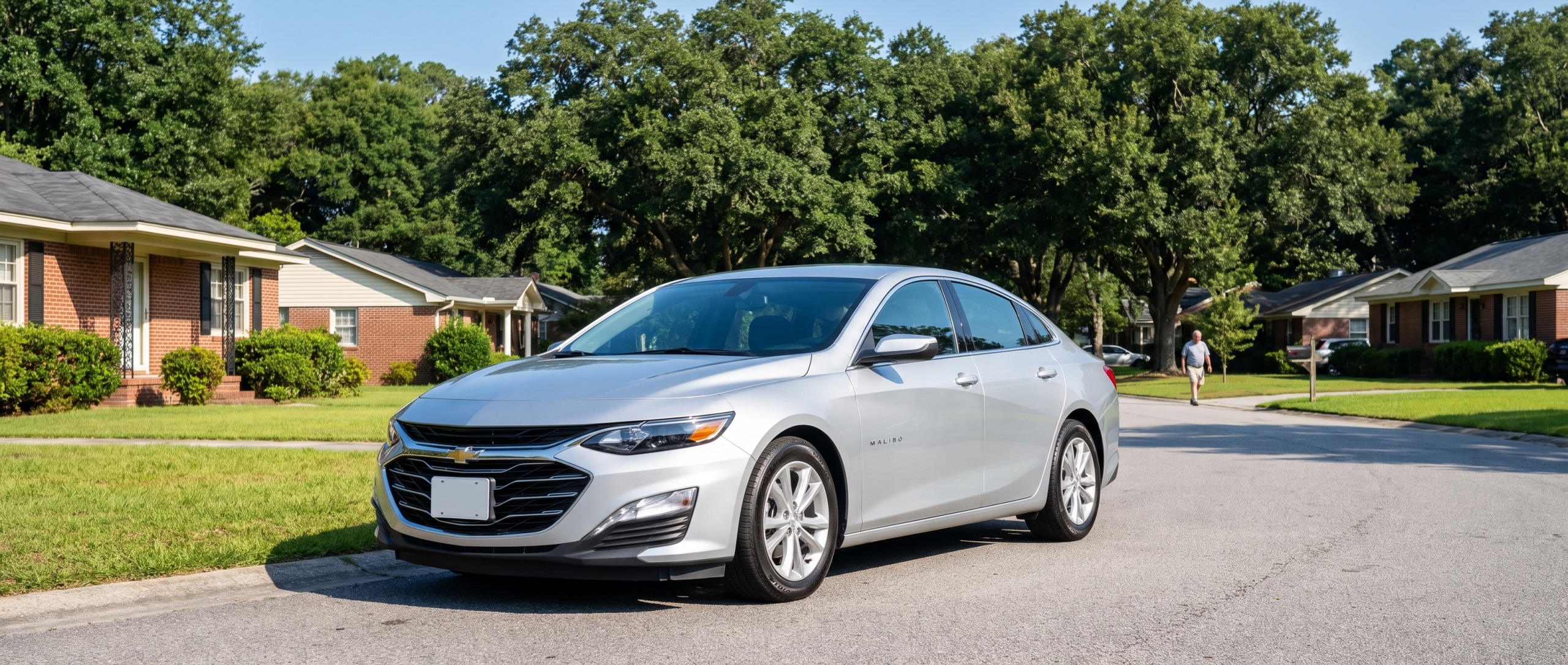
We’ll admit the title is an exaggeration. Barely. Students come through our service center at Wilson Chevrolet having bought a used Malibu on excitement and a low sticker price, then learn they picked one of the recall-heavy early years of the seventh generation. The Malibu really is a smart commuter sedan for students running the I-77 corridor to Midlands Technical College. It’s comfortable, it sips fuel, and used copies are plentiful right now because Chevrolet discontinued the nameplate after the 2025 model year. Not every year is created equal, though. Look at a few things before you sign anything.
What’s Actually Going On with the Malibu’s Model-Year Divide?
The seventh-generation Chevrolet Malibu (2016-2025) is the one you’ll find on every used lot in Fairfield County and the Columbia area right now, and most of it is a smart buy, but the label hides a real spread, because Chevrolet made meaningful mechanical and safety changes across that span and NHTSA opened recalls on specific years. So knowing those years cold before you shop pays off.
Here’s the quick diagnostic table.
| Model Years | What Changed | Key Recalls (NHTSA-documented) | Buyer Verdict |
|---|---|---|---|
| 2016-2018 | Launch years, 1.5T + optional 2.0T, Android Auto/CarPlay wired | Per NHTSA, 9 recalls on 2016 alone; PPS airbag calibration defect (2016-2018) | Proceed with caution; verify all recall work is completed |
| 2019-2020 | New CVT (smoother than prior transmission), revised front end | Rear seat belt retractor recall covers 2016-2021; verify closure | Solid choice IF recalls are closed |
| 2021 | Wireless Apple CarPlay and Android Auto added standard | Rear seat belt retractor recall, driver seat frame weld recall (per NHTSA) | Good tech year; confirm both recalls resolved |
| 2022-2023 | AEB with pedestrian detection became standard (2023); front impact bar weld recall | Per NHTSA campaign 22V923000: front impact bar may not be properly welded to the frame rail | Be careful here (get a pre-purchase inspection) |
| 2024-2025 | Final production years; rear park assist added 2024; AEB standard | Fewest open recalls in the generation | Sweet spot for used buyers |
The EPA rates the 2024 Chevrolet Malibu at 27 city / 35 highway with the 1.5-liter turbocharged four-cylinder. Those numbers matter for a student who’s making a 30-mile run from Winnsboro down I-77 to MTC’s Airport or Beltline campus most mornings.
The Two Recalls That Matter Most for a Budget Buyer
Two recalls in this generation deserve your full attention before money changes hands, and both are fixable, but only one is a quick tighten while the other can end with GM buying the car back, so the year you pick decides how much homework you’ll owe yourself.
Browse our pre-owned inventory before you commit to any private-party car, and use NHTSA.gov to check the VIN of any Malibu you’re considering.
Rear seat belt retractor (2016-2021 Malibus). Per NHTSA, the rear seat belt retractors on these years may have been improperly secured with loose or missing fasteners. An unsecured retractor won’t function correctly in a crash. The remedy is a dealer inspection and tightening, free of charge. It’s a quick fix, but you need confirmation it was done.
Front impact bar weld (2022-2023 Malibus). Per NHTSA campaign 22V923000, certain 2022-2023 Malibus have a front impact bar that may not be properly welded to the front frame rail. If the weld is defective, front crash sensors may not perform correctly. GM’s stated remedy is an inspection, and if the defect is found, the vehicle is repurchased by GM. A repurchase is about as serious as a recall gets. A 2022 or 2023 Malibu is only a clean buy if you’ve got documentation showing the inspection was completed and the car passed.
Skipping a pre-purchase inspection to save a little is tempting on a tight budget, and it’s the wrong call here. A one-time inspection fee is cheap compared to discovering a structural safety issue after you’ve bought the car.
The Sweet Spot Years and Why They Fit the I-77 Commute
For an MTC commuter specifically, the 2019-2021 range (with recalls confirmed closed) and the 2024 model year tend to give the fewest surprises, and while no used car is a guarantee, those years line up with how the Malibu was actually built for steady highway miles. Our team sees it in the used Malibus that come through our service bays, and that’s a pattern we’ll stand behind.
The 2019 update swapped the prior automatic transmission for a CVT paired to the 1.5-liter turbo. That pairing is tuned for steady-speed highway cruising, which is exactly what a 30-mile I-77 run looks like. Come 2021, wireless Apple CarPlay and Android Auto arrived as standard equipment, so you’re not fumbling with a cable before class. The 2024 rounds out Chevy Safety Assist (automatic emergency braking with pedestrian detection, lane keep assist, forward collision warning) as standard across all trims, which helps in Columbia metro traffic once you get off the interstate.
The Malibu asks one honest tradeoff of you, and it’s front-wheel drive only. Every year, every trim. If you’re planning to haul anything heavier than a backpack and a printer in the trunk, the Malibu’s 15.7 cubic feet of cargo space is fine but not generous. And while 163 horsepower from the 1.5-liter turbo handles highway merges comfortably, this is no rocket. Call it a practical, efficient commuter, which is exactly what it was designed to be, and for a student running to West Columbia five days a week, it’s the right tool.
See our financing options if you’d like to talk about how used-vehicle financing works before you shop.
DIY Checks vs. Bringing It to Our Service Team
You can verify a good chunk of a used Malibu’s condition yourself in the parking lot, and that saves you a service visit, but the structural items need a lift and a technician who knows what a clean weld looks like, so you’ll want to plan on splitting the work.
Things you can check yourself:
- Pull the free NHTSA VIN report and confirm recall status on every open recall for the year you’re considering.
- Check the 8-inch infotainment touchscreen for responsiveness. Dead zones or lag can point to a previous liquid spill.
- Look at the CVT fluid on 2019 and newer models. It should be pinkish-red and not smell burnt, and a dark brown color or a burnt smell means the transmission has been stressed.
- Test wireless CarPlay/Android Auto on a 2021 or newer. If it won’t pair, that module has often been replaced with an incompatible aftermarket unit.
- Check the rear seat belt buckles on 2016-2021 models by pulling firmly. They should lock solidly without any play.
What our service center handles:
The front impact bar weld inspection on 2022-2023 models is not a DIY job. The job needs a proper lift and a technician who knows what a complete weld should look like. We can also do a full pre-purchase inspection on any used Malibu you’re considering, whether you bought it from us or found it on a private listing across Fairfield County, no judgment either way.
We’re straightforward about what we find. If a car isn’t worth buying, we’ll say so.
Frequently Asked Questions
Is a used Chevrolet Malibu a reliable choice for a student at Midlands Technical College?
The 2019-2021 and 2024 Malibu years are generally reliable commuter cars once NHTSA recalls are verified as closed. The 1.5-liter turbocharged engine paired with a CVT is well-suited to steady highway driving on I-77 between Winnsboro and the Columbia area. The 2016-2018 years carry the most open recall exposure, including a Passenger Presence System airbag calibration defect documented by NHTSA, so those years require more due diligence before buying.
What is the fuel economy of a used Chevrolet Malibu?
The EPA rates the 2024 Chevrolet Malibu at 27 mpg city and 35 mpg highway with the standard 1.5-liter turbocharged four-cylinder engine. The 2023 model carries similar figures. For a commuter covering 60 miles round-trip to MTC campuses in West Columbia, that fuel economy translates to meaningful savings compared to less efficient used sedans in the same price range.
Connect with us


- August 2026
- July 2026
- June 2026
- May 2026
- April 2026
- March 2026
- February 2026
- January 2026
- November 2025
- June 2025
- May 2025
- April 2025
- February 2025
- December 2024
- November 2024
- September 2024
- August 2024
- July 2024
- April 2024
- March 2024
- February 2024
- January 2024
- December 2023
- October 2023
- September 2023
- May 2023
- April 2023
- March 2023
- February 2023
- January 2023
- September 2022
- July 2022
- June 2022
- March 2022
- January 2022
- December 2021
- November 2021
- October 2021
- September 2021
- August 2021
- July 2021
- June 2021
- April 2021
- January 2021
- December 2020
- November 2020
- October 2020
- September 2020
- August 2020
- July 2020
- June 2020
- May 2020