





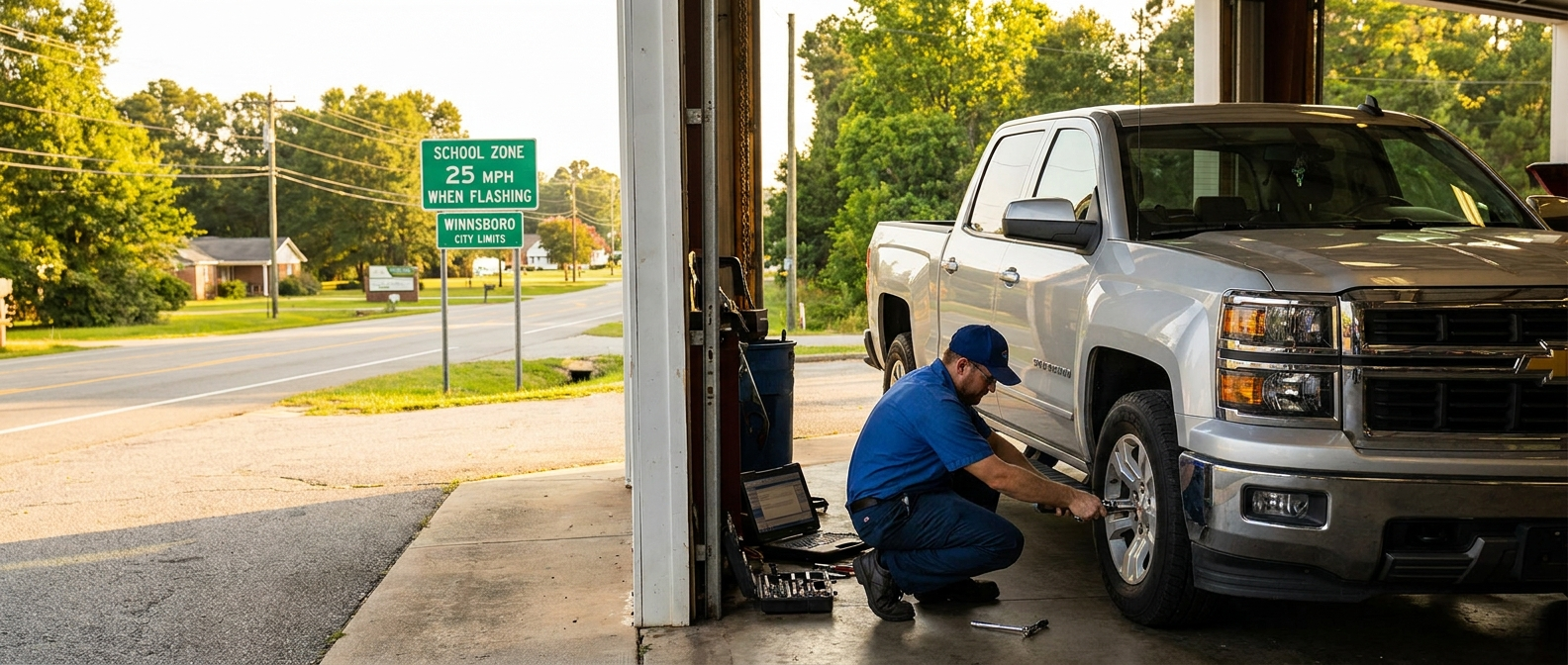
School in Fairfield County started July 30, and US-321 through Winnsboro shifted almost overnight from a relatively open summer corridor to a stop-and-go school-zone commute, twice a day, five days a week. Brake pads don’t care what the calendar says, but your driving pattern absolutely changes how fast they wear. Stop-and-go traffic with frequent hard stops is one of the most demanding cycles a brake system faces.
We’re on US-321 N Business ourselves here at Wilson Chevrolet, so we see what this road does to vehicles. In this guide we break down exactly what a Chevrolet brake inspection covers, how stop-and-go school traffic loads your system, and which signs mean it’s time to book a service appointment before a minor wear issue becomes a rotor problem.
What Do the Brake Specs Actually Mean for Your Chevrolet?
Chevrolet Certified Service documentation calls out 2 mm of remaining friction material as the replacement threshold for brake pads, which is thinner than two stacked pennies, and since most pads start life between 10 mm and 12 mm thick, by the time the wear indicator squeals you’ve used roughly 80 percent of what you had. That’s late in the game. So the number is worth knowing before the noise starts.
| Brake Component | New Condition | Service Alert Threshold | Chevrolet Action |
|---|---|---|---|
| Brake pads (friction material) | ~10-12 mm thick | 2 mm remaining | Replace immediately (per Chevrolet Certified Service) |
| Brake rotors | Stamped nominal thickness on casting | Min. thickness stamped on rotor (typically 2-3 mm less than new) | Replace before reaching minimum; do not resurface below it |
| Brake fluid | Clear to light amber | Dark, cloudy, or moisture-contaminated | Exchange recommended when condition warrants |
| Wear indicator tabs | Retracted | Contact with rotor surface | Audible squeal (schedule service promptly) |
Rotors are marked the same way. Chevrolet stamps the minimum acceptable thickness right into the rotor casting. Once a rotor is worn or machined below that mark, it can’t safely dissipate the heat a full stop generates, and heat is the enemy of consistent braking.
Why does that matter right now? Because heat builds fastest in exactly the kind of driving US-321 sees during school drop-off and pickup: repeated moderate-to-hard stops from 25-35 mph, short distances between stops, and an engine that doesn’t hold the sustained highway speed needed to let things cool between applications. This is a brake-unfriendly cycle, and it compounds across five mornings and five afternoons every week.
Stop-and-Go School Traffic and What It Does to Your Pads and Rotors
Highway miles are actually easier on your brakes than a stop-and-go commute, because you’re using the pedal less often, more gradually, and from lower relative speeds in many situations. A Silverado 1500 owner who puts 15,000 miles a year on mostly I-77 highway runs may have pads that outlast a neighbor doing the same mileage on a school-zone route with a full truck bed.
Stop-and-go traffic changes the math in three specific ways.
- More brake applications per mile. A school-zone corridor with crosswalks, bus stops, and signal lights means far more pedal applications per mile than open-road driving. More applications equals more friction, more heat, and faster pad wear.
- Sustained heat buildup. Short stops don’t allow rotors to shed heat between applications the way a long highway run does. Heat that stays in the rotor speeds up both pad glazing and rotor warping.
- Heavier-loaded vehicles. Families running carpool aren’t driving with an empty vehicle. Chevrolet’s own guidance notes that driving habits and vehicle load conditions directly influence how quickly brake components wear (there’s no universal mileage interval because conditions vary that much).
A Tahoe carrying six passengers to school and back weighs meaningfully more fully loaded than empty. The brake system stops whatever mass you give it.
Between service visits, here’s what to listen and feel for.
- A high-pitched squeal during normal braking (wear indicator contacting the rotor)
- Grinding or metal-on-metal scraping (pad material fully worn, backing plate contacting rotor)
- Pulsation or vibration through the brake pedal (warped or unevenly worn rotor)
- A soft or spongy pedal feel (air in the brake lines or degraded brake fluid)
- The vehicle pulling to one side under braking (uneven pad wear or a sticking caliper)
Any one of those is a reason to schedule service. A squeal is a warning. A grind means damage is happening as you drive.
What a Full Chevrolet Brake Inspection Actually Covers
A proper Chevrolet brake inspection covers more than a glance through the wheel spokes, because per Chevrolet Certified Service a trained technician checks front and rear brake pads (or shoes on drum-equipped rear axles), rotors, hoses, and calipers for wear, and also inspects the fluid lines for cracks and leaks.
Six distinct systems get evaluated in a single service visit.
- Pad thickness (measured, not estimated)
- Rotor condition (thickness, surface scoring, heat spotting, and lateral runout)
- Caliper operation (checking that pistons retract properly and slides aren’t seized)
- Brake hoses and hard lines (looking for cracks, bulges, or seepage)
- Brake fluid condition (color and moisture content affect how the fluid performs under heat)
- Wear indicators (confirming the mechanical alert tabs are functional)
A Traverse running three-row family carpool load and a Silverado towing on weekends put different demands on those six systems, but the checklist doesn’t change. What our team finds tells you which components need work now, which ones need watching, and which ones are fine until the next visit.
Brake service isn’t a fixed-schedule item the way an oil change is. There’s no single mileage number that covers every driver’s situation, and Chevrolet’s own guidance says exactly that. A driver doing a lot of stop-and-go school-zone miles in August in Winnsboro may need pads sooner than the neighbor who drives the same Silverado mostly on I-77 between here and Columbia. Driving pattern matters more than the odometer.
Who Needs a Brake Inspection Right Now?
If you haven’t had a brake check since spring, the answer is probably you, and here’s how to self-triage before you call us. A quick honest read of your own driving usually points the way.
Fairfield County’s school year kicked off July 30. If you’ve been running school drop-offs since then, you’ve already put your pads through roughly two weeks of the most demanding daily cycle they’ll see all year. None of that is a scare tactic. It’s just what the math looks like when you add up two school runs a day on a stop-and-go stretch like US-321.
You’re a good candidate for a brake inspection now if any of these fit.
- You haven’t had brakes inspected in the last 12 months
- You’re hearing intermittent squealing during light braking
- Your vehicle pulls slightly left or right when you stop
- You’ve added regular carpool duty to your weekly routine since late July
- Your pedal feels less firm than it did six months ago
The vehicles in our area that show the most varied brake wear tend to be full-size trucks and three-row SUVs (Silverados, Tahoes, Traverses), because they’re doing double duty as daily commuters and weekend haulers. Heavy use across two very different driving profiles adds up. Our service center can tell you where you stand in one appointment.
We’re straightforward about one thing. Not every inspection ends with a parts recommendation. Sometimes pads measure at 6 mm and you’ve got months ahead of you. Knowing that is worth something too.
Frequently Asked Questions
What triggers the brake squeal on my Chevrolet, and should I ignore it?
The squeal is almost always your wear indicator doing its job. Chevrolet builds metal tabs into the brake pads that contact the rotor surface when friction material reaches approximately 2 mm of remaining thickness. That contact creates the high-pitched sound. It’s a designed alert, not a random noise, and you shouldn’t ignore it. Continuing to drive on pads past that point means the metal backing plate will eventually contact the rotor directly, turning a pad replacement into a rotor replacement as well.
Does stop-and-go school traffic really wear brakes faster than highway driving?
Yes, and the difference is real. Chevrolet’s service guidance explicitly states there is no fixed mileage interval for brake service because wear depends on driving habits and conditions. Stop-and-go driving with frequent moderate-to-hard stops generates more heat cycles per mile than sustained highway speeds, and heat is the primary driver of accelerated pad and rotor wear. School-zone routes with crosswalks, bus stops, and traffic signals are one of the higher-wear driving patterns your brake system encounters.
Connect with us


- August 2026
- July 2026
- June 2026
- May 2026
- April 2026
- March 2026
- February 2026
- January 2026
- November 2025
- June 2025
- May 2025
- April 2025
- February 2025
- December 2024
- November 2024
- September 2024
- August 2024
- July 2024
- April 2024
- March 2024
- February 2024
- January 2024
- December 2023
- October 2023
- September 2023
- May 2023
- April 2023
- March 2023
- February 2023
- January 2023
- September 2022
- July 2022
- June 2022
- March 2022
- January 2022
- December 2021
- November 2021
- October 2021
- September 2021
- August 2021
- July 2021
- June 2021
- April 2021
- January 2021
- December 2020
- November 2020
- October 2020
- September 2020
- August 2020
- July 2020
- June 2020
- May 2020