





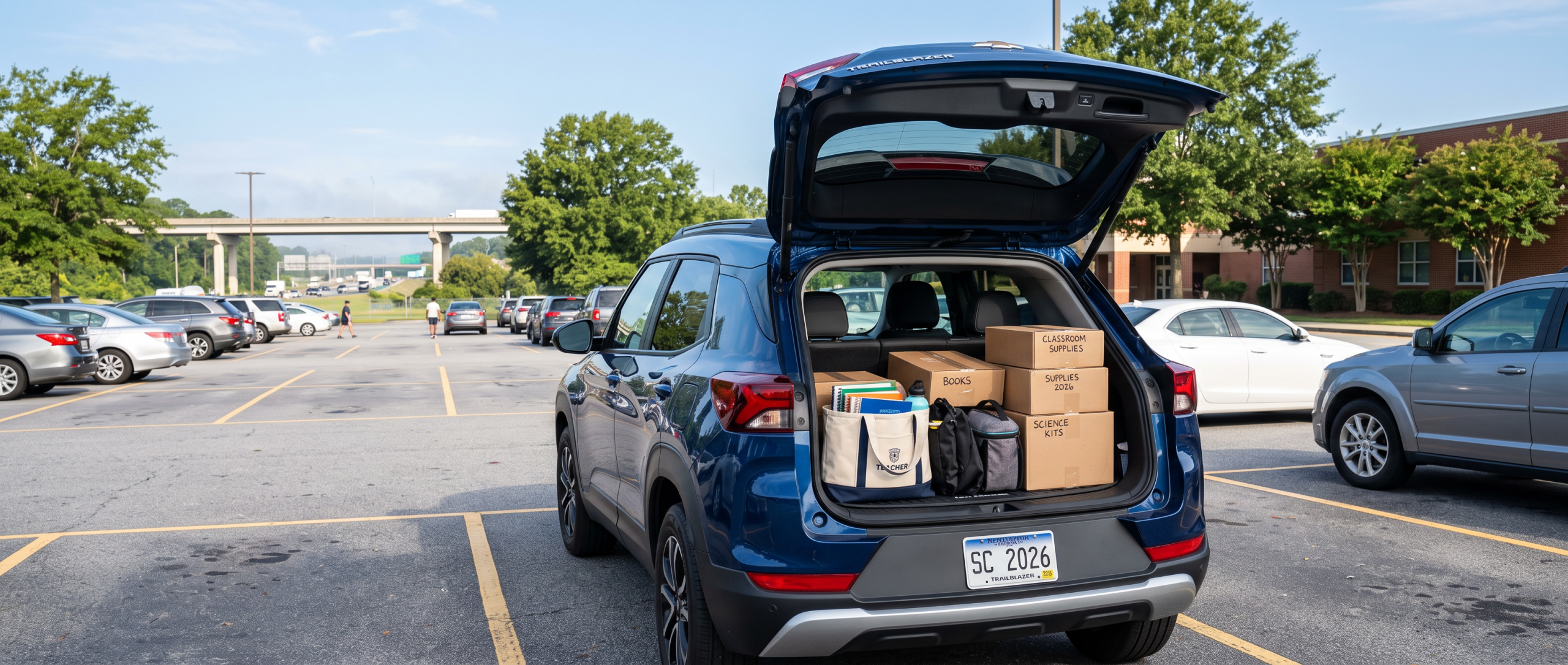
Teachers in Fairfield County and Blythewood don’t shop for a car the usual way. You’re thinking about crates of science kits, oversized poster boards, that Friday afternoon run down I-77 to pick up supplies from Columbia, and whether you can get through a full week of commuting without a second glance at the gas gauge. The variables that decide your next vehicle come down to cargo flexibility, daily fuel cost, and whether the safety tech on board keeps you sharp at 7 a.m. when school starts.
Our team at Wilson Chevrolet watches this play out every August. The kindergarten teacher, the shop teacher, and the varsity soccer coach aren’t shopping for the same vehicle, and a teacher’s life on the lot looks different from one subject to the next. This guide maps three verified 2026 Chevrolet models to three real teaching profiles, with the actual numbers behind each pick.
- Light carrier / solo commuter: The 2026 Trax earns 30 mpg combined (EPA-estimated) and fits 25.6 cubic feet of cargo behind the rear seats. Best for teachers whose supplies stay light and whose commute runs the I-77 corridor daily.
- Medium carrier / after-school activities: The 2026 Trailblazer with AWD and the 1.3L engine bumps cargo to 54.4 cubic feet folded and adds traction on wet Fairfield County back roads. The honest tradeoff is the AWD drops you to 26/29 mpg city/highway (EPA).
- Heavy carrier / coaching teacher: The 2026 Traverse carries up to 97.6 cubic feet (seats folded) and tows up to 5,000 pounds when equipped. Fuel economy drops to 20 city / 26 highway on FWD. It’s the right call only when your cargo list is genuinely long.
- Every 2026 model on this list comes standard with Chevy Safety Assist, which includes Automatic Emergency Braking and Lane Keep Assist.
What Actually Matters When You’re Picking a Teacher’s Vehicle?
Cargo access, fuel economy across roughly 180 school days, and standard safety tech separate a good teacher vehicle from a frustrating one, and horsepower or trim colors, for all their brochure appeal, don’t settle whether the car fits your teaching week. Everything else is secondary. Below is the decision and spec comparison by Chevrolet model, using verified figures from Chevrolet and EPA ratings:
| Model | Best For | Cargo (seats up / folded) | EPA Combined MPG | Key Tradeoff |
|---|---|---|---|---|
| 2026 Trax | Solo commuter, light supply load | 25.6 / 54.1 cu ft | 30 mpg (FWD) | No AWD available |
| 2026 Trailblazer | Medium load, after-school activities | 25.3 / 54.4 cu ft | 27 mpg (AWD) | AWD requires 1.3L engine upgrade |
| 2026 Traverse | Coaching teacher, heavy gear or towing | 22.9 / 97.6 cu ft | 22 mpg (FWD) | Larger footprint, lower mpg |
Treat this table as your starting point, and don’t stop there. The sections below break down where each model earns its place and where it comes up short.
Fuel Economy Is the Number That Compounds All Year
Fuel economy is the number that steadily adds up across a school year, since a teacher commuting five days a week from Blythewood to Winnsboro covers roughly 50 miles round-trip on I-77, so any single tank feels minor until the gallons stack up over 180 days. Add it up and you’re near 9,000 miles in a school year from the commute alone, before any supply runs or field trips.
The EPA rates the 2026 Trax at 28 city / 32 highway / 30 combined mpg, and it wins this category cleanly. Over that 9,000-mile school year, the Trax’s efficiency gap versus the Traverse (EPA-rated at 20 city / 26 highway / 22 combined on FWD) adds up to meaningful gallons, and it’s worth running that math before you buy, since a teacher’s salary is finite and visible.
The Trailblazer with the 1.3L turbo and AWD comes in at 26 city / 29 highway per EPA ratings, a reasonable middle. You’re not bleeding fuel on the I-77 run, and you pick up traction for those wet county roads off SC 34 on a January morning. AWD on the Trailblazer won’t turn heads, though it quietly earns its keep.
See Current Chevy Specials for Teachers
Cargo Space: Where the Three Models Actually Differ
Cargo is where these three models genuinely part ways, and it tends to be the first thing worth sorting out, because the Trax and Trailblazer look far apart in the brochure yet sit closer together than you’d guess. Both offer roughly 25 cubic feet behind the rear seats and roughly 54 cubic feet folded. The 60/40 split rear seat on the Trax lets you fold one side for a long item and still carry a passenger, useful without being magic.
Step up to the Traverse and you’re in a different league. With up to 97.6 cubic feet of total cargo volume (third row and second row folded), it’s built for the PE teacher, the band director, or the coach who doubles as a teacher and drives equipment to Blythewood-McCants competitions on Friday afternoons. The third row also means you can carpool colleagues or shuttle student volunteers without asking them to sit on a supply crate.
The tradeoff with the Traverse is size. At 204.5 inches long and 87.9 inches wide (Chevrolet dimensions), it won’t slide neatly into every school parking lot, and teachers at older buildings with tighter lots will feel it.
The coaching teacher’s case for the Traverse gets stronger when towing enters the picture. Chevrolet lists the 2026 Traverse at up to 5,000 pounds towing capacity when properly equipped. A loaded equipment trailer for a track meet fits inside that window. None of the smaller models come close, and you’ll feel that the day you hitch a trailer. When hauling equipment off I-77 is a regular part of September through May rather than an occasional trip, the Traverse is the right call.
| Pros | Cons | |
|---|---|---|
| Trax | Best mpg of the three, compact for tight lots, good cargo for the size | No AWD, smaller cabin for larger loads |
| Trailblazer | AWD available, highway mpg stays strong, compact footprint | AWD requires 1.3L engine, rear legroom can feel snug |
| Traverse | Largest cargo volume, towing capable, 3-row flexibility | Lower mpg, larger footprint, more than most solo teachers need |
Match the Vehicle to How You Actually Drive
Matching the vehicle to your actual week is where this gets simple, and the Trax is the answer for a tight-lot commuter running five days on I-77 with a couple of tote bags and a rolling cart of supplies, provided the load stays light. It doesn’t need to do more than that, and it does exactly that well. FWD-only is the single limitation here. Wet leaves on a November morning in Winnsboro are manageable. A genuine ice event, rare as they are in Fairfield County, isn’t where you want to test it.
The Trailblazer with AWD and the 1.3L engine is the pick for teachers with more varied schedules. After-school clubs, off-site professional development in Columbia, early morning arrivals when the roads haven’t dried yet. The 155 horsepower and 174 lb-ft of torque (Chevrolet-listed for the 1.3L AWD configuration) give you a little more confidence merging onto I-77 with a full load. Worth a look if your teaching life doesn’t end at 3:30 p.m.
The Traverse is the coaching teacher’s vehicle. Full stop. If you’re hauling equipment, carpooling athletes, or occasionally towing, the mpg tradeoff is real but it’s earned. Trying to make a Trax do that job is the wrong answer, and we’d tell you that, smaller sale or not.
Every model in this comparison comes standard with Chevy Safety Assist, which bundles Automatic Emergency Braking, Forward Collision Alert, Lane Keep Assist with Lane Departure Warning, and IntelliBeam automatic high beams. You’ll notice it on the pre-dawn drives that come with morning duty and early-season athletic practice schedules.
Frequently Asked Questions
Which 2026 Chevrolet gets the best fuel economy for a teacher commuting in Winnsboro or Blythewood?
The 2026 Trax earns the best fuel economy of the three models covered here. The EPA rates it at 28 mpg city, 32 mpg highway, and 30 mpg combined. That’s relevant for teachers commuting daily on I-77 between Winnsboro and Blythewood, where highway miles dominate the school-year drive. The Trailblazer AWD follows at 26 city / 29 highway per EPA ratings, and the Traverse FWD comes in at 20 city / 26 highway.
Does a teacher really need AWD in Fairfield County, South Carolina?
Probably not for most of the school year. Fairfield County winters are mild, and I-77 stays clear after most weather events. The case for AWD on the Trailblazer is less about snow and more about wet county roads and early-morning moisture on rural routes off SC 34. If your commute is all highway and parking lots, FWD on the Trax is fine. If you’re driving to after-school activities on unpaved or poorly-drained roads, the Trailblazer’s AWD option gives you a real confidence margin for a modest efficiency tradeoff.
Connect with us


- August 2026
- July 2026
- June 2026
- May 2026
- April 2026
- March 2026
- February 2026
- January 2026
- November 2025
- June 2025
- May 2025
- April 2025
- February 2025
- December 2024
- November 2024
- September 2024
- August 2024
- July 2024
- April 2024
- March 2024
- February 2024
- January 2024
- December 2023
- October 2023
- September 2023
- May 2023
- April 2023
- March 2023
- February 2023
- January 2023
- September 2022
- July 2022
- June 2022
- March 2022
- January 2022
- December 2021
- November 2021
- October 2021
- September 2021
- August 2021
- July 2021
- June 2021
- April 2021
- January 2021
- December 2020
- November 2020
- October 2020
- September 2020
- August 2020
- July 2020
- June 2020
- May 2020