




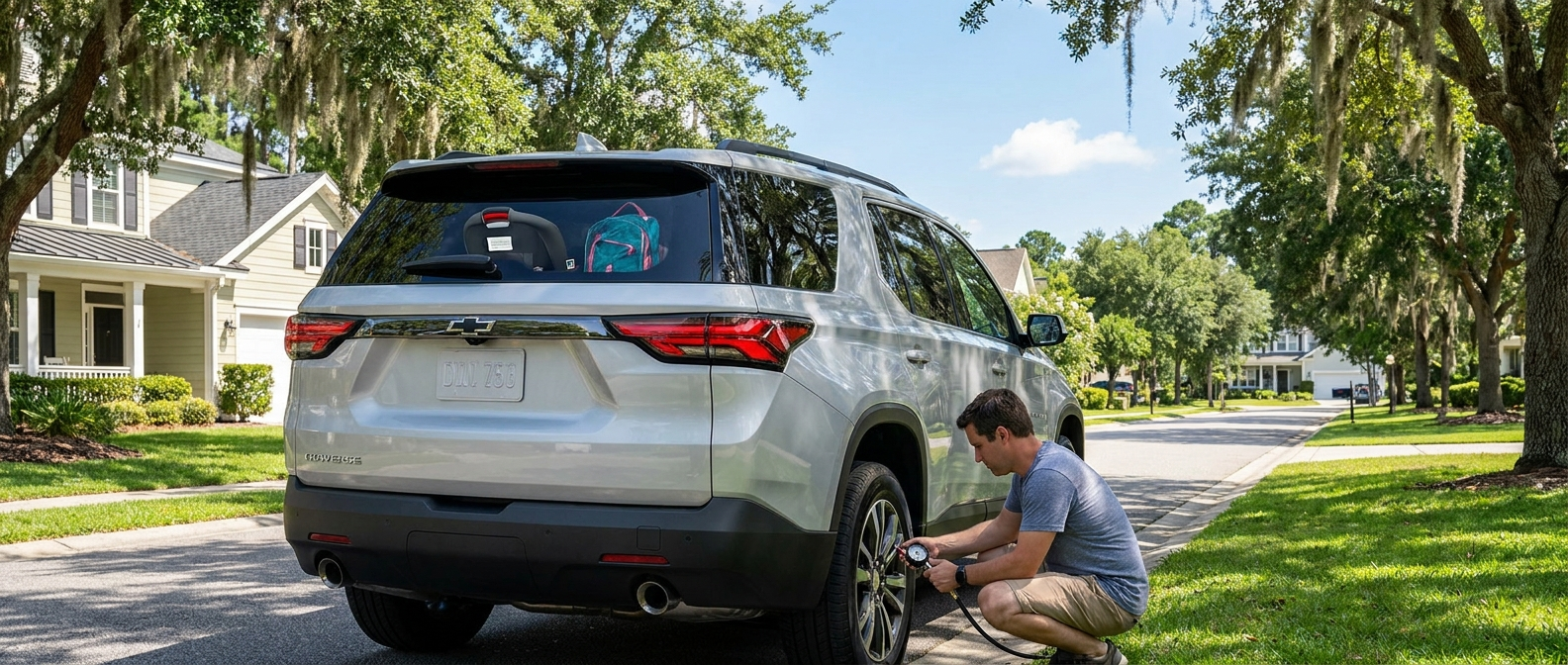
The first week of school is a bad time to learn your tires were losing pressure all summer. Here’s the fast version. Check your Chevy’s cold tire pressure before 8 a.m., match it to the number on the driver’s door placard, and run a quick tread test while you’re crouched down there. That two-minute stop keeps you clear of the August trap, heat that makes tires look fine on a noon gauge even when they weren’t aired up right at dawn.
The Chevrolet Traverse hauls car seats, sports bags, and a full Fairfield County carpool. It earns tires set to the number that’s genuinely right for it.
Will Your Tires Handle the School-Year Load?
Your Chevy’s tires will handle the school-year load fine as long as you set them cold and confirm the figure, because August in Winnsboro is rough on rubber, with afternoon highs pushing into the mid-90s and pavement running hotter still. The physics is straightforward. Tire pressure rises roughly 1 PSI for every 10 degrees Fahrenheit of temperature gain, which means a tire you air up at 7 a.m. can read 4 to 6 PSI higher by the time you’re doing afternoon pickup after driving I-77 in stop-and-go heat. None of that is a problem on its own. The trap catches parents who check at noon, see a number that looks fine, and figure the tires were right all along. They might not have been.
For Chevy’s family lineup, the table below gives you the real numbers. Chevrolet lists these as cold-tire targets, meaning the vehicle has been parked for at least three hours and driven less than a mile since sitting. Check your specific trim’s door-jamb placard to confirm your exact figure.
| Chevy Model / Trim | OEM Tire Size | Recommended Cold PSI | Check Method | Fits the School-Run Job? |
|---|---|---|---|---|
| Traverse LS | 245/70R17 | 35 PSI (confirm placard) | Cold gauge before 8 a.m. | Yes |
| Traverse LT | 255/65R18 or 255/55R20 | 35 PSI (confirm placard) | Cold gauge before 8 a.m. | Yes |
| Traverse LTZ / RS / High Country | 255/55R20 or 275/45R22 | 35 PSI (confirm placard) | Cold gauge before 8 a.m. | Yes |
| Equinox (most trims) | Varies by trim | 35 PSI (confirm placard) | Cold gauge before 8 a.m. | Yes |
| Tahoe (family hauler) | Varies by trim | Confirm placard | Cold gauge before 8 a.m. | Yes (larger load means more pressure to get right) |
| Trailblazer | Varies by trim | Confirm placard | Cold gauge before 8 a.m. | Yes |
*Chevrolet lists 35 PSI as the most common cold-tire target across its family SUV lineup. Your door-jamb placard is the authoritative source for your specific vehicle. Never read pressure from a hot tire and use that number to set inflation.*
How to Load the Check Correctly (Before the Bell Rings)
Doing this right takes three tools and about four minutes, and the one rule that makes or breaks it is timing, because a gauge read cold before the first drive tells the truth while a reading taken after I-77 heat runs high and fools you. In our experience, the numbers that mislead people are the ones pulled after the car has been driven. Do it cold, every time.
Step 1: Time it. Check pressure before the first drive of the day, ideally before 8 a.m. in August. Once you’ve been on the road, heat from the engine bay, road friction, and ambient air all push the reading up.
Step 2: Grab a real gauge. Your Traverse and most Chevys have a Tire Pressure Monitoring System (TPMS), but Chevrolet engineers built that system to warn you at the dangerous end. It won’t fine-tune anything for you. A quality dial or digital gauge (a small investment at any auto parts store) gives you the actual PSI to work with. NHTSA notes that only 19 percent of drivers properly inflate their tires.
Step 3: Check all five. Four tires plus the spare. The spare is the one every parent forgets about until they’re pulled over on US 321 in a thunderstorm.
Step 4: Match the placard, not the tire sidewall. The number stamped on the sidewall is the tire’s maximum capacity, not your vehicle’s recommended operating pressure. Open the driver’s door and look for the sticker on the door jamb. That number is the one that matters.
Step 5: Do the quarter test on tread. Insert a quarter into the tread groove, Washington’s head going in first. If you can see the top of Washington’s head, you’re at approximately 4/32″ of tread depth, which is the early-warning zone for wet-weather stopping. September in Fairfield County means afternoon thunderstorms. Better to catch borderline tread this week than during the first week of school.
- [ ] Check pressure before 8 a.m. on a day the car sat overnight
- [ ] Confirm target PSI from the driver’s door-jamb placard
- [ ] Inflate or deflate to match the cold-tire target
- [ ] Repeat for all four tires plus the spare
- [ ] Insert a quarter tread-first into the shallowest-looking groove; flag it if you see Washington’s head
- [ ] Inspect each sidewall for cracks, bulges, or embedded debris
- [ ] Check that the TPMS system is functional (no persistent amber light)
Chevrolet Equinox owners: the same cold-check logic applies, and the 35 PSI target is the same baseline. Tire size changes by trim, so always use the placard.
The Job Done: What You’ve Actually Accomplished
Run this check the right way and you’ve handled a five-minute job that’s easy to skip, and the payoff is real, because per NHTSA data, 511 people died in tire-related crashes in 2024. None of that is meant to scare you. Think of it as putting a five-minute driveway check in its proper place.
Loaded with backpacks, a booster seat, and after-school gear, a Chevy Traverse or Tahoe is carrying real weight. Tires underinflated by 25% or more wear faster along the outer edges, reduce wet-weather traction, and extend stopping distances in a way you won’t notice until a school-zone moment demands everything the tire has. South Carolina’s back-to-school schedule drops right in the hottest, wettest stretch of the year. The last thing you want is to learn your tires were marginal in the middle of it.
Get the check done this week. If tread depth is near the 4/32″ threshold or the cold pressure doesn’t hold overnight, our service center on US 321 can handle a rotation, inspection, or swap before the first bell.
By the Wilson Chevrolet Team | August 2026
Connect with us


- August 2026
- July 2026
- June 2026
- May 2026
- April 2026
- March 2026
- February 2026
- January 2026
- November 2025
- June 2025
- May 2025
- April 2025
- February 2025
- December 2024
- November 2024
- September 2024
- August 2024
- July 2024
- April 2024
- March 2024
- February 2024
- January 2024
- December 2023
- October 2023
- September 2023
- May 2023
- April 2023
- March 2023
- February 2023
- January 2023
- September 2022
- July 2022
- June 2022
- March 2022
- January 2022
- December 2021
- November 2021
- October 2021
- September 2021
- August 2021
- July 2021
- June 2021
- April 2021
- January 2021
- December 2020
- November 2020
- October 2020
- September 2020
- August 2020
- July 2020
- June 2020
- May 2020