





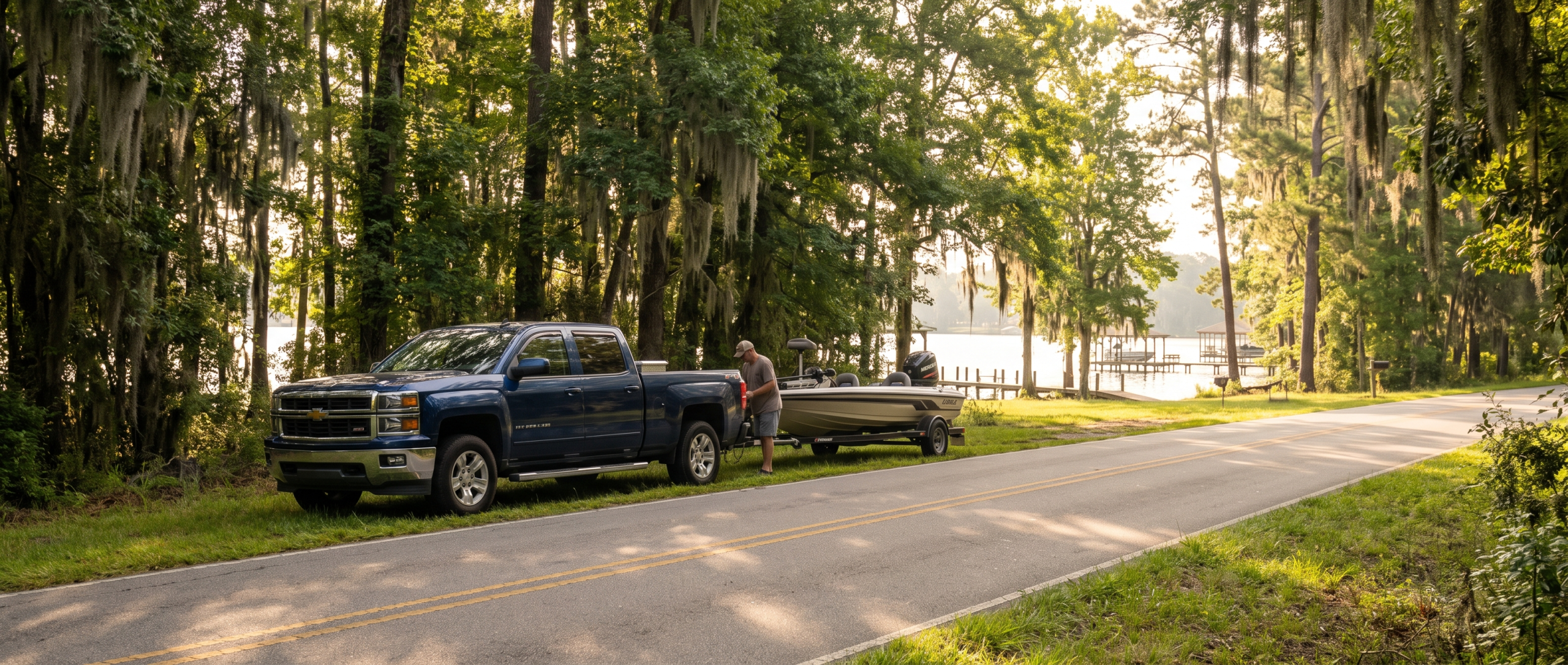
Pull out of Winnsboro on US 321, merge onto I-77 south, take exit 41, and you are about 25 minutes from the boat ramp on Desportes Island at Lake Wateree State Park. That is the plan. The vehicle part of that plan deserves 20 minutes in your driveway before you go.
South Carolina summers hit Chevrolet engines with two punishment factors that most general checklists ignore. A Silverado 1500 towing a bass boat to the lake faces temperatures that regularly push above 90 degrees from May through September, layered on top of humidity that accelerates coolant breakdown and battery corrosion at a rate a dry-heat state never produces. This guide maps the five checks that matter most to that specific run — and connects each one to what Lake Wateree actually asks of your truck when you get there.
What’s the Plan at a Glance?
| Stop | What to Do | Best Time | Parking / Notes |
|---|---|---|---|
| Your driveway — Winnsboro | Run five pre-trip checks (see below) | Morning before 8 a.m. — tires read accurate cold | Give yourself 20 minutes |
| I-77 South to Exit 41 | Monitor temp gauge; engage Tow/Haul mode if towing | Depart by 9 a.m. to beat peak midday heat | ~25-minute run from Winnsboro |
| Lake Wateree State Park — two-lane boat ramp | Launch, then run a quick fluid/temp check | Weekdays for shortest wait | Paved lots near day-use area |
| Park store on Desportes Island | Fuel at the on-lake pump; grab ice and a fishing license | Mon-Thu 8 a.m.-5 p.m.; Fri-Sun 7 a.m.-7 p.m. | Short walk from campsites |
| Desportes Island nature trail | 2.3-mile loop — stretch your legs, spot bald eagles and osprey | Early morning or late afternoon | Trail starts near the park road |
The Lake Makes Real Demands on Your Cooling System
Fourteen thousand acres of water, a two-lane concrete boat ramp, and twenty-five miles of I-77 in late-June sun. That combination puts a tow vehicle’s cooling system under genuine pressure — and that is the first thing to sort before you leave Fairfield County.
A Traverse or a Silverado towing a loaded trailer adds weight and drag that pushes engine temperature up. The cooling system absorbs that heat and sheds it through the radiator, but this process becomes less efficient as coolant ages. South Carolina’s sustained heat above 90 degrees between May and September degrades coolant faster than the calendar-based replacement intervals assume. Before any lake run, squeeze the upper radiator hose when the engine is cold — a hose that feels soft, gummy, or shows surface cracking needs attention before you leave Winnsboro, not on the shoulder of Hwy 21.
Check the coolant reservoir against the “full cold” line. If the fluid looks brownish or the last flush is a distant memory, bring it to the Wilson Chevrolet service center on US 321 before the trip. The repair bill for an overheated engine on a rural back road is steep.
Schedule a Pre-Trip Service Check
Towing to the Ramp Means Transmission Fluid Matters
Most drivers think of engine oil before a long drive. Fewer think about transmission fluid — and that gap is where a towing truck gets hurt in summer.
A Colorado or a Silverado hauling a boat puts the transmission under sustained heat load that fresh fluid handles cleanly and degraded fluid handles poorly. Healthy automatic transmission fluid is translucent and reddish. Fluid that looks dark brown or carries any burnt smell is already breaking down. South Carolina heat between May and September compounds that degradation on every trip, and the boat launch at Lake Wateree State Park adds a specific stress: repeated low-speed maneuvering at the two-lane ramp, in direct sun, after a highway run. That start-stop cycle is exactly where a compromised gearbox shows its age.
A transmission fluid check before lake season — or before any serious towing run — is one of the highest-value service items for Fairfield County drivers who use their trucks the way trucks were built to be used.
Tire Pressure and Battery: Two Five-Minute Checks
Both checks are quick. Both matter more in a South Carolina summer than drivers typically expect.
Tire pressure. Heat causes tire air to expand. NHTSA guidance puts the change at roughly 1 PSI for every 10-degree rise in ambient temperature. Check your tires in the morning with cold tires, against the spec on your door jamb sticker — that is the authoritative source for your exact model and trim, not a general number. For most Chevy trucks and SUVs, the general target lands around 35 PSI, but the door jamb sticker is always the final word. Do not bleed air after a hot highway run; the reading will be falsely high and you will be underinflated by morning. South Carolina summer pavement can push surface temperatures well past 100 degrees, and an underinflated tire on hot asphalt is a blowout risk.
Battery. Most drivers associate battery failure with winter. In the Midlands, summer heat is actually the more common culprit. High temperatures accelerate internal battery corrosion and fluid evaporation faster than cold weather does. Any battery approaching the three-to-five-year mark in South Carolina’s climate deserves a load test before lake season. A healthy alternator typically shows a voltmeter reading of 13.5 to 14.5 volts with the engine running.
- Check tire pressure cold, in the morning, against the door jamb sticker
- Do not bleed air from tires after a highway run — that reading is not accurate
- Inspect battery terminals for white or greenish corrosion buildup
- Load-test any battery near the three-to-five-year range before summer
- Replace a clogged cabin air filter — it forces your AC to work harder in SC humidity
The Right Chevy for 13,000 Acres of Lake
The vehicle you bring shapes the whole day. A Silverado 2500 HD handles a larger boat and a full camper payload with room to spare, and its towing capacity means the hill on the way into Desportes Island barely registers. The Colorado is a better fit for a family-sized bass boat or a pair of kayaks in the bed — nimble enough to maneuver the park’s paved campsite lanes and easy to park near the day-use area. The Traverse seats seven, carries the cooler, the rods, and the camping gear, and turns the run down I-77 into something that actually feels like the trip is already underway.
Whatever you drive, the maintenance work above translates directly to time on the water. Lake Wateree’s 13,000-plus surface acres hold bass, crappie, catfish, and striped bass — the South Carolina Department of Natural Resources actively stocks the striped bass population to keep the fishery healthy. The park’s 72 campsites all include water and electrical hookups, the on-lake fuel pump keeps boaters moving, and kayak rentals run year-round. None of that matters if you are stuck on the shoulder of I-77 with a temperature gauge in the red.
The Wilson Chevrolet team on US 321 in Winnsboro knows what the Lake Wateree run actually asks of a Chevy. A summer multi-point inspection before you hitch the trailer is the most practical thing you can do before the season gets into full swing.
By the Wilson Chevrolet Team | June 2026
Connect with us


- August 2026
- July 2026
- June 2026
- May 2026
- April 2026
- March 2026
- February 2026
- January 2026
- November 2025
- June 2025
- May 2025
- April 2025
- February 2025
- December 2024
- November 2024
- September 2024
- August 2024
- July 2024
- April 2024
- March 2024
- February 2024
- January 2024
- December 2023
- October 2023
- September 2023
- May 2023
- April 2023
- March 2023
- February 2023
- January 2023
- September 2022
- July 2022
- June 2022
- March 2022
- January 2022
- December 2021
- November 2021
- October 2021
- September 2021
- August 2021
- July 2021
- June 2021
- April 2021
- January 2021
- December 2020
- November 2020
- October 2020
- September 2020
- August 2020
- July 2020
- June 2020
- May 2020