





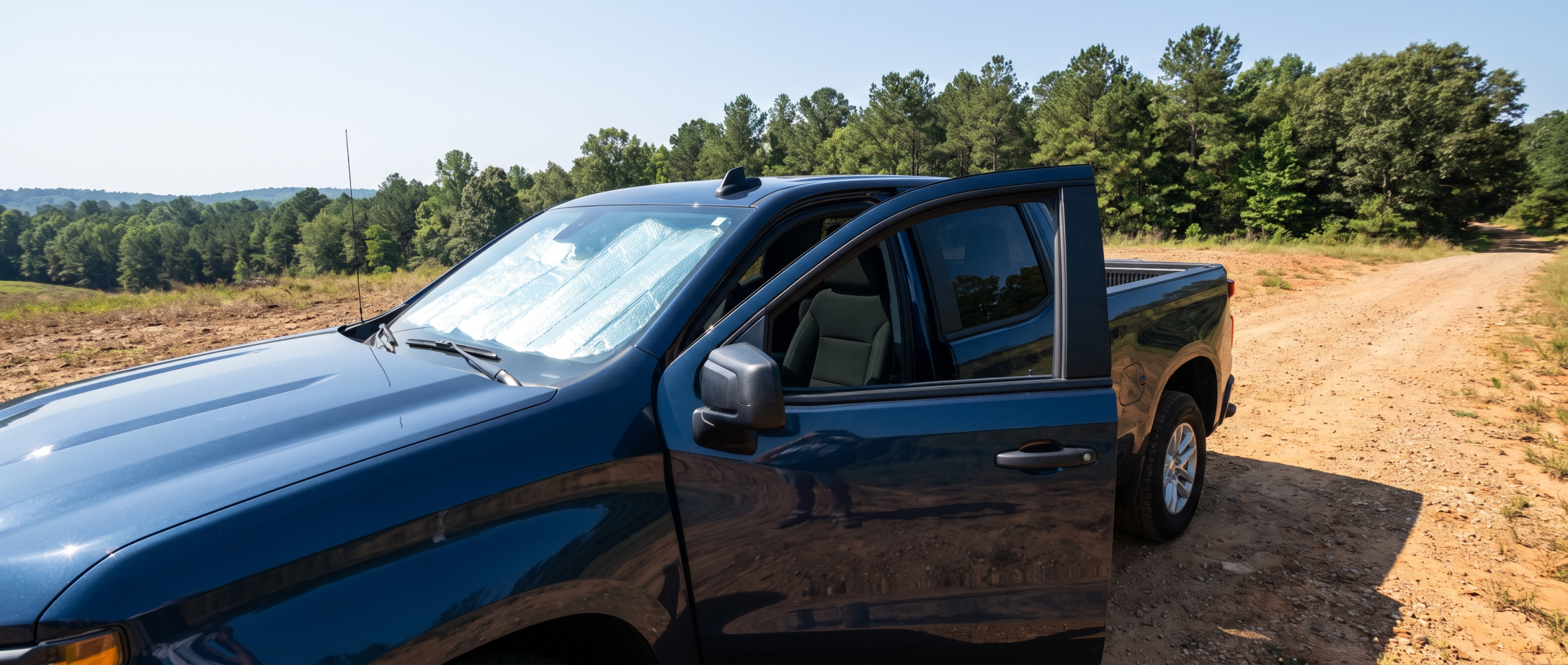
A parked car under South Carolina’s July sun can hit interior temperatures above 130 degrees Fahrenheit — sometimes well above it. That heat is cooking your dashboard, drying out your leather, and fading your upholstery every day your Chevy sits in a parking lot. The question Fairfield County drivers face is a practical one: reach for a windshield sunshade, or invest in window tint? Both protect, but they work differently, cost differently, and matter more or less depending on which Chevy you drive and how you use it.
- A reflective windshield sunshade is the fastest, most flexible protection — deploy it every time you park in direct sun and your dashboard and front seats get meaningful heat relief immediately.
- Window tint (legally 27% VLT or lighter on side windows for passenger cars in South Carolina) provides continuous, all-glass UV blocking without any action required after installation.
- Leather interiors found in higher Silverado and Tahoe trims need both: tint handles the constant UV load; a sunshade covers the windshield, which SC law generally limits to above the AS-1 line only.
- South Carolina’s climate runs hot from roughly April through October — protection applied only in peak summer still leaves your interior exposed during months with plenty of UV intensity.
- The smartest approach for most Winnsboro drivers is tint first, sunshade as a daily backup — especially if your Chevy parks outdoors most of the day.
What Is the Real Difference Between These Two Options?
Sunshades and window tint both reduce UV damage, but they protect your Chevy by entirely different mechanisms — and neither one alone does the complete job.
| Factor | Windshield Sunshade | Window Tint (27% VLT) |
|---|---|---|
| How it works | Reflects solar energy before it enters the cabin | Film blocks UV and infrared heat through the glass permanently |
| Coverage | Windshield only (when deployed) | All tinted windows, continuously |
| SC legal limit | No restriction (stays above AS-1 line on windshield) | 27% VLT minimum for side/rear windows on passenger cars |
| Action required | Must be deployed every time you park | None after professional installation |
| Ideal for | Daily parking protection, leather seats, quick wins | Continuous UV blocking on side windows while driving |
| Works while driving | No | Yes |
UV rays break down the molecular structure of plastic, leather, and vinyl over time — causing colors to fade, materials to yellow, and surfaces to crack. The damage begins well before it is visible. A sunshade physically reflects that energy before it reaches your dash. Window tint blocks UV from entering through your side and rear glass around the clock. Because South Carolina limits windshield tint to above the manufacturer’s AS-1 line (a narrow strip near the top), the windshield is always a sunshade’s territory.
Does Your Chevy’s Interior Type Change the Answer?
Yes — and this is the decision point most generic articles skip entirely. The surface materials in your specific Chevy matter a great deal.
Higher-trim Silverado 1500 configurations with leather seating are the Chevy interior most vulnerable to South Carolina sun. Leather dries out and cracks when natural oils evaporate faster than they can be replenished under repeated heat cycling. Dark leather absorbs more heat, accelerating that process. For any leather-equipped Chevy — a loaded Silverado LTZ, a Tahoe Premier, or an upper-tier Traverse — the case for window tint on side windows is strong: it provides the continuous UV blocking that keeps leather supple between conditioning applications.
Cloth or vinyl interiors (common in work-spec Silverado WT trims or entry Equinox grades) hold up somewhat better, but fabric still loses color and develops worn texture under sustained UV exposure. For these vehicles, a quality windshield sunshade deployed consistently is the most cost-effective first step, with tint as a meaningful upgrade for anyone parking outdoors all day.
The Tahoe and Traverse deserve a specific note: both have large side glass areas that admit significant solar energy even when you are parked and the sunshade is up. Window tint on those rear passenger windows — where South Carolina allows any VLT darkness on multipurpose vehicles — gives families real protection for the back-seat occupants and cargo on runs to Lake Wateree.
Schedule a Service Appointment
The South Carolina Tint Law Details Most People Get Wrong
South Carolina’s tint law has one of the more straightforward frameworks in the Southeast, but there are two details that trip up Chevy owners and sometimes lead to a misdemeanor citation.
Passenger cars vs. multipurpose vehicles (MPVs). Trucks like the Silverado are NOT classified as multipurpose vehicles in South Carolina. That means every window — front, rear sides, and rear windshield — must meet the 27% VLT standard. If you drive an SUV (Equinox, Tahoe, Traverse, Trailblazer), the rear side windows and rear windshield can go darker, any VLT, as long as rear side windows leave a clear strip at the top.
The windshield rule. No tint film below the AS-1 line on any vehicle. That line, etched by the manufacturer near the top of the windshield, marks where legal tint coverage ends. Everything below it is the sunshade’s job.
Certification stickers are required. SC law requires a sticker on every tinted window identifying the film as compliant. Your installer should handle this, but ask explicitly. A missing sticker during a traffic stop costs as much as the tint itself in fines.
Protecting the Surfaces That Take the Most Abuse
The windshield receives the most direct sun while parked, making it both the highest-heat entry point and the one window tint cannot fully address under SC law.
Dashboard plastics begin to fade from black toward gray as UV radiation destroys pigment molecules. Steering wheels develop sticky surfaces when heat breaks down polyurethane coatings. These are not cosmetic inconveniences — once the protective layer of a plastic dashboard has failed, it cannot be meaningfully restored. A reflective windshield sunshade, deployed every time you park outside, is the single most effective weapon against dashboard degradation.
For side glass and rear glass, the combination of UV inhibitors in window film and consistent leather conditioning (applied every one to two months during Fairfield County’s hot season, which runs effectively from April through October) is what keeps leather-trimmed Chevy interiors looking sharp for years rather than months.
Two more habits that add up: remove heat-sensitive items — electronics, sunscreen tubes, and plastic bottles — from the dash and front seat before locking up. And crack a window slightly if safely possible while parked; that small pressure equalization meaningfully reduces the greenhouse effect that traps peak heat inside the cabin.
So Which Should You Choose for Your Chevy?
Choose a sunshade first if you are primarily protecting against dashboard and front-seat damage, you want zero installation cost or legal compliance questions, or your Chevy has cloth seating and parks outdoors for shorter periods. A quality custom-fit sunshade deployed consistently handles the windshield — the biggest heat-entry point — with no permanence and no permit.
Choose window tint first if you drive a Chevy with leather seating, your vehicle parks all day in full sun along US 321 or an exposed lot, you have rear-seat passengers (especially children) who need consistent UV protection while the vehicle is moving, or you own an SUV where SC law allows darker rear windows. Tint works while you drive and requires nothing from you after installation.
For most Winnsboro and Fairfield County Chevy owners, the answer is both — professionally installed window tint at the legal 27% VLT on side windows, plus a windshield sunshade you reach for every time you park outside. Neither solution alone is complete, and together they cover all four glass faces of your vehicle across every hour it spends in the South Carolina sun.
Frequently Asked Questions
Does window tint work on Chevy trucks the same as on SUVs in South Carolina?
Not exactly. South Carolina classifies pickup trucks like the Silverado 1500 and Silverado 2500 HD as passenger vehicles, not multipurpose vehicles. That means all windows — front sides, rear sides, and the rear windshield — must meet the same 27% VLT minimum. Chevy SUVs (Equinox, Traverse, Tahoe, Trailblazer) are classified as multipurpose vehicles, so their rear side windows and rear windshield can be tinted darker, any VLT percentage, as long as rear side windows have a clear strip at the top. The practical result: a Tahoe owner has more tint flexibility than a Silverado owner under SC law.
Will a windshield sunshade really make a noticeable difference on a hot Winnsboro afternoon?
Yes. A parked car’s interior can exceed 130 degrees Fahrenheit in direct summer sun. A reflective windshield sunshade reduces the solar energy entering through the largest single piece of glass on your Chevy. The effect is most noticeable on the dashboard surface temperature and the front seats — the areas that receive the most direct radiation through the windshield. The catch is consistency: the sunshade only works when it is deployed. Drivers who use one every single time they park in the sun accumulate significantly less dashboard fading and leather drying over a Chevy’s lifetime than those who use it occasionally.
Connect with us


- August 2026
- July 2026
- June 2026
- May 2026
- April 2026
- March 2026
- February 2026
- January 2026
- November 2025
- June 2025
- May 2025
- April 2025
- February 2025
- December 2024
- November 2024
- September 2024
- August 2024
- July 2024
- April 2024
- March 2024
- February 2024
- January 2024
- December 2023
- October 2023
- September 2023
- May 2023
- April 2023
- March 2023
- February 2023
- January 2023
- September 2022
- July 2022
- June 2022
- March 2022
- January 2022
- December 2021
- November 2021
- October 2021
- September 2021
- August 2021
- July 2021
- June 2021
- April 2021
- January 2021
- December 2020
- November 2020
- October 2020
- September 2020
- August 2020
- July 2020
- June 2020
- May 2020