





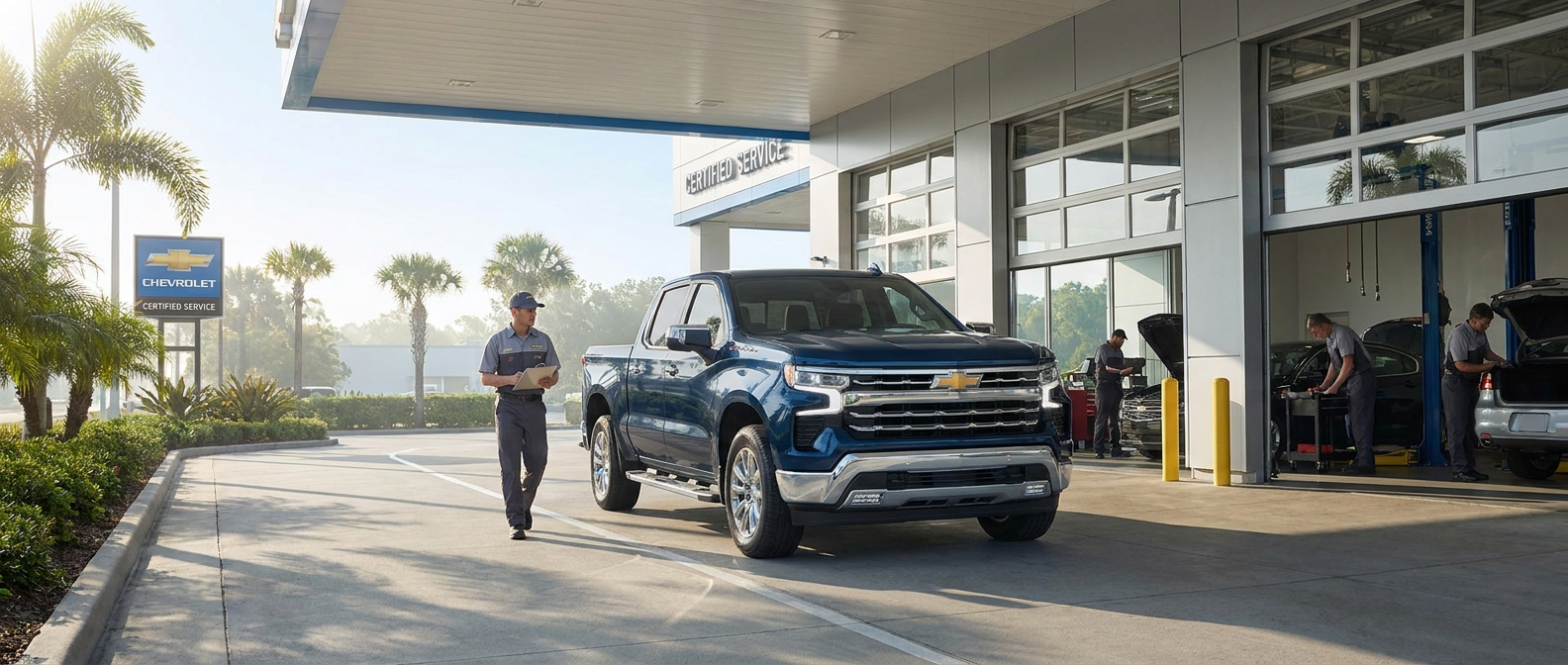
Labor Day weekend falls on September 7, 2026. We’re twelve days out, and every service bay in the Midlands is about to fill up.
If your Chevrolet has spent the summer doing short Winnsboro-to-Columbia runs on I-77, the heat alone has been working against your battery, your tires, and your fluids since June. None of those systems announce a problem until they’re already failing. This guide breaks down which service items matter most for a Fairfield County driver heading out this weekend, which ones you can skip if you’re in a time crunch, and when to call us so you can grab a slot before the rush.
- Oil and filter: Book if your Oil Life Monitor reads below 40% or you haven’t changed it since spring. Full-synthetic dexos1 oil is required on all 2026 Silverados, Traverses, and Tahoes.
- Tires: Check pressure manually before you leave. Your TPMS light won’t come on until you’re roughly 25% below the recommended PSI. Already in dangerous territory for a loaded highway run.
- Battery: Three or more years old with a lot of short summer trips? Get it load-tested now. Summer heat is harder on batteries than winter cold.
- Coolant and brakes: Quick visual checks your technician can fold into a multi-point inspection.
- Timing: Call or book online by August 29 to reliably get a pre-Labor Day slot.
Schedule your pre-trip service at Wilson Chevrolet
What Actually Matters When Choosing a Pre-Trip Service?
Not every line on a generic road-trip checklist deserves the same urgency, and the items that matter most for a Fairfield County driver share one trait, which is that South Carolina’s late-summer conditions have been wearing your Chevy down since June. Sort by that and the short list writes itself.
| Service Item | Best For | Key Spec / Trigger | Real Tradeoff |
|---|---|---|---|
| Oil and filter change | Trucks towing, loaded SUVs, anyone within their service window | Chevrolet specifies dexos1 full-synthetic; 2026 Traverse 2.5L turbo and Silverado 5.3L both take 0W-20 dexos1; up to 7,500-mile interval under normal conditions | Monitor may show 30% (a full-load August highway run burns hotter than your typical commute) |
| Tire pressure check and rotation | All vehicles, especially loaded trucks and three-row SUVs | TPMS warning light triggers at roughly 25% below recommended PSI; correct PSI is on your driver-door jamb sticker, not the sidewall | Rotation is urgent only if you’re within 1,000 miles of your 7,500-mile rotation interval |
| Battery load test | Any Chevy with a battery 3 or more years old; vehicles used mainly for short trips | Heat accelerates internal corrosion and fluid evaporation; a marginal August battery can fail completely by October | Load tests take about 10 minutes; if it passes, you’re done |
| Brake inspection | Anyone noticing a soft pedal, pulling, or squealing; Silverado and Tahoe owners who tow | Brake fluid is hygroscopic and its boiling point drops as it absorbs summer humidity; pad replacement typically needed between 40,000 and 60,000 miles | If your pedal feels normal and you have no noise, a visual at your oil change is enough |
| Coolant check | Any vehicle without a coolant service in the last two or more years | Reservoir should sit between MIN and MAX marks cold; fluid should hold its original color (not brown or rusty) | Full flush is only necessary if fluid is degraded or the system hasn’t been serviced in roughly two years or 30,000 miles |
| Wiper blades | Anyone driving into afternoon storm territory along the SC coast or Appalachian foothills | Chevrolet recommends replacement every 6 to 12 months | Fast and low cost (no reason to skip it if yours are already streaking) |
The Oil Life Monitor Is Smart. It Doesn’t Know You’re Towing a Camper.
Chevrolet’s Oil Life Monitor is genuinely useful technology, and it calculates when oil needs changing from engine temperature, driving style, and trip length rather than a plain mileage counter. On the 2026 Silverado 1500, 2026 Tahoe, and Traverse, Chevrolet recommends oil and filter service at up to 7,500-mile intervals under normal driving conditions using the correct dexos1 full-synthetic. Under severe conditions (heavy towing, dusty roads, lots of short stop-and-go runs), the system can call for service as early as 3,000 to 5,000 miles.
The monitor is calibrated to your usual driving pattern, and it can’t feel a trailer on the hitch. Pack three adults and a week of gear, hook up for a Lake Wateree camping run, and push the truck on I-77 in August heat for a couple of hours, and you’ve handed the engine a completely different duty cycle. If your monitor sits below 40% right now, do the oil change before the trip. Finding out what the bottom of that range feels like on a jammed holiday highway isn’t worth it.
For the 2026 Chevrolet Traverse specifically, the 2.5L turbocharged engine requires dexos1 Gen 3 full-synthetic SAE 0W-20. Don’t approximate that one. Turbochargers run hot, and conventional oil can’t reliably protect the turbo bearings at sustained highway temperatures.
Don’t skip the tire section because you figure your TPMS would have warned you by now. It probably hasn’t, and the reason is worth a minute.
- The TPMS light typically doesn’t activate until a tire is roughly 25% below the recommended PSI
- A Silverado running a recommended 35 PSI could drop to around 26 PSI before the dashboard says anything
- A tire that low on a loaded truck at highway speed is a handling and blowout risk
- Check pressure with a handheld gauge when tires are cold (vehicle parked at least three hours or driven fewer than a mile)
- Rotate at the 7,500-mile rhythm. On AWD vehicles, skipping rotations puts real strain on the drivetrain system.
Match Your Service to How You’re Actually Traveling
Different trips call for different prep, and the smart move is matching the work to what you’re doing this weekend rather than to a one-size checklist. We’ll walk it by trip type.
Short highway run to visit family in Charlotte? A 75-mile cruise north on I-77 in a healthy Equinox needs oil, tire pressure, and wiper blades, and that’s genuinely the whole list. You don’t need to chase every item on a truck-towing checklist when you aren’t towing a thing.
Pull a camper or a boat trailer, though, and the scope changes. Transmission fluid, a brake inspection, and a battery load test all earn their place. Vehicles under towing loads build extra heat in the transmission, and Chevrolet advises that under hard-use conditions the transmission fluid should be changed around 45,000 miles rather than at the standard interval. Heavy loads also shift weight during braking in ways that drive more heat into the pads and rotors.
Pay real attention to the battery if you’ve mostly used your Chevy for short Winnsboro-area errands all summer (quick commutes down US 321, school pickups, grocery runs). Short trips don’t give the alternator enough time to fully recharge after startup. Add South Carolina’s sustained heat from June through August, which speeds up internal corrosion and fluid evaporation inside the cells, and a battery that tested fine in spring may have little reserve left. Three or more years old? A 10-minute load test settles it. It either passes or it doesn’t.
Frequently Asked Questions
How far in advance should I schedule Chevrolet service before a Labor Day road trip?
At least seven to ten days before the holiday weekend. Labor Day 2026 falls on Monday, September 7, which means service bays in the Winnsboro and Columbia area start filling up significantly the week before. Calling or booking online by August 29 gives you a realistic shot at a morning appointment with enough time to pick up your vehicle the same day. Waiting until the week of the holiday usually means taking whatever slot is left.
Does Chevrolet’s Oil Life Monitor replace the need to check oil before a long trip?
The monitor is reliable for routine driving but it doesn’t automatically adjust for a sudden change in duty cycle. If you’re about to tow for the first time since your last change, or you’re loading significantly more weight than usual, check both the percentage on the display and the actual level on the dipstick before you leave. A reading of 30% or below combined with a full load on an August highway is a reasonable trigger to schedule a fresh oil change. The system calculates wear based on how you typically drive (not how you’re about to drive).
Connect with us


- August 2026
- July 2026
- June 2026
- May 2026
- April 2026
- March 2026
- February 2026
- January 2026
- November 2025
- June 2025
- May 2025
- April 2025
- February 2025
- December 2024
- November 2024
- September 2024
- August 2024
- July 2024
- April 2024
- March 2024
- February 2024
- January 2024
- December 2023
- October 2023
- September 2023
- May 2023
- April 2023
- March 2023
- February 2023
- January 2023
- September 2022
- July 2022
- June 2022
- March 2022
- January 2022
- December 2021
- November 2021
- October 2021
- September 2021
- August 2021
- July 2021
- June 2021
- April 2021
- January 2021
- December 2020
- November 2020
- October 2020
- September 2020
- August 2020
- July 2020
- June 2020
- May 2020