





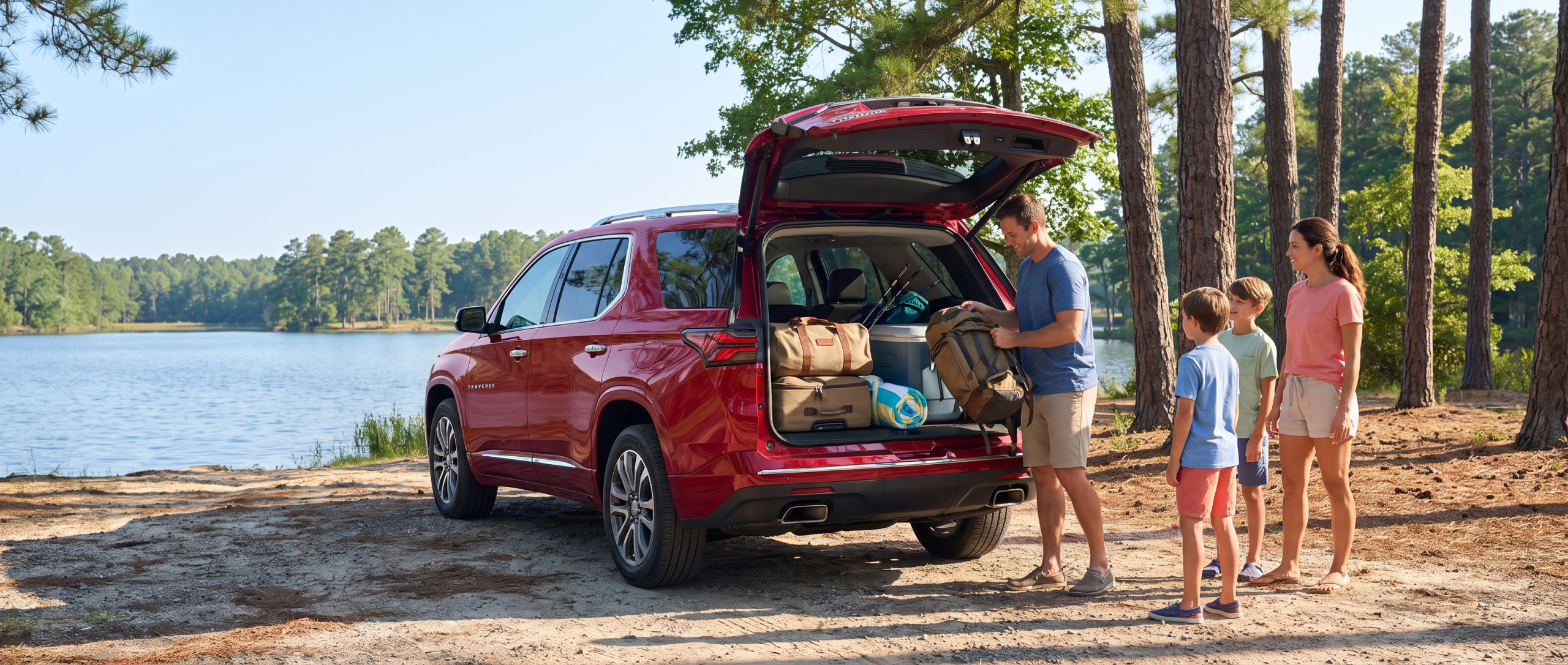
The 2026 Chevrolet Traverse holds 97.6 cubic feet of cargo when both rear rows fold flat. Chevrolet publishes that number, and it holds up. As planning information for a family running all three rows, though, it’s close to useless. You’ve got kids in the second row, maybe a teenager in the third, and a pile of gear that still has to fit somewhere. Passengers versus cargo is the actual road-trip puzzle, and no spec sheet solves it for you.
We walk families through this at Wilson Chevrolet every summer. The ones who load up most efficiently aren’t the ones with the biggest vehicle. They’re the ones who understand how the Traverse cabin divides, and what each zone actually holds. So here’s the row-by-row framework, built on the numbers this truck really delivers.
What Do the Specs Actually Mean for a Real Family Load?
Those cargo numbers only mean something once you can picture them against an actual family load, so we’ve turned each figure into what it does on your trip, with every number verified against Chevrolet’s specs and EPA ratings. Numbers land better when you can see them.
| Spec | Verified Figure | What It Means on Your Trip |
|---|---|---|
| Cargo (all seats up) | 22.9 cu ft | One rolling suitcase + a soft duffel behind row 3 |
| Cargo (row 3 folded) | 56.6 cu ft | Two large suitcases + a cooler + kids’ backpacks |
| Cargo (rows 2+3 folded) | 97.6 cu ft | Full camping haul, bikes with wheels off, or lake gear |
| Engine | 2.5L turbo, 328 hp / 326 lb-ft torque | Handles a loaded cabin on I-77 grades without laboring |
| Towing | Up to 5,000 lbs (properly equipped) | Covers a Lake Wateree fishing boat or utility trailer |
| Fuel economy (FWD) | EPA-est. 20 city / 26 hwy mpg | 19.4-gallon tank; solid highway range between stops |
| Fuel economy (AWD) | EPA-est. 20 city / 24 hwy mpg | 21.7-gallon tank partly offsets the efficiency difference |
| Third-row legroom | 32+ inches | Usable for adults, not just a kids-only row |
| Touchscreen | 17.7 inches, standard | Wireless CarPlay and Android Auto, no cable hunting |
| USB ports | 6 throughout the cabin | Enough for every seat, practically speaking |
Here’s the blunt tradeoff. With a family of six across all three rows, that 22.9 cubic feet behind row three is your entire working cargo zone. Cargo room gets genuinely tight. It fits more than the number suggests on paper, and it still leaves a gap for a full week of gear, which is the planning problem this guide solves.
Packing the Traverse Row by Row
The smartest way to pack a Traverse is to treat it as three separate zones rather than one big bin, since each zone has a specific job and matching your gear to the right zone is how you fit passengers and cargo without repacking at the trailhead.
Browse our current Traverse models and you’ll notice the standard Smart Slide second-row seats right away. They slide forward without removing a child seat, so third-row access stays open even with a car seat locked into row two. That mechanical detail is what makes the row-by-row system work.
Zone 1: Behind the third row (22.9 cu ft, all seats up)
Check this layer first, because it’s your grab-on-arrival zone. Pack it with the snack bag, a small soft cooler, the kids’ entertainment totes, and any shoes coming off for the drive. Soft-sided bags belong here because they compress into odd spaces. A rigid hard-shell suitcase fits too (around 20 to 22 inches of cargo depth clears behind row three), but it fills the entire zone on its own. Keep this layer flexible and low so your rear sight lines stay clear.
Zone 2: The third-row floor and seat-back pockets
Third-row passengers get door pockets plus the row-two seat-back storage. Give each one a slim tablet sleeve, a set of headphones, and a water bottle, and that space earns its keep. Fold the third row down for a gear-heavy trip (a Lake Wateree weekend with kayaks, or a cooler that rivals a small refrigerator) and you open up that 56.6-cubic-foot zone, enough to lay a proper cooler, a large duffel, and a folded camp chair flat without Tetris-level effort.
Zone 3: The second-row floor and console
Run your snack rotation from the second-row floor and console. One collapsible fabric crate between rear-seat feet corrals the snack bag, the tissues, and the cable tangle that otherwise migrates under every seat on the I-77 run south toward Columbia. The 2026 Traverse ships with six USB ports spread through the cabin, which works out to one per seat. Bring one short cable per row and you’re covered. The standard wireless charging pad on the front console handles the driver and passenger with no cable at all.
The safety suite pays off on summer road trips. The I-77 stretch between Winnsboro and Columbia runs through active construction zones in peak summer, and lane shifts happen fast. Lane Keep Assist keeps the Traverse from drifting when your attention swings to the back seat for a second, and Forward Collision Alert gives you an early heads-up when a gap closes quicker than expected. Every trim gets it standard. Not an upgrade. Not a package.
Who the 2026 Traverse Fits Best (and One Honest Limitation)
The 2026 Traverse fits Winnsboro families who run all three rows on a regular basis, and it holds its own against both bigger and smaller Chevrolets in that job, even if it won’t be the right answer for every household. On raw volume, it won’t match a Chevy Tahoe. The Tahoe stretches to 122.7 cubic feet max cargo on a full-size body-on-frame platform, but the Traverse is also a full foot shorter in overall length and slots into a standard garage bay without a tape measure. That matters in Fairfield County, where plenty of driveways and garages went up before three-row SUVs became standard family equipment.
If you’re running two kids or fewer and the third row stays folded more than it’s used, the Chevy Equinox earns a serious look. Smaller footprint, sharper fuel economy, easier to park at the crowded summer lot at Carolina Adventure World. But move four or more people plus a weekend of gear (especially with a boat trailer or a kayak haul for Lake Wateree in the mix), and the Traverse is sized for exactly that job.
On the AWD question for South Carolina summer driving, you don’t need it for July. The EPA-estimated 26-mpg highway on the FWD model is two miles per gallon better than the AWD version, and the flat Midlands roads between Winnsboro and the lake don’t demand all-wheel traction in dry summer conditions. Our team’s read is simple. Go AWD if you’re towing near the 5,000-pound limit or running this vehicle year-round through January ice on US 321. Go FWD for summer road trips, where the highway efficiency and the slightly longer tank range make more practical sense.
Stop in and we’ll walk you through the cargo bay on an actual vehicle before you decide anything. We’ve seen it clear up a decision fast, and it’s worth doing. Bring a measuring tape.
Frequently Asked Questions
Does the 2026 Traverse have enough USB ports for a family of five or six?
Yes. Chevrolet distributes six USB ports through the 2026 Traverse’s three-row cabin, which works out to roughly one per seat. The front row also gets a standard wireless charging pad, so the driver and passenger don’t need a cable at all. For a family of five or six on a long drive, one short USB-C cable per row covers every device without hunting for ports.
Is front-wheel drive enough for summer road trips around Winnsboro, SC?
For summer driving on I-77 and the Midlands roads around Fairfield County, front-wheel drive handles it cleanly. The EPA rates the 2026 Traverse FWD at 20 city and 26 highway miles per gallon, which is two miles per gallon better on the highway than the AWD version. South Carolina’s summer roads don’t demand AWD traction. The stronger case for AWD is winter ice and near-capacity towing. If the vehicle runs primarily in summer and your tow weight stays well under the 5,000-pound ceiling, FWD is the smarter fuel-economy choice for this market.
Connect with us


- July 2026
- June 2026
- May 2026
- April 2026
- March 2026
- February 2026
- January 2026
- November 2025
- June 2025
- May 2025
- April 2025
- February 2025
- December 2024
- November 2024
- September 2024
- August 2024
- July 2024
- April 2024
- March 2024
- February 2024
- January 2024
- December 2023
- October 2023
- September 2023
- May 2023
- April 2023
- March 2023
- February 2023
- January 2023
- September 2022
- July 2022
- June 2022
- March 2022
- January 2022
- December 2021
- November 2021
- October 2021
- September 2021
- August 2021
- July 2021
- June 2021
- April 2021
- January 2021
- December 2020
- November 2020
- October 2020
- September 2020
- August 2020
- July 2020
- June 2020
- May 2020