





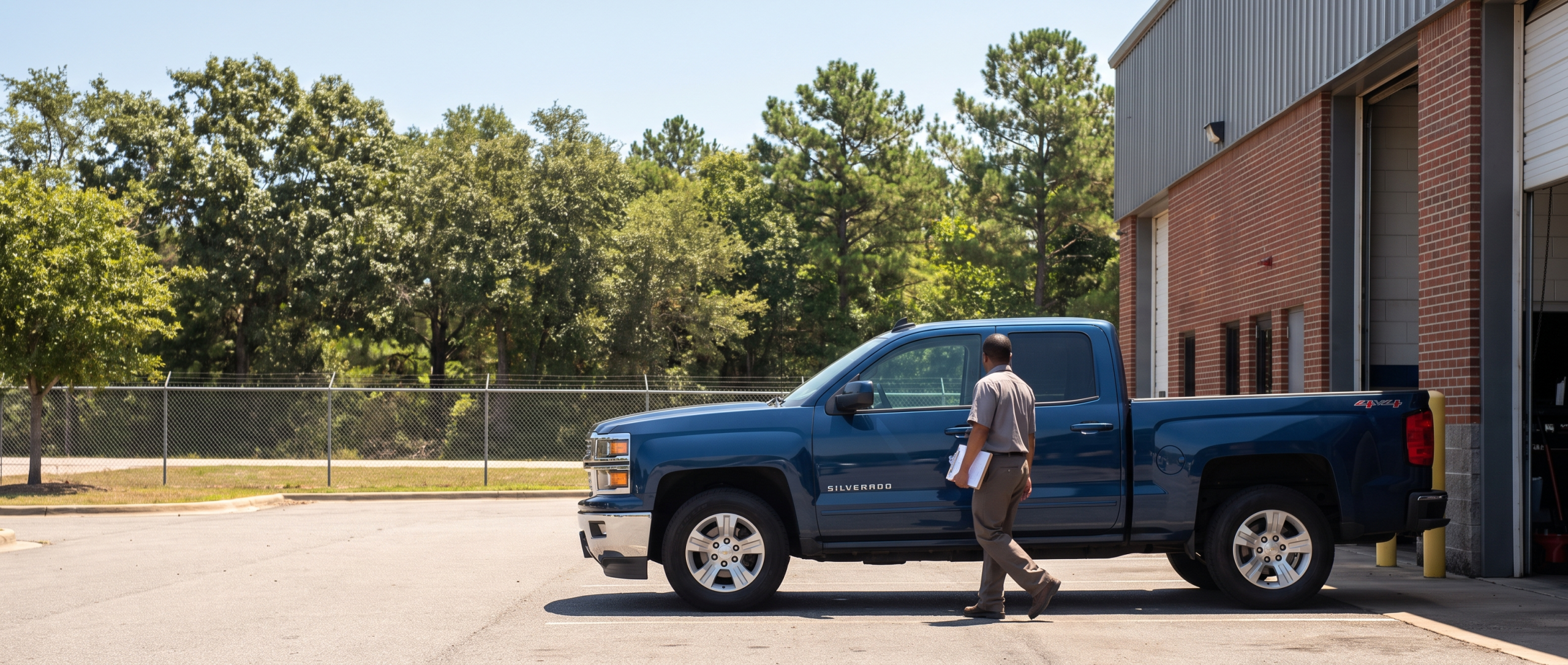
Winnsboro gets serious in July. The average heat index climbs to roughly 111 degrees Fahrenheit, daily highs push into the low 90s, and afternoon thunderstorms roll through several times a week. That combination does specific, measurable damage to specific systems on your Chevy. The question isn’t really “should I service it?” It’s which services matter most for your truck or SUV right now, and why mid-July is a better window than waiting until August when everyone else is scrambling.
Here’s the short version. Then we’ll walk through each call.
- Battery first. AAA confirms heat, not cold, is the leading cause of battery failure. If yours is past three years old, get it tested before August.
- Coolant and cooling system. Engines above 90 degrees Fahrenheit ambient push coolant harder. Towing a boat to Lake Wateree on a 93-degree Fahrenheit afternoon is a real stress test.
- AC and cabin air filter together. A clogged cabin filter chokes your compressor. Replacing both at the same visit is the efficient move.
- Tire pressure is active. AAA notes that every 10-degree rise in temperature adds about 1 PSI. July’s swings matter.
- Mid-July timing advantage. Service centers fill up fast as summer deepens. Scheduling now generally means shorter waits and more appointment flexibility than late August.
Book a service appointment at Wilson Chevrolet
What Actually Matters When Choosing Summer Service for a Chevy?
July heat targets specific weak points, and a generic “summer checklist” treats a Silverado 1500 towing a camper the same as a Trax running school pickups. Those aren’t the same vehicle under the same load, and the services that pay off in July aren’t the ones that pay off in January.
Below is a direct comparison of the main July service categories, what drives the urgency, and the honest tradeoffs:
| Service | Best For | Key Driver | Honest Tradeoff |
|---|---|---|---|
| Battery load test | Any Chevy 3+ years old | AAA data: heat is the top cause of battery failure; heat causes battery fluid to evaporate | A passing test today doesn’t guarantee fall performance if the battery is borderline |
| Cooling system inspection | Silverado 1500/2500 HD towing, Tahoe with heavy loads | Ambient temps above 90 degrees Fahrenheit push the system toward its limits | Not urgent if vehicle is newer and coolant was recently flushed |
| AC diagnostic + cabin air filter | Traverse, Equinox, Trailblazer, Trax | Clogged cabin filter reduces airflow and strains the compressor | If the system is blowing cold and the filter is recent, this can wait |
| Tire pressure check + rotation | All models, especially trucks towing | Each 10-degree temp rise adds roughly 1 PSI; over-inflation raises blowout risk | Rotation alone is low urgency unless you’re near the 7,500-mile mark |
| Fluid check (oil, transmission, brake) | Silverado HD towing, any vehicle near service interval | Heat thins oil faster; transmission fluid darkens under load heat | Purely calendar-based unless the Oil Life Monitor or dipstick tells you otherwise |
| Multi-point inspection | Any vehicle without a recent checkup | Catches belts, hoses, and brake fluid condition before they fail in heat | Adds time to the visit; worth combining with another service |
Not every vehicle needs every row. Our service team starts by looking at your mileage, your service history, and what you’re actually doing with the truck this summer.
The Cooling System Is the One We Take Seriously on Trucks
Silverado 1500 and Silverado 2500 HD owners towing through July are running their cooling systems at elevated demand. When ambient air is already in the low 90s, the engine’s cooling loop has less thermal headroom. Coolant absorbs heat and sheds it through the radiator, and that process becomes less efficient as the fluid ages and its chemical properties break down.
Two things we check consistently on trucks: the coolant level against the “full cold” mark (low coolant lets air pockets form, which causes localized overheating that can warp components), and the condition of the fluid itself. Fresh Chevrolet DEX-COOL should be orange-tinted and translucent. Dark, murky fluid has lost its corrosion inhibitors, and no amount of topping off fixes that.
We’ll be straight about the tradeoff: if your vehicle is under two years old and coolant was factory-fresh, a full flush probably isn’t the priority this visit. A visual inspection to confirm levels and hose condition is the sensible starting point.
The Tahoe running full passenger loads faces a similar version of this. Larger passenger count means more heat sources inside the cabin, and the cooling system also manages transmission heat on longer highway runs up I-77 toward Charlotte or down toward Columbia.
Does the Heat Really Hurt Your Battery?
AAA’s data is clear on this: heat is the leading cause of battery failure, accounting for roughly 25 percent of summer roadside calls. Many drivers assume winter is the battery killer. It’s not. High temperatures accelerate the chemical reactions inside the battery and cause battery fluid to evaporate, weakening its ability to hold a charge. A battery that passes a quick test in May can still deteriorate through June and July as heat accumulates.
The three-year mark is the practical trigger. Before it, a load test is a good idea but not urgent. After it, the conversation changes. A battery that struggles during a test in the service lane rarely improves when August heat and heavy AC demand pile on.
For customers running up and down I-77 for work commutes to Columbia, a dead battery at an exit ramp is a worse situation than a service appointment now. Worth thinking about.
| Scenario | Pros | Cons |
|---|---|---|
| Test and replace proactively (3+ year battery) | Peace of mind through the rest of summer and fall; no stranded risk | Cost of replacement before failure |
| Test and monitor (2-3 year battery, passing load test) | Avoids unnecessary replacement; technician sets a baseline reading | Requires a follow-up test in fall before cold weather |
| Skip testing | No appointment needed now | Real risk of sudden failure in peak summer heat |
The second row is where we land with a lot of customers. A clean passing test gives our team a baseline reading, we note the result, and we recommend retesting before November when cold-crank performance becomes the variable.
Equinox owners specifically: your battery also powers a heavier AC compressor load during South Carolina summers. If you’re running the AC continuously on a long commute, that’s more sustained draw than the battery sees in spring.
Match the Service to How You’re Actually Using the Truck This Summer
A question that comes up regularly at the service counter is “Do I need all of this, or just some?” The answer depends on three things: your mileage, your actual use, and whether your Chevy is giving you any signals.
Chevrolet’s Oil Life Monitoring System on 2026 models watches engine revolutions, operating temperatures, and miles driven together, not just the odometer. It’s designed to alert you within 600 miles of a needed oil change. If that light is on, the system has already accounted for the heat load you’ve been generating. Don’t override it.
A practical breakdown by use pattern:
- If you’re towing to Lake Wateree or hauling to a job site: Coolant system inspection, transmission fluid check, and tire pressure adjustment are all relevant. Towing adds thermal load to multiple systems simultaneously.
- If you’re mostly doing school runs and commutes in an Equinox or Traverse: The AC diagnostic and cabin air filter replacement matter more. A clogged cabin filter chokes airflow, forcing the compressor to work harder to cool the same space. Replacing it is a simple visit with a real payoff in cabin comfort and compressor life.
- If you’re driving a Silverado 1500 or Colorado for mixed use: Battery test, tire pressure check, and a multi-point inspection cover the relevant ground efficiently. Combine them with your next oil change if the mileage lines up.
- If you haven’t been to the service center since last fall: A full multi-point inspection now is the honest recommendation. It surfaces anything that’s been quietly developing through spring, and mid-July is still more manageable than the August crunch.
Scheduling friction is the real downside of waiting. Lanes get fuller as summer progresses. Booking online now at Wilson Chevrolet is the practical workaround.
Frequently Asked Questions
Does summer heat really hurt car batteries more than winter cold?
Yes. AAA data shows heat is the leading cause of battery failure, not cold. High temperatures accelerate chemical reactions inside the battery and cause the fluid to evaporate, reducing its ability to hold a charge. A battery that appears functional in spring can degrade meaningfully through a South Carolina July. AAA advises that batteries typically last three to five years and should be tested regularly after the three-year mark, with testing becoming more urgent as summer heat accumulates.
How do I know if my Chevy’s AC system needs service versus just a cabin air filter change?
Start with the cabin air filter. A clogged filter restricts airflow through the blower and forces the AC compressor to run harder to cool the cabin. Replacing a dirty filter is a straightforward service that often restores cooling performance noticeably. If the system is blowing warm air despite good airflow, or you hear unusual noises from the compressor, that points to the AC system itself, and a diagnostic check is the right next step. Our service team at Wilson Chevrolet runs both checks at the same visit so you don’t guess at which problem you actually have.
Why should I service my Chevy in mid-July rather than wait until later in summer?
Service centers experience heavy demand as summer progresses. Booking appointments in mid-July typically means shorter wait times and more appointment flexibility compared to late August. Scheduling now helps you address cooling system and battery concerns before peak heat stress arrives in late summer.
Connect with us


- July 2026
- June 2026
- May 2026
- April 2026
- March 2026
- February 2026
- January 2026
- November 2025
- June 2025
- May 2025
- April 2025
- February 2025
- December 2024
- November 2024
- September 2024
- August 2024
- July 2024
- April 2024
- March 2024
- February 2024
- January 2024
- December 2023
- October 2023
- September 2023
- May 2023
- April 2023
- March 2023
- February 2023
- January 2023
- September 2022
- July 2022
- June 2022
- March 2022
- January 2022
- December 2021
- November 2021
- October 2021
- September 2021
- August 2021
- July 2021
- June 2021
- April 2021
- January 2021
- December 2020
- November 2020
- October 2020
- September 2020
- August 2020
- July 2020
- June 2020
- May 2020