





You’re trying to fit kayaks, coolers, and a full family into one vehicle for a run down to Lake Wateree, or you’re loading ATV gear for a weekend at Carolina Adventure World and you need every cubic foot to count. The right Chevy comes down to a question the spec sheet never asks. How many seats do you need standing up while the gear rides along?
- Tahoe (pick for most families): 72.5 cu ft with the third row folded, seats still up front and in row 2. This is the gear-and-people balance winner for Fairfield County families who do both.
- Traverse (pick for crossover comfort): 97.6 cu ft maximum is class-leading for a midsize SUV, but towing tops out at 5,000 lbs and the step-in is lower and easier for kids.
- Colorado (pick for gear that gets wet or dirty): Open bed handles bikes, muddy ATVs, and gear that can’t go inside. Payload up to 1,710 lbs. But seat five, not seven.
- Towing a boat or trailer: The Tahoe reaches 8,400 lbs max; the Colorado reaches 7,700 lbs; the Traverse is not the choice here.
- The tradeoff you need to hear: The Tahoe’s behind-the-third-row space (25.5 cu ft with all seats up) is tighter than it sounds. Plan to fold that row for any serious gear run.
The 2026 Chevrolet Tahoe sits at the center of this comparison for a reason, though it isn’t the automatic winner for every load you’ll throw at it.
How Do the Three Stack Up on Cargo?
On paper the answer flips with the load, because the Colorado’s open bed wins for wet and dirty gear while the Tahoe’s folded-flat interior wins on raw volume, and the side-by-side below sorts it out using figures drawn straight from Chevrolet-published specifications.
| Configuration | 2026 Tahoe | 2026 Traverse | 2026 Colorado |
|---|---|---|---|
| Cargo (all seats up / 3rd row up) | 25.5 cu ft | 22.9 cu ft | 41.9 cu ft (open bed) |
| Cargo (3rd row folded) | 72.5 cu ft | 56.6 cu ft | Not applicable |
| Maximum cargo (all rows flat) | 122.7 cu ft | 97.6 cu ft | Not applicable |
| Max towing capacity | 8,400 lbs | 5,000 lbs | 7,700 lbs |
| Payload (truck bed) | Not applicable | Not applicable | Up to 1,710 lbs |
| Seating capacity | Up to 9 | Up to 8 | 5 |
| Load floor | Flat (IRS) | Flat | Open bed |
| Best for | Gear + full crew | Family comfort + max interior | Wet/dirty gear, boats, ATVs |
Check the load floor, not just the cubic-foot total. The Tahoe’s independent rear suspension creates a genuinely flat load floor, which matters when you’re sliding two 10-foot kayaks into a 211-inch vehicle. A crossover platform gives the Traverse a lower step-in height. And the Colorado’s open bed keeps your fishing rods and muddy trail bikes out of the same air as the crew.
Load shape matters as much as volume.
Does the Tahoe Actually Fit Sports Gear With the Family Inside?
Yes, the Tahoe fits sports gear with the family inside, as long as you fold the third row, because the figure that trips people up is the all-seats-up number, and the working setup gets a lot roomier once row three drops out of the way. The 2026 Tahoe lists 122.7 cu ft maximum, and that’s real, but it takes all seats folded flat. For Winnsboro families driving to Lake Wateree with a full crew, the working number is 72.5 cu ft when you fold just the third row and keep rows one and two up. Call it the realistic gear-hauling configuration when you’re carrying five or six people.
The 2026 Traverse maxes at 97.6 cu ft, also with all rear seats down. Its more useful comparison point is 56.6 cu ft with the third row folded, notably less than the Tahoe in the same configuration.
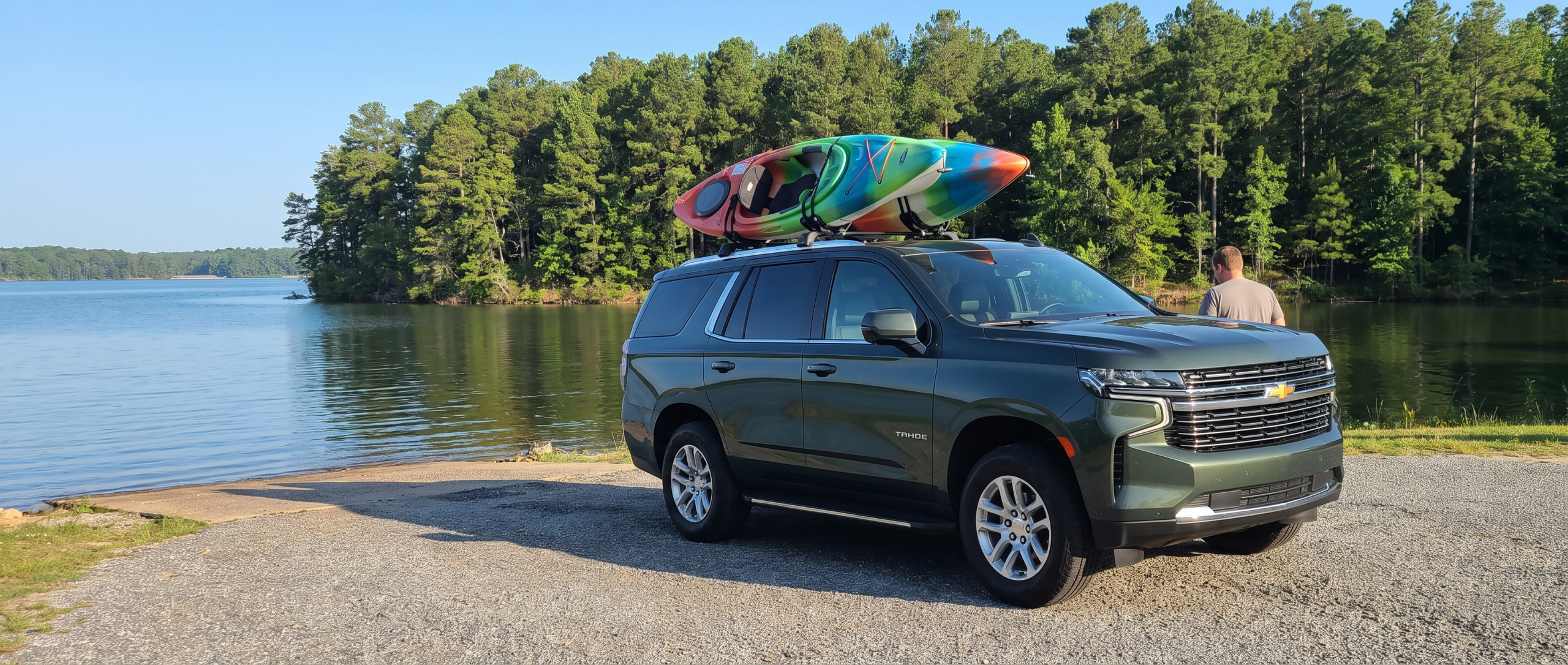
On hot South Carolina summer runs, we lean hard on those standard roof rails. Strap the kayaks or paddleboards up top, keep the interior for the crew and the cooler, and you’ve handled the space equation without folding a single seat.
Which Option Wins When You’re Towing to Lake Wateree?
When you’re towing to the Lake Wateree ramp, the Tahoe and Colorado pull cleanly away from the Traverse, and the winner between them comes down mostly to trailer weight rather than anything you’ll read in a cargo chart. Chevrolet rates the 2026 Tahoe at up to 8,400 lbs maximum towing capacity and the 2026 Colorado at up to 7,700 lbs. The Colorado is the better call when the gear goes in the bed and the boat goes on the hitch, and it’s sized right for parking at the boat ramp and on the trail. Carolina Adventure World is in Winnsboro.
The Traverse’s 5,000 lb towing rating handles a small personal watercraft trailer on calm lake days, but we’d steer you toward the Tahoe or Colorado the moment that trailer gets heavier.
Which Chevy Fits Your Sports Gear Lifestyle in Fairfield County?
Pick by what your weekend actually looks like, because each of these Chevys wins a different job and none of them wins all three, so match the vehicle to your real load and your real crew before you fall for a single headline number.
You need the 2026 Tahoe if: Your crew runs five or more, your gear includes kayaks, paddleboards, or camping equipment, and you want to tow a boat while keeping everyone comfortable on the I-77 run down to Lake Wateree. The flat load floor (Chevrolet’s independent rear suspension earns its keep here) and the roof rails make gear management straightforward. Accept the honest tradeoff, though. With all three rows up, 25.5 cu ft isn’t a lot of room for a full gear haul, so you’ll fold that third row and plan accordingly.
You need the 2026 Traverse if: Your household runs two or three kids, their sports bags, and a couple of bikes, you’re not towing anything heavy, and the outdoor adventures stay land-based. The lower step-in is easier for younger kids, the maximum 97.6 cu ft beats any other three-row crossover in the segment, and the 60/40 split third row lets you fold one side while keeping a seat on the other.
You need the 2026 Colorado if: The gear is bulky, muddy, or wet (mountain bikes, ramp-loaded ATVs, kayaks that won’t fit inside anything) and your crew is four or five people, not six or seven. Skip the idea of a sealed cargo area, because the 5’2″ crew-cab bed at 41.9 cu ft is open-air by design and rain will hit your gear. Plan for bed covers or dry bags. Payload up to 1,710 lbs means real capacity for serious loads, and 7,700 lbs of towing headroom covers most recreational trailers on the market.
Frequently Asked Questions
Will a full-size kayak fit inside a 2026 Tahoe?
A standard 10-foot recreational kayak won’t fit fully inside the Tahoe’s cargo area with the hatch closed, even with every seat folded, because the interior cargo length runs shorter than the hull. The practical solution is those standard roof rails. Strap the kayak on top, carry paddles and gear bags inside, and put the 72.5 cu ft (third row folded) to work on everything else. Chevrolet lists crossbars as an available accessory; they are not included standard, so add them before the first Lake Wateree run.
Does the Traverse tow enough for a small boat?
The 2026 Traverse is rated by Chevrolet for up to 5,000 lbs maximum towing capacity, which covers a small aluminum fishing boat or a single-seat personal watercraft on a light trailer. Larger ski boats and pontoons run heavier, so they sit outside that number. For anything you’d regularly pull to Lake Wateree with a full crew on board, the 2026 Tahoe’s 8,400 lb rating or the Colorado’s 7,700 lb rating gives you more headroom and peace of mind.
Connect with us


- August 2026
- July 2026
- June 2026
- May 2026
- April 2026
- March 2026
- February 2026
- January 2026
- November 2025
- June 2025
- May 2025
- April 2025
- February 2025
- December 2024
- November 2024
- September 2024
- August 2024
- July 2024
- April 2024
- March 2024
- February 2024
- January 2024
- December 2023
- October 2023
- September 2023
- May 2023
- April 2023
- March 2023
- February 2023
- January 2023
- September 2022
- July 2022
- June 2022
- March 2022
- January 2022
- December 2021
- November 2021
- October 2021
- September 2021
- August 2021
- July 2021
- June 2021
- April 2021
- January 2021
- December 2020
- November 2020
- October 2020
- September 2020
- August 2020
- July 2020
- June 2020
- May 2020