





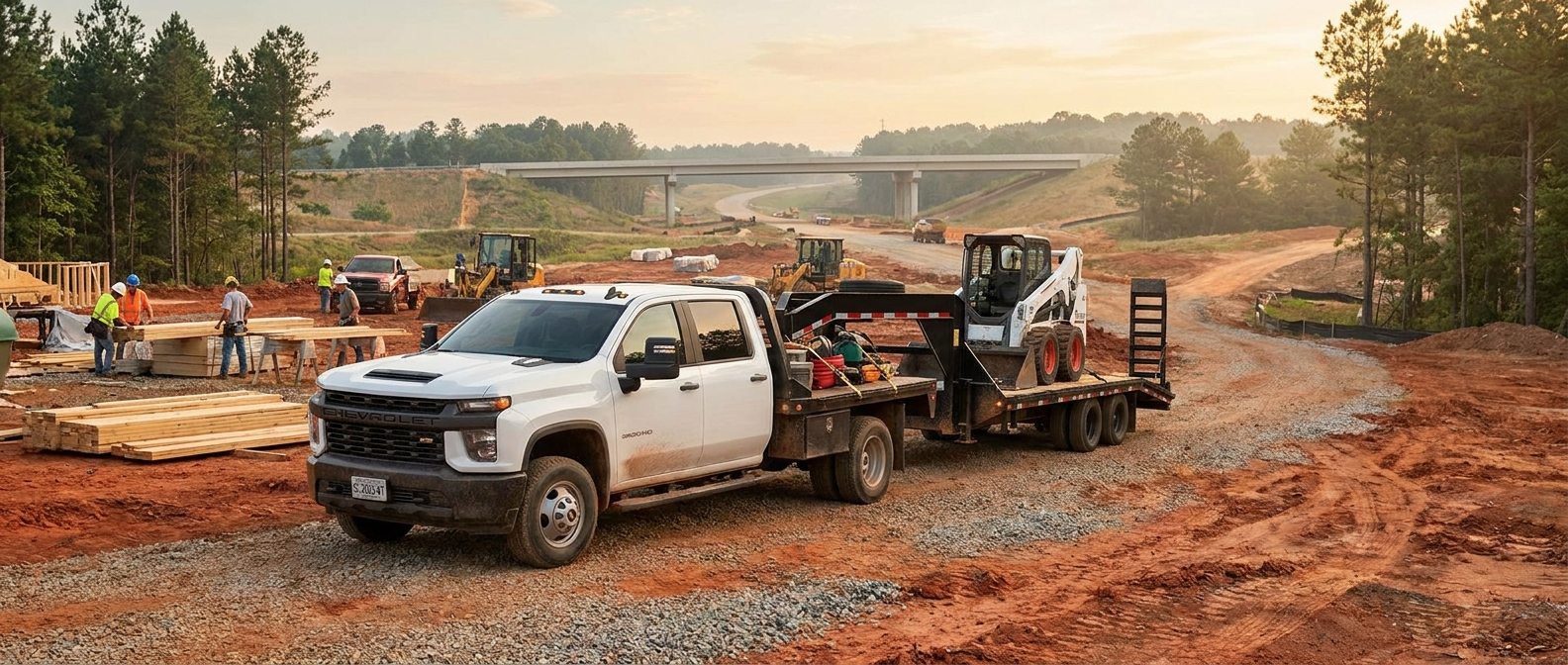
For jobsite work around here, the 2026 Silverado 2500HD is the right truck, and that part isn’t really in doubt. The harder call is which engine fits your actual work pattern, and whether the 2026’s new standard trailer brake controller changes how you should think about it.
The short answer depends on what you pull. If you’re pulling equipment trailers over 14,000 pounds week in and week out, or running I-77 south toward Columbia with a loaded gooseneck, the Duramax diesel earns its place. If your day is mostly in-town starts and stops, drop-offs at subdivisions off Blythewood Road, and loads under 12,000 pounds, the 6.6L gas V8 is a capable, lower-maintenance choice that most generic articles won’t admit.
How Do the Two Engines Actually Work?
The 2026 Silverado 2500HD runs two distinct powertrains, and the difference goes well beyond what you’ll read on a spec sheet.
| Feature | 6.6L Gas V8 | 6.6L Duramax Turbo-Diesel V8 |
|---|---|---|
| Horsepower | 401 hp | 470 hp |
| Torque | 464 lb-ft | 975 lb-ft |
| Max Conventional Tow | ~14,500 lbs | 18,500 lbs |
| Max Gooseneck Tow | Not rated for gooseneck peak | 22,070 lbs (with 5th Wheel/GN Prep) |
| Payload (max) | Up to 3,689 lbs (verify door sticker) | Up to 3,689 lbs (verify door sticker) |
| Transmission | Allison 10-speed automatic | Allison 10-speed automatic |
| Best for | Short hauls, jobsite variety, lower complexity | Long pulls, heavy gooseneck loads, highway efficiency |
| DEF/DPF maintenance | No | Yes |
Chevrolet lists both the gas and diesel at a maximum payload of up to 3,689 lbs, though your door-jamb sticker is the authoritative number for your specific build. Both engines pair to the Allison 10-speed automatic, and that’s a genuine strength of this platform. The torque gap matters more than the payload. You get 975 lb-ft from the Duramax against 464 from the gas V8, and you feel that 511 lb-ft spread when you pull a loaded skid steer up a grade, or when you hold highway speed with a heavy trailer and the engine barely spins up.
The Duramax delivers that torque low in the RPM range. Forum communities of 2500HD owners describe it as the difference between a diesel and a gas V8 on sustained pulls. The diesel pulls without drama, and the gas V8 gets the job done. You’ll just hear it working harder.
See which configurations we have on the lot at Wilson Chevrolet
Which Engine Do You Actually Need Around Here?
Which engine you need depends on your load profile, and around Blythewood the loads are anything but light right now. Scout Motors’ manufacturing facility under construction in Blythewood has 500 construction workers already on the site, and a significant I-77 interchange groundbreaking ceremony was held in February to handle the project’s traffic. There are 32 active development projects tracked in Blythewood right now. None of that is slow growth. It’s a full construction season with real equipment moving up and down I-77.
All of that context feeds straight into your engine decision. Let’s sort out which engine fits.
If your loads typically run under 12,000-13,000 pounds (a tandem utility trailer with a compact excavator, tools and materials for residential builds, or a landscape equipment trailer), the 6.6L gas V8 covers you. It handles approximately 14,500 lbs conventional, it doesn’t require Diesel Exhaust Fluid, and an oil change is simpler and less expensive. For contractors doing short daily loops through Blythewood and back to Winnsboro, the gas engine earns its keep.
If you’re running gooseneck loads, heavy equipment trailers, or making regular highway runs down I-77 toward Columbia or up toward Charlotte, the Duramax changes the feel of the job. Eighteen thousand five hundred pounds conventional, 22,070 lbs with the 5th Wheel/Gooseneck Prep Package. Right there, the diesel’s 975 lb-ft of torque stops being a bragging right and becomes a functional margin.
The tradeoff here is real, and it’s worth naming. Diesel adds maintenance complexity, including DEF fluid, DPF filter service, and higher service costs per interval. For a contractor whose truck mostly runs jobsite-to-jobsite in Richland County with loads under the gas threshold, that complexity doesn’t buy you anything. For the operator pulling heavy iron consistently, it’s worth every bit of it.
View Current Silverado 2500HD Offers
The 2026 Change That Actually Matters to You: Standard Trailer Brake Controller
The standard trailer brake controller is the 2026 change that quietly reshapes the buying decision. For 2026, Chevrolet made the integrated trailer brake controller standard on every single Silverado 2500HD trim, from Work Truck through High Country. Before this year, it was a mid-to-upper trim feature or an add-on. Now the in-dash controller is factory-installed in every truck we sell. You’ll have it on day one.
In practice, that works simply. When you press the brake pedal, the system sends proportional brake-force signals directly to your trailer’s electric brakes through the truck’s own antilock brake electronics. It reads how hard you’re stopping and applies the trailer brakes in proportion. It is not a fixed-gain separate box you dial in after the fact.
For a construction worker hitching an equipment trailer often, the value isn’t just convenience. You get consistent, calibrated trailer braking from a Work Truck spec without paying for a higher trim or buying an aftermarket Prodigy and running wiring.
| Term | What It Means for You |
|---|---|
| Integrated trailer brake controller | Factory unit wired into the truck’s ABS; controls trailer electric brakes proportionally |
| DEF (Diesel Exhaust Fluid) | Required additive for diesel emissions; must be kept topped up; additional service cost |
| DPF (Diesel Particulate Filter) | Exhaust filter that regenerates passively on highway runs; short-trip-only operation can cause issues |
| Gooseneck Prep Package | Factory-installed bed mounting points and wiring for 5th wheel or gooseneck hitches |
| Allison 10-speed automatic | Heavy-duty transmission used by both gas and diesel Silverado HD builds |
| Durabed | Silverado HD’s steel cargo bed (83.5 cubic feet, 12 tie-down points rated at 500 lbs each) |
Not sure if you need the 2500HD or if the Silverado 1500 would cover it?
What This Means for Your Next Work Truck
Our team at Wilson Chevrolet is about 25 minutes up I-77 from Blythewood on US 321 in Winnsboro. Contractors, tradesmen, and fleet buyers all work through this same engine decision, and we’re glad to talk it through. We’d frame it this way. The 2026 Silverado 2500HD is the right platform for the Blythewood construction market right now. For the majority of in-county work, the gas V8 is a capable, practical choice. The Duramax diesel is the right call the moment your load profile or your haul distances push past what the gas engine handles comfortably.
The standard trailer brake controller means you’re no longer forced up the trim ladder just to get proper trailer braking. For fleet buyers who want Work Truck functionality without the options cost, that’s a genuine change.
We’ll walk through your specific trailer weights, your typical routes, and what cab and bed configuration matches your crew, or you can start with the link below. Either way, come out and see us.
Frequently Asked Questions
Does the 2026 Silverado 2500HD come with a trailer brake controller on the base Work Truck trim?
Yes. For 2026, Chevrolet made the integrated trailer brake controller standard on every Silverado 2500HD trim, including the base Work Truck. The in-dash unit connects directly to the truck’s antilock brake electronics and applies proportional braking force to your trailer’s electric brakes based on how hard you press the brake pedal.
Gas or Duramax diesel (which makes more sense for construction work around Blythewood)?
It depends on your load profile. The 6.6L gas V8 (401 hp, 464 lb-ft of torque) handles conventional towing up to approximately 14,500 lbs and is the lower-maintenance option for shorter, in-county hauls. The 6.6L Duramax diesel (470 hp, 975 lb-ft) handles up to 18,500 lbs conventionally and 22,070 lbs gooseneck, and makes more sense if you’re running heavy equipment trailers regularly or making frequent I-77 highway pulls. The diesel requires DEF fluid and higher-cost service intervals, so for lighter construction patterns, the gas engine is a honest, capable choice.
Connect with us


- August 2026
- July 2026
- June 2026
- May 2026
- April 2026
- March 2026
- February 2026
- January 2026
- November 2025
- June 2025
- May 2025
- April 2025
- February 2025
- December 2024
- November 2024
- September 2024
- August 2024
- July 2024
- April 2024
- March 2024
- February 2024
- January 2024
- December 2023
- October 2023
- September 2023
- May 2023
- April 2023
- March 2023
- February 2023
- January 2023
- September 2022
- July 2022
- June 2022
- March 2022
- January 2022
- December 2021
- November 2021
- October 2021
- September 2021
- August 2021
- July 2021
- June 2021
- April 2021
- January 2021
- December 2020
- November 2020
- October 2020
- September 2020
- August 2020
- July 2020
- June 2020
- May 2020