





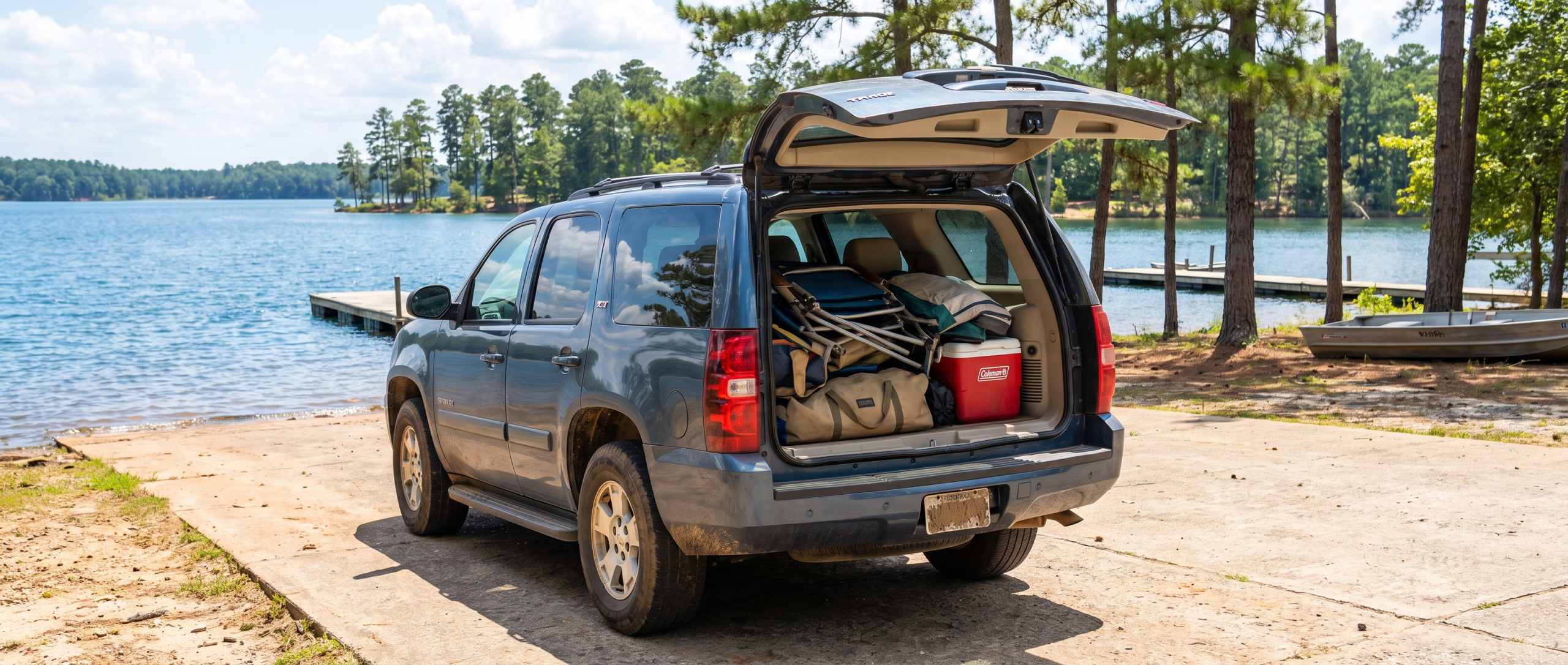
Summer road trips don’t forgive a bad vehicle choice. If you’re shopping a used Tahoe right now for family travel, we’ll give you the honest answer up front. The 2021 redesign is the cleanest dividing line in the model’s history, and almost everything you care about as a family buyer changed on that side of it.
Browse our current pre-owned Chevrolet Tahoe inventory and then come back here to understand exactly what each generation delivers and where each one can bite you.
- Sweet spot for most family buyers: 2022 to 2024, which lets the 2021 first-year build issues shake out while keeping the redesign’s third-row space and independent rear suspension
- Budget-conscious sweet spot: 2018 to 2020, with the caveat that you verify the AFM lifter history before you buy
- Years to approach with extra caution: 2007 to 2009 (highest documented complaint volumes), 2015 to 2017 (two separate brake and steering recalls to verify), and 2021 first-run builds (early quality reports)
- The single biggest upgrade in Tahoe history for families: the 2021 switch to independent rear suspension, which added 10.1 inches of third-row legroom and nearly doubled cargo space behind row three
- Always run the VIN through NHTSA’s recall database before purchase. Open recalls are free to fix at any Chevrolet dealership, but only if you know they exist.
Which Tahoe Years Hit the Sweet Spot for Families?
For most family buyers the sweet spot lands on 2022 to 2024, since those years pair the 2021 redesign with a full production cycle of build refinement, and that’s why this generation earns the top spot in our book. We’ll walk each range and where it fits.
The 2021 Tahoe was a genuine generational leap. Chevrolet moved to independent rear suspension for the first time in the nameplate’s history, stretching the third row by 10.1 inches (to 34.9 inches of legroom) and pushing cargo space behind the third row from 15.3 cubic feet to 25.5. On a two-day drive that matters enormously, because adults can actually sit in row three without their knees in their chins. Fold everything flat and you get 122.9 cubic feet (enough for a full week’s gear for five, plus a cooler).
We nudge buyers toward 2022 to 2024 rather than the 2021 launch year for one plain reason. A new generation of a mass-produced vehicle tends to iron out its build-quality wrinkles by year two, and on a purchase this size that patience costs very little while saving real headaches.
| Year Range | Generation | Sweet Spot? | Key Notes |
|---|---|---|---|
| 2007 to 2009 | 4th gen (early) | Avoid | Highest documented complaint volumes; AFM lifter failures begin |
| 2010 to 2014 | 4th gen (mid-late) | Acceptable | Solid towing; AFM present (verify lifter history); piston-ring TSB on 5.3L |
| 2015 to 2017 | 4th gen (refresh) | Caution | Two NHTSA recalls (brake vacuum pump, electric power steering); confirm completed |
| 2018 to 2020 | 4th gen (final) | Good value | Refreshed transmission; up to 8,600 lbs towing; AFM risk still present |
| 2021 | 5th gen (launch) | Good, watch build quality | IRS, 25.5 cu ft cargo, 34.9 in. third-row legroom (but early production reports mixed) |
| 2022 to 2024 | 5th gen (settled) | Sweet Spot | Same specs as 2021 redesign, build quality more consistent |
Which Years Should You Watch Out For?
Before you hand over a check for any fourth-generation Tahoe (2007 to 2020), the AFM lifter issue is the one thing you need to understand, and it isn’t a dealbreaker on a well-maintained truck, but it’s the item that separates a smart buy from an expensive lesson.
Chevrolet’s Active Fuel Management system (designed to cut fuel use by shutting down four cylinders under light load) uses specialized hydraulic lifters that are a documented weak point. NHTSA Technical Service Bulletin PIP4568R, issued by GM and covering 2007 to 2014 Tahoes, addresses tick noise and misfires on AFM cylinders. The symptom shows up as a rhythmic engine tick that worsens under acceleration, followed by misfire codes. When a lifter collapses and isn’t addressed quickly, it can damage the camshaft and push metal debris through the engine. The resulting repair is a major teardown. None of that is a reason to avoid these trucks entirely, but it’s a reason to ask for complete oil-change records and listen carefully on a test drive.
A few specific ranges deserve extra attention.
2007 to 2009. These years carry the highest documented complaint volumes in the Tahoe’s history. The AFM system had just launched and the calibration problems were at their worst. We’d only recommend them if the price reflects the risk. Line up a trusted pre-purchase inspection first.
2015 to 2017. Two separate NHTSA recall campaigns affected these years. One (NHTSA campaign 18V586) addressed intermittent electric power steering assist loss. The other addressed brake vacuum pump output that could reduce braking assist. Both are corrected free of charge at any Chevrolet dealership, but only if the work was already done, so you’ll want proof. Before you buy, run the VIN. Confirm both remedies show as completed.
2021 (first-run builds). The redesign itself is excellent. Some early 2021 production vehicles showed paint and panel quality inconsistencies, and a seat belt buckle assembly recall affected 2021 to 2022 Tahoes (NHTSA, covering third-row buckle rivet formation). The buckle recall is a free fix. Confirm it’s been addressed.
If three-row space matters but the Tahoe budget is a stretch, the Chevrolet Traverse is worth putting side by side. It gives up the body-on-frame towing muscle in exchange for a more manageable footprint and better fuel economy.
Which Year Fits Which Buyer?
Not every family needs a 2022 to 2024, and matching the right year to your driving comes down to being straight about how you’ll really use the truck, so we’ll sort buyers into a few real-world profiles and point each one at the range that fits.
You’re heading to Lake Wateree or loading up for a long I-77 haul and you need a trailer behind you. Lake Wateree sits in central South Carolina. Get a 2021 or newer. Chevrolet rates the 5.3L V8 (2WD, properly equipped) at up to 8,400 pounds of towing. The independent rear suspension makes the highway miles more livable for the people not driving. If you’re pulling a boat or a camper through the Midlands summer heat, you want the newer transmission calibrations and the more settled build.
You need three real rows, not two and a cargo shelf. Again, 2021+. The 10.1-inch gain in third-row legroom isn’t marketing math. The gap shows up as the difference between teenagers refusing to get in and teenagers finally fitting. Before 2021, the solid rear axle ate into that floor space. The IRS erased it.
You’re working with a tighter budget and you’re comfortable doing your homework. A 2018 to 2020 Tahoe with documented service records, completed recalls, and a pre-purchase inspection can be a smart buy. Towing on those years ran up to 8,600 pounds (5.3L V8, in fact slightly above the 2021+ spec). The AFM risk is real but manageable if maintenance was consistent and oil changes came every 5,000 miles or less. Records make or break that year.
You want to get in and out without worrying about AFM lifters at all. Target 2022 and up. Chevrolet moved from AFM to Dynamic Fuel Management on the newer fifth-generation trucks, and the DFM system’s different architecture has a shorter track record of the same catastrophic failure pattern. You’re not completely clear of lifter territory with DFM, but the documented complaint profile is substantially lower so far. The peace of mind is worth it.
One honest tradeoff is worth naming. The fifth-generation Tahoe is a big vehicle. At 210.7 inches long, it’s not small-town-parking-lot friendly. If most of your driving is local Winnsboro errands and the trip to the lake is seasonal, that size can feel like a lot. The Traverse handles daily-driver duty with less real estate and similar three-row space for buyers who don’t regularly need that 8,400-pound tow rating.
Bring the VIN to our service center before you finalize anything. Once you’ve landed on a year range, our team can check for open NHTSA recalls on that specific vehicle and put eyes on the AFM-related items a quick test drive won’t always surface.
Schedule a pre-purchase inspection with our service team and we’ll tell you what we see, not what a listing says.
Frequently Asked Questions
Is the 2021 Chevrolet Tahoe a good used buy, or should I wait for a 2022?
The 2021 redesign brought genuine, measurable improvements. It added 10.1 inches of third-row legroom (to 34.9 inches total), pushed cargo space behind the third row from 15.3 to 25.5 cubic feet, and switched to independent rear suspension. It’s a good truck. Still, first-year production of any new generation tends to carry more early-build variability, and a 2021 to 2022 NHTSA recall covering third-row seat belt buckle assemblies means you should confirm the remedy was completed before purchase. A 2022 gives you the same platform with an extra production year of refinement.
What is the AFM lifter issue and which Tahoe years are affected?
AFM stands for Active Fuel Management, Chevrolet’s system for deactivating cylinders under light load to save fuel. The specialized hydraulic lifters that enable it are a documented failure point in 2007 to 2020 Tahoes. NHTSA Technical Service Bulletin PIP4568R covers the tick-noise-and-misfire symptom on 2007 to 2014 models specifically. The failure pattern continued into later fourth-generation trucks. Symptoms include a rhythmic ticking from the engine and misfire codes (P0300 range). If you’re considering any 2007 to 2020 Tahoe, request complete oil change records, listen for tick on a warm engine, and factor a pre-purchase inspection into the decision.
How much can a used Chevrolet Tahoe tow for pulling a boat or camper?
It depends on the generation, and you’ll want to match the number to your trailer. Chevrolet rates 2021-and-newer Tahoes (5.3L V8, 2WD, properly equipped) at up to 8,400 pounds of towing capacity. The outgoing 2020 generation (5.3L V8) was rated slightly higher at 8,600 pounds. The 2015 to 2020 range ran 7,900 to 8,600 pounds depending on configuration. For a typical pontoon boat and trailer in the 4,500 to 6,000-pound range, any Tahoe from 2015 onward configured for towing has the capability. The bigger question is maintenance history on the transmission and cooling system.
Connect with us


- July 2026
- June 2026
- May 2026
- April 2026
- March 2026
- February 2026
- January 2026
- November 2025
- June 2025
- May 2025
- April 2025
- February 2025
- December 2024
- November 2024
- September 2024
- August 2024
- July 2024
- April 2024
- March 2024
- February 2024
- January 2024
- December 2023
- October 2023
- September 2023
- May 2023
- April 2023
- March 2023
- February 2023
- January 2023
- September 2022
- July 2022
- June 2022
- March 2022
- January 2022
- December 2021
- November 2021
- October 2021
- September 2021
- August 2021
- July 2021
- June 2021
- April 2021
- January 2021
- December 2020
- November 2020
- October 2020
- September 2020
- August 2020
- July 2020
- June 2020
- May 2020