





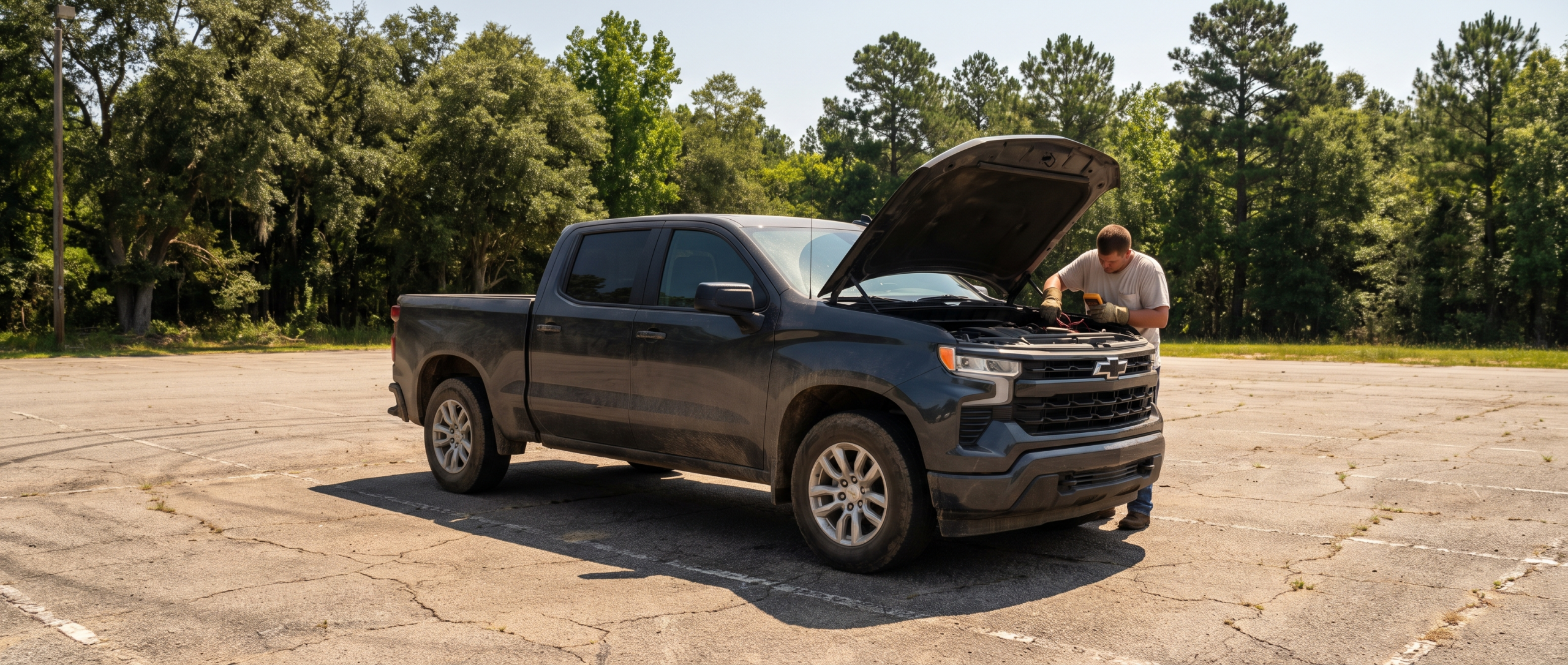
Pull up to a gas station anywhere along I-77 on a July afternoon and you’ll spot one. A Chevy truck or SUV sitting idle, hood up, owner staring at the engine bay with that look. A dead battery in 93-degree heat is a genuinely miserable situation, and it’s almost always preventable. The good news is your Chevy will tell you it’s coming, if you know where to look.
So run a quick visual and functional check right now, before the hottest weeks of the Winnsboro summer turn a weak battery into a crisis.
Our Silverado 1500 inventory shows this more than any other model in summer, but every Chevy on the road is dealing with the same South Carolina heat.
What Do You Need Before You Start?
You need very little for this check, and most of it’s already in your house or your cab, with one optional tool if you want an actual voltage number instead of a visual guess. The whole thing takes about ten minutes. Grab what you can before you head out.
| Item | Why You Need It | Where to Get It |
|---|---|---|
| Safety glasses | Battery acid is corrosive | Any hardware store |
| Nitrile gloves | Same reason | Any hardware store |
| Flashlight or phone light | Terminal corrosion hides in shadow | You already have it |
| Clean dry rag or paper towel | Wipe down terminals for a clear look | Grab from the cab |
| Multimeter (optional) | Measures resting voltage | Auto parts store |
And that’s the entire kit. No special tools required. Want to go further? A proper load test at our service center takes about five minutes when we run it, and it settles what the visual check can only hint at.
The 6-Step Battery Warning Sign Check
South Carolina summers are hard on a battery in a way the outside temperature never fully shows, because the worst of the heat concentrates under the hood rather than out in the open air. The ideal operating temperature for a lead-acid battery is around 77 degrees Fahrenheit. Winnsboro’s July average high is 91.6 degrees Fahrenheit outside. Under the hood, especially after a run down US 321 or a longer I-77 stretch, that under-hood air can exceed 150 degrees Fahrenheit. Per AAA, batteries in southern US states last an average of 17 months less than the same battery would in cooler northern climates. The damage is invisible and it stacks up all season. You can catch it in six steps, and here’s each one.
Step 1: Check the age first.
Find the manufacture date sticker on the top or side of the battery case. A code like “7/23” means July 2023. That battery’s three years old this month. Most Chevy batteries last between three and five years, and in South Carolina heat, that window runs closer to the three-year end. If it’s past four years and you haven’t tested it this season, you’ve got your answer right there.
Traverse owners and Tahoe owners have higher electrical loads to manage (three rows, powered running boards, rear entertainment systems), which shortens that window further under sustained summer driving.
Step 2: Look at the terminals.
Pop the hood and put on your gloves. Look at the positive (red) and negative (black) terminals where the cables clamp to the battery posts. A light gray or white powdery crust is ordinary, slow-building corrosion. Blue-green residue or a thick crusty buildup is a problem. Per AAA service guidance, terminal corrosion increases electrical resistance and can prevent your battery from fully charging even when the alternator is working fine. You get an invisible drain nobody catches until the morning the truck won’t crank.
Step 3: Inspect the battery case.
Look at the battery housing itself. It should be a clean rectangular box with flat sides. If the sides are bulging outward or the case looks swollen, you’re looking at a heat damage flag. Excess under-hood heat causes internal gas pressure to build, physically distorting the casing. A swollen battery is not a “probably fine for now” situation. It needs to come out.
Step 4: Smell around the battery.
This sounds strange, but do it. A rotten-egg or sulfur smell near the battery (not elsewhere in the engine bay) means the battery is off-gassing hydrogen sulfide, which happens when it overheats or develops an internal short. In Winnsboro heat in July, that’s a fire and safety concern. Not a start-it-and-hope-for-the-best situation.
Step 5: Test the cranking feel.
Sit in the cab and start the engine. Pay attention to what happens in the first second. A healthy battery fires the starter fast, with no hesitation. A weak battery produces a slower, more labored crank, sometimes with a brief delay before the engine turns over. On push-button Chevy models, listen for a rapid clicking from the starter solenoid without the engine catching. That click is the solenoid trying to engage with insufficient current. You’re hearing a near-dead battery, not a problem that’ll “warm up.”
Step 6: Watch for electrical misbehavior.
After the engine starts, observe your instrument cluster and accessories over the first 60 seconds. Flickering dashboard lights, a dimmer-than-usual cluster display, an infotainment system that reboots on startup, or power windows that move slowly all point to a battery struggling to maintain stable output voltage. On newer Chevys with large touchscreens and driver-assist systems, a marginal battery causes electronics to glitch before the battery ever fails to start the vehicle. That glitching is the warning shot. Take it seriously.
Schedule a Battery Check at Our Service Center
The Part Nobody Explains: Summer Kills, Winter Gets the Blame
The failure you notice and the damage that caused it happen in different seasons, which is what most battery articles leave out. Your Chevy is most likely to fail to start on a cold December morning, but the damage was done in July. Heat accelerates internal chemical reactions, evaporates electrolyte fluid in standard flooded batteries, and corrodes the internal lead plates at a rate cold weather alone would never match. By October, a heat-damaged battery may still start your truck every morning without complaint. Then the first cold snap hits, and it can’t produce enough cold-cranking amps to turn the engine. Winter takes the blame for what August did.
So we check batteries twice, once before peak summer and once before temperatures consistently drop below 50 degrees Fahrenheit. One inspection protects both seasons.
Book your pre-fall battery inspection here when the time comes. Short and worth it.
Your Print-and-Go Summer Battery Recap
This recap gathers every warning sign into one glance so you don’t have to hold the entire sequence in your head at the engine bay, though a photo on your phone beats memory every time. Take a picture of the list before you go outside, and work down it in order.
- Age over 3 years? Have it tested this week, not this month.
- Blue-green crust on terminals? Clean or replace (that buildup is actively blocking charging).
- Swollen or bulging case? Replace immediately. No debate.
- Rotten-egg smell near the battery? Come see us today.
- Sluggish or clicking crank? Load test needed; do not wait.
- Flickering dash lights or infotainment reboot on startup? Marginal battery, flag it.
- AC load check: With the engine running, turn on the AC on max. If the headlights dim noticeably, the battery and alternator are struggling under combined load.
The tradeoff is worth stating plainly. This visual and functional check will catch most heat-damaged batteries before they fail completely, but it won’t catch every marginal battery that’s borderline and not yet showing symptoms. A professional load test, which draws current at rated amperage while measuring voltage drop, is the definitive confirmation. Our service center runs that test with Chevrolet-specific equipment. If your battery’s three years old or older, the visual check is a good start and the load test is the actual answer.
Equinox drivers doing a lot of short-trip driving around Ridgeway or Blythewood should know that frequent short trips are particularly hard on a battery in summer. The alternator needs sustained driving time to fully recharge after each startup, and in heat that’s already stressing the battery, the math runs out faster than a few short hops can keep up with.
Frequently Asked Questions
Does South Carolina summer heat really damage car batteries faster than winter cold does?
Yes. AAA reports that batteries in the southern United States last an average of 17 months less than in cooler northern climates. Under-hood temperatures during summer driving can exceed 150 degrees Fahrenheit, which evaporates electrolyte fluid and accelerates internal corrosion.
What voltage should a healthy Chevy battery show?
A fully charged battery at rest should read between 12.6 and 12.8 volts. With the engine running, the alternator should bring the reading up to between 13.7 and 14.7 volts. Readings outside that range point to either a failing battery or alternator. By the Wilson Chevrolet Team | July 2026
Connect with us


- July 2026
- June 2026
- May 2026
- April 2026
- March 2026
- February 2026
- January 2026
- November 2025
- June 2025
- May 2025
- April 2025
- February 2025
- December 2024
- November 2024
- September 2024
- August 2024
- July 2024
- April 2024
- March 2024
- February 2024
- January 2024
- December 2023
- October 2023
- September 2023
- May 2023
- April 2023
- March 2023
- February 2023
- January 2023
- September 2022
- July 2022
- June 2022
- March 2022
- January 2022
- December 2021
- November 2021
- October 2021
- September 2021
- August 2021
- July 2021
- June 2021
- April 2021
- January 2021
- December 2020
- November 2020
- October 2020
- September 2020
- August 2020
- July 2020
- June 2020
- May 2020