



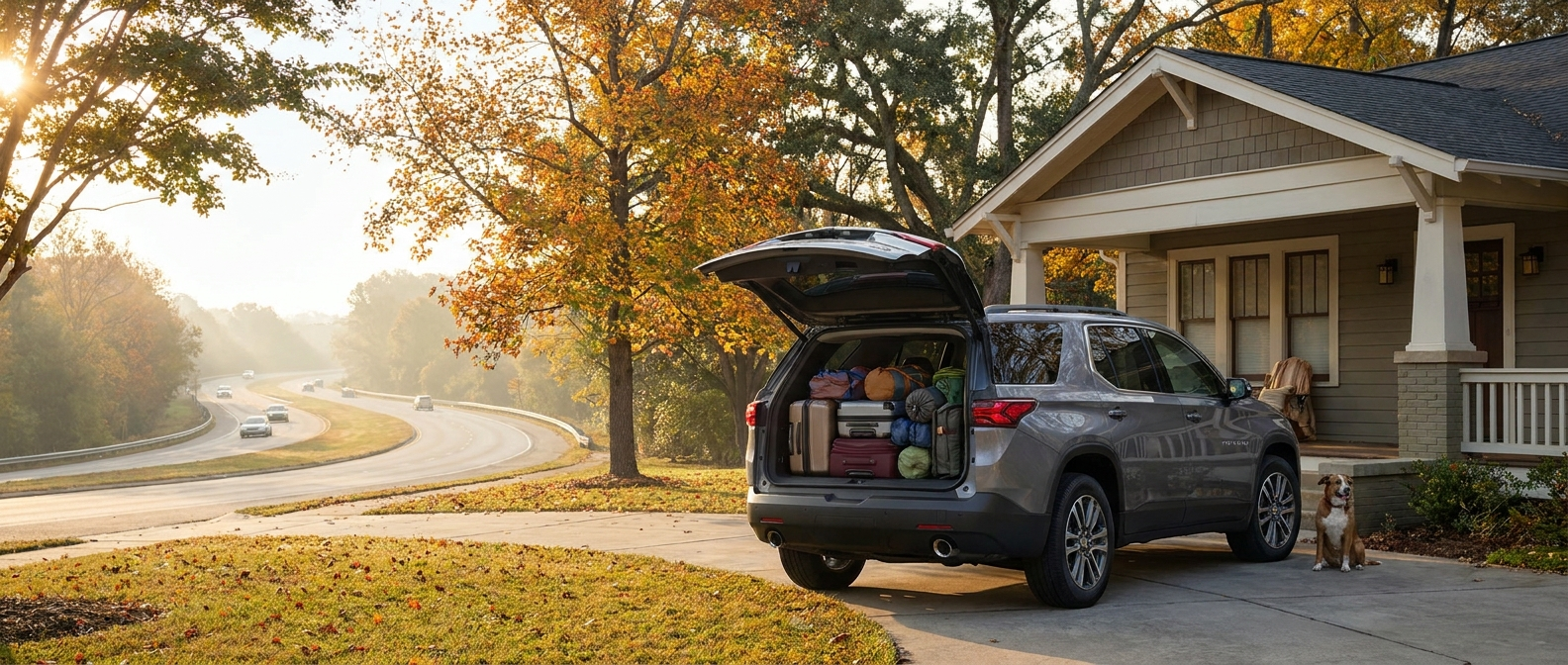
Thanksgiving week is the single busiest travel stretch of the year, and I-77 through Fairfield County carries a big piece of that traffic north toward Charlotte and south toward Columbia. A quick pre-trip service pass right now takes about an hour. A roadside breakdown on the Wednesday before Thanksgiving doesn't. So here's exactly what to run through before you go.
Schedule your pre-trip service at Wilson Chevrolet before the holiday rush fills our service bays.
What Goes on the Checklist?
Work through every item below before you leave, and if any of them leave you unsure, bring the vehicle in so our team can run a multi-point inspection that covers the whole list. We'd rather catch a soft tire or a tired battery here than have you find it on the shoulder of the interstate. None of this takes long. The hard part is just doing it before you pack the car.
Tires
- [ ] Check PSI cold (before the first drive of the day) against the placard on the driver's door jamb, NOT the sidewall number
- [ ] Look for uneven wear, sidewall cracking, or embedded objects
- [ ] Verify tread depth is above 4/32 inch (use the quarter test: if you can see above Washington's head, it's time for tires)
- [ ] Check the spare (pressure and condition)
Engine Oil
- [ ] Check the Oil Life Monitor reading; if it's below 40%, change it before the trip
- [ ] Confirm the correct oil spec for your Chevy (see the why-it-matters table below)
- [ ] Look at the dipstick level and color; dark, gritty oil is overdue regardless of what the monitor says
Battery
- [ ] Ask for a load test if the battery is 3 or more years old
- [ ] Inspect terminals for corrosion buildup
- [ ] Note how the engine cranks; a slow or labored start is a warning
Brakes
- [ ] Listen for any squeal or grind on your last few drives
- [ ] Have pads measured if you're within your service window; Chevrolet advises replacement when pad thickness drops to 2mm
- [ ] Check that the parking brake engages and releases cleanly
Fluids
- [ ] Engine coolant (at the cold fill line)
- [ ] Brake fluid (clear to light yellow; dark fluid means moisture contamination)
- [ ] Transmission fluid (level and color; bright red is good, dark brown is not)
- [ ] Windshield washer fluid (top off completely, especially for night highway driving)
- [ ] Power steering fluid if your vehicle has a hydraulic system
Lights and Wipers
- [ ] Walk around and confirm: headlights (low and high), taillights, brake lights, turn signals, hazards
- [ ] Run the wipers; streaking in a November rain on a dark two-lane is exactly when you don't want to discover a cracked blade
- [ ] Test the rear defroster
Emergency Kit
- [ ] Jumper cables or a jump-start pack
- [ ] Flashlight with fresh batteries
- [ ] Basic first-aid kit
- [ ] Phone charger and backup battery
- [ ] Blanket (November lows in the Midlands can dip into the 30s)
- [ ] Tire pressure gauge
- [ ] Vehicle registration, insurance card, and roadside assistance contact
Why These Items Actually Matter
Every item on that list earns its place through a real mechanism, not superstition, and a couple of them carry specifics worth slowing down for. You don't have to take our word on faith. Once you see what's happening under the hood and at the wheel, the reasons hold up on their own.
Tires: The PSI Drop Is Physics, Not Bad Luck
A loaded Traverse or a Silverado 1500 climbing I-77 with a full cab and cargo needs every PSI it's rated for, and cold weather quietly works against you here. Tire pressure drops approximately 1 PSI for every 10 degrees Fahrenheit the temperature falls. A loaded Traverse or a Silverado 1500 running low on pressure under all that weight is working harder than it should be. South Carolina's Midlands stays mild through most of November. But set your pressure on a 70-degree afternoon, leave on a 40-degree morning, and that's a 30-degree swing. You could be 3 PSI low before you even turn the key.
The fix is simple. Check cold, use the door-jamb number, and top off the morning you leave. TPMS warning lights help, but per NHTSA, that light typically doesn't trigger until a tire is about 25 percent below the recommended PSI. That's a lot of miles on a low tire before the warning catches up to you.
Oil: The Monitor Is Smart, But It Doesn't Know You're Hauling the Family
Chevrolet's Oil Life Monitor is genuinely good technology, and it tracks engine speed, temperature, and operating conditions to calculate real oil degradation rather than counting down blind miles. Under normal driving, most 2026 Chevys are rated for up to a 7,500-mile oil change interval on the correct dexos1 full-synthetic oil. That number holds when your driving looks like the driving the system was built to read.
Here's the tradeoff we see at our service center. The monitor is calibrated for how you normally drive. Load a Tahoe with five people and two weeks of luggage, run it at highway speed for four hours, and that's a harder thermal cycle than your daily commute. If your monitor reads below 40%, change the oil this week. Don't push it into a loaded highway run.
| Chevy Model / Engine | Required Oil Spec | Viscosity |
|---|---|---|
| Silverado 1500 (5.3L or 6.2L EcoTec3 V8) | dexos1 Gen 3 Full Synthetic | SAE 0W-20 |
| Silverado 1500 (2.7L TurboMax I4) | dexos1 Gen 3 Full Synthetic | SAE 5W-30 |
| Traverse (2.5L Turbo, all 2026 trims) | dexos1 Gen 3 Full Synthetic | SAE 0W-20 |
| Tahoe (5.3L EcoTec3 V8) | dexos1 Gen 3 Full Synthetic | SAE 0W-20 |
| Colorado (2.7L Turbo) | dexos1 Gen 3 Full Synthetic | SAE 5W-30 |
| Equinox / Trax / Trailblazer (1.2L / 1.5L Turbo) | dexos1 Gen 3 Full Synthetic | SAE 0W-20 |
Confirm your engine and trim in the owner's manual or on the door-jamb sticker. Don't approximate the spec.
Brakes: Extra Weight Is Extra Work
A fully loaded SUV needs more room to stop than an empty one, and that isn't a dramatic claim so much as plain physics playing out on a long descent. If you haven't had brakes inspected in the last 12 months or 15,000 miles, get it done now. Chevrolet advises replacement when brake pad material reaches 2mm of remaining thickness. Our service team checks that measurement as part of a standard multi-point inspection.
Book a Pre-Trip Multi-Point Inspection
Battery: Cold Start After a Warm Fall Is Exactly When They Fail
A battery that ran fine all October can still buckle when the first real cold front drops temperatures into the low 30s overnight, because mild fall weather hides weak cells that only show under cold-start strain. A load test takes five minutes at our service center. If the battery is three or more years old, the test is worth doing. Replacing one now is a small inconvenience. A no-start in a Charlotte parking garage on Black Friday is a much bigger one.
The Item / Why-It-Matters Table
| Checklist Item | Why It Matters for a Holiday Trip |
|---|---|
| Tire PSI (checked cold) | 1 PSI drops per 10 degrees Fahrenheit temp fall; a morning cold front can leave you 3 PSI low before you leave the driveway |
| Tire tread above 4/32 inch | Wet pavement stopping distance increases significantly below this threshold |
| Oil Life Monitor below 40% | Loaded highway driving runs hotter than your commute; don't carry that stress into a long run |
| Correct dexos1 oil spec | Using the wrong viscosity can accelerate wear on turbo components |
| Battery load test (3+ years old) | Cold mornings expose weak cells that test fine in warm weather |
| Brake pad check | Extra passenger and cargo weight adds stopping demand; 2mm is the replacement threshold |
| All lights functional | Early-November sunsets mean you're almost certainly driving at least part of the trip in the dark |
| Windshield washer fluid (full) | Night highway spray from trucks ahead is relentless; a dry reservoir at 70 mph is a real visibility problem |
| Spare tire at proper PSI | A flat spare is useless; check it every time you check the other four |
| Emergency kit stocked | Even a well-serviced vehicle can have an unexpected issue; a kit means you're waiting comfortably, not stranded |
Print-and-Go Recap
Pull this up before you leave the driveway, and run through it the morning of your departure rather than the night before the drive. Tires settle and temperatures shift overnight, so a morning pass catches what a bedtime check misses.
The quick-check morning of:
- Tire PSI cold (all four plus the spare)
- Oil Life Monitor reading (if below 40%, see us first)
- All lights on (a 60-second walk-around catches a bulb before it's a problem)
- Washer fluid topped off
- Emergency kit in the vehicle
The service appointments to book this week:
- Multi-point inspection if you haven't had one recently
- Oil and filter if the monitor is reading low
- Battery load test if the battery is 3 or more years old
- Brake inspection if you've heard any squeal or grind lately
Our service center is open Monday through Friday, and the week before Thanksgiving fills up fast. Book early.
By the Wilson Chevrolet Team | November 2026
Frequently Asked Questions
How far in advance should I schedule Chevrolet service before a Thanksgiving road trip?
Book at least five to seven days before Thanksgiving. The week of the holiday, service bays across the region fill quickly. Scheduling by mid-November gives our technicians time to source any parts you need and still get you on the road before Wednesday traffic peaks on I-77.
Does the Chevrolet Oil Life Monitor tell me if I need an oil change before a long trip?
The Oil Life Monitor tracks real driving conditions and is accurate for normal commuting, though it's calibrated for how you typically drive. A loaded family highway run is thermally harder on the oil than your everyday routine. Our team's guideline is simple. If the monitor reads below 40%, change the oil before the trip rather than banking on the remaining percentage to hold through extra demand.