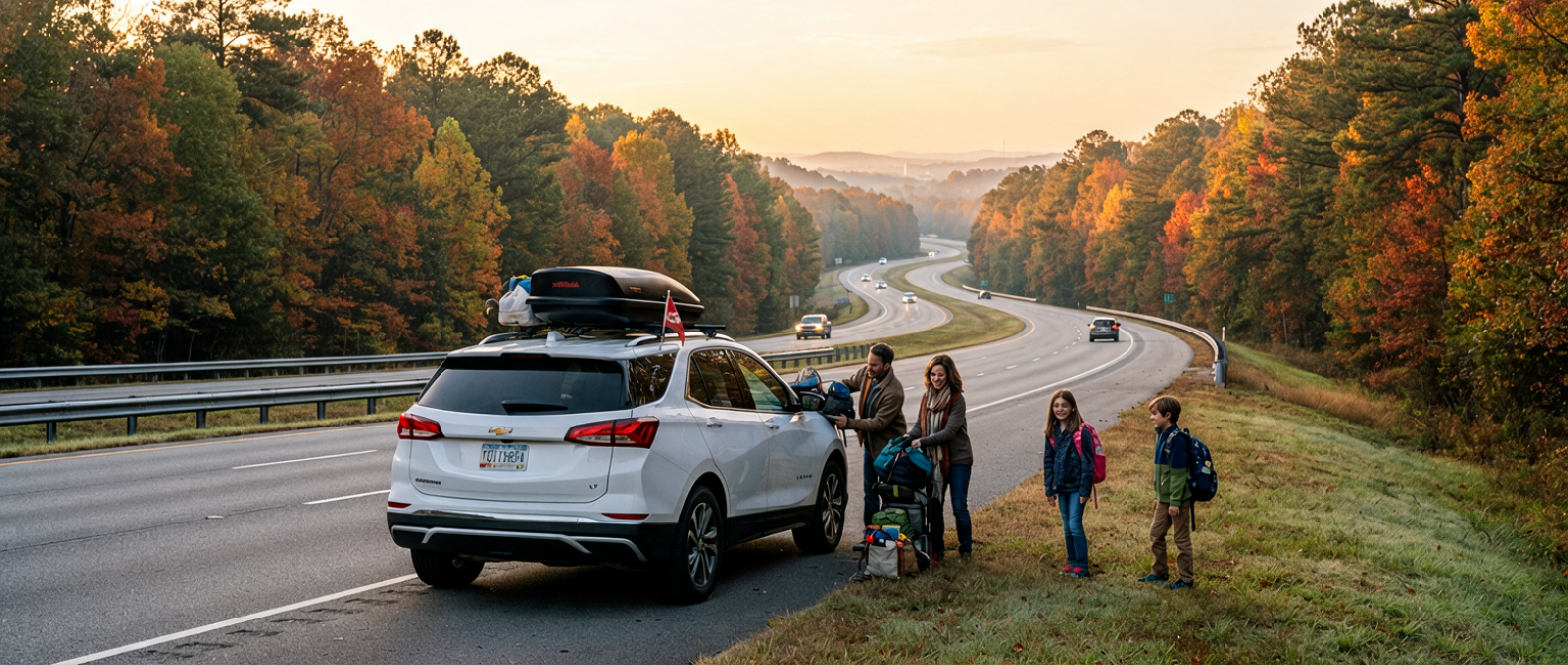




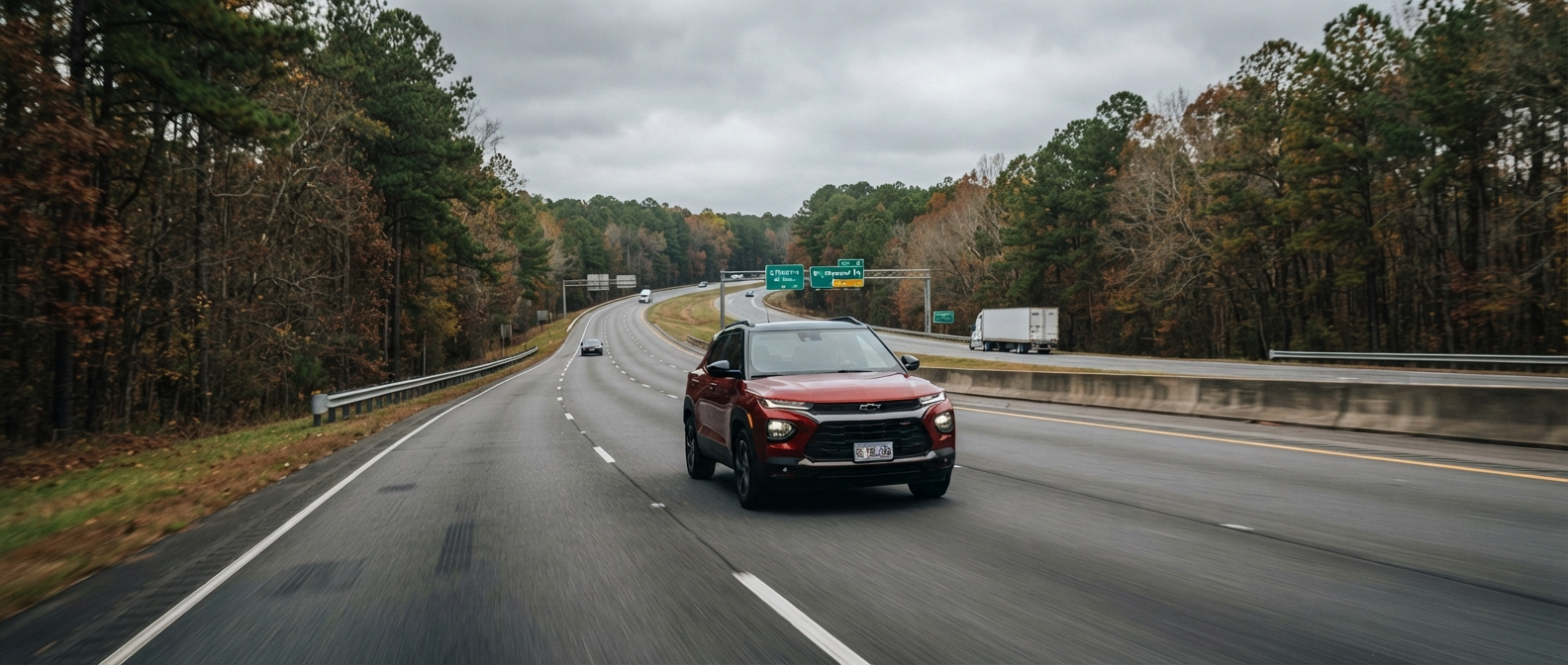
Winnsboro to Columbia on I-77 covers about 30 miles one way. Add parking, a stop-and-go loop through a crowded shopping center, and a loaded-down return trip, and that round trip tests whatever you're driving. A fair question this time of year is whether the 2026 Chevrolet Trailblazer will stretch its tank far enough to make the holiday run with fuel to spare.
Yes, it will, though which Trailblazer you pick changes the math considerably. The difference between FWD and AWD isn't just a traction decision. You're swapping a transmission, raising engine load, and giving up a 4-mpg swing in combined efficiency. We'll cover what matters before you sign.
How Does the Trailblazer's Fuel Economy Actually Work?
Three powertrain combinations give you three different efficiency stories, and the gap is wide enough to matter, since the 1.2L and 1.3L front-drive setups both post strong numbers while the AWD version trades a few mpg for extra grip. So the right pick depends on how you actually drive. The EPA's official 2026 ratings show the gap clearly.
| Configuration | Engine | Transmission | City MPG | Hwy MPG | Combined MPG | Tank Range (est.) |
|---|---|---|---|---|---|---|
| 1.2L Turbo FWD (LS / LT) | 1.2L turbo 3-cyl, 137 hp | CVT | 30 | 31 | 30 | ~396 miles |
| 1.3L Turbo FWD (RS / ACTIV FWD) | 1.3L turbo 3-cyl, 155 hp | CVT | 29 | 33 | 31 | ~435 miles |
| 1.3L Turbo AWD (all AWD trims) | 1.3L turbo 3-cyl, 155 hp | 9-speed automatic | 26 | 29 | 27 | ~356 miles |
The EPA estimates are for the 2026 model year. Tank range estimates use the 13.2-gallon fuel tank at each configuration's combined mpg rating.
Something counterintuitive turns up in those numbers. The larger 1.3L engine beats the smaller 1.2L on the highway, 33 mpg versus 31. Both engines run a CVT when paired with front-wheel drive, but the 1.3L's 174 lb-ft of torque arrives at just 1,500 rpm. That lower torque peak lets the CVT hold a less-stressed, more efficient engine speed at steady interstate cruising. The 1.2L works a bit harder to keep the same pace. That's why its highway number lands two mpg lower.
The AWD story gets interesting from here. Chevrolet doesn't simply bolt a rear axle onto the existing FWD drivetrain. Every 2026 Trailblazer with AWD gets the 1.3L engine and replaces the CVT with a 9-speed automatic gearbox. The 9-speed handles the torque demands of sending power rearward, but it steps through defined gear ratios instead of continuously optimizing rpm the way a CVT does. The gearbox change is the mechanical reason the AWD Trailblazer gives up 4 combined mpg against the identical engine in FWD, as much as the added drivetrain weight.
See Current Trailblazer Offers
Which Trailblazer Configuration Makes Sense for Fairfield County Driving?
Browse our current Trailblazer lineup and you'll find both FWD and AWD trims in stock, and for most Fairfield County driving the front-drive 1.3L earns its keep, though AWD makes real sense when wet roads and heavy loads are a regular part of your week. Think it through on the routes our customers actually drive.
Smooth Midlands pavement, steady speeds, and minimal elevation change are exactly where the 1.3L FWD's 33-mpg highway rating does its best work. The I-77 run from Winnsboro south to Columbia is essentially a highway trip. On a 60-mile round trip at steady highway speeds, the gap between FWD and AWD shows up on every fill-up, not just as a theoretical edge case.
South Carolina's winter weather picture matters here. Winnsboro and Fairfield County see occasional frost and rare light snow, but prolonged icy road conditions are genuinely uncommon. Columbia's shopping districts see even less. For a buyer whose primary use is the holiday Columbia run (or a longer stretch north on I-77 toward Charlotte), AWD's traction advantage simply doesn't come into play on most December and January mornings.
The trade-off is a fair one. AWD gives real confidence on the rare slick morning, and the 9-speed automatic has a more satisfying, conventional feel under hard acceleration. Those are legitimate benefits. You pay for them in fuel economy on every trip, though, even the dry ones.
If you regularly carry a full cabin, stack heavy cargo after big shopping days, or drive through significant Midlands thunderstorm standing water, the AWD's rear-axle grip provides something the FWD can't match. For a driver whose calendar mostly shows dry I-77 miles, the FWD configuration keeps more money at the pump over time.
Comparing to the Trax? If the holiday haul stays modest and a smaller footprint suits you, the Chevy Trax also runs a small turbocharged engine with competitive efficiency. The Trailblazer pulls ahead when cargo space is the priority. Its maximum cargo volume reaches 54.4 cubic feet, a meaningful jump when you're loading gifts in the back.
| Your Driving Situation | Best Trailblazer Choice | Combined MPG |
|---|---|---|
| Mostly I-77 highway, dry Midlands roads, efficiency priority | 1.3L FWD (RS or ACTIV FWD) | 31 |
| Mix of highway with frequent rain and occasional frost | 1.3L AWD (LT AWD or RS AWD) | 27 |
| City-primary, want the highest city number | 1.2L FWD (LS or LT) | 30 |
| Frequent full cabin, heaviest cargo loads | 1.3L AWD | 27 |
Quick Glossary
| Term | What It Means in Plain Language |
|---|---|
| CVT | Continuously Variable Transmission. Uses a belt-and-pulley system instead of fixed gears, holding the engine at its most fuel-efficient RPM across the range. All FWD Trailblazers use this. |
| 9-speed automatic | A traditional stepped gearbox with nine defined gear ratios. All AWD Trailblazers use this. More conventional shift feel, slightly lower highway efficiency than the CVT. |
| Combined MPG | The EPA's weighted average: 55% city driving, 45% highway. The most practically useful single efficiency number. |
| EPA rating | The federal fuel economy estimate, produced under controlled laboratory conditions. Real-world results vary with speed, load, and outside temperature. |
What This Means When You're Ready to Decide
The 2026 Trailblazer fits the kind of driving most Fairfield County families actually do, the I-77 runs to Columbia for work or shopping, weekend trips out toward Lake Wateree, and the occasional longer haul when the holiday calendar fills up, though real efficiency still hinges on your FWD-or-AWD choice. Its 13.2-gallon tank and highway numbers translate to fewer stops at the pump, not more.
Our read is straightforward. If the Columbia holiday run is your primary use case and you don't face genuine traction challenges regularly, the 1.3L FWD is the efficiency-forward choice. It delivers 31 combined mpg and an estimated 435-mile highway range on regular fuel. If AWD would genuinely change how you feel on bad-weather mornings, or you haul heavier loads, it's a worthwhile step up. Just go in knowing the efficiency difference runs to 4 real combined mpg, enough to feel at the pump.
Stop in on US 321 and we'll walk you through both drivetrains on the lot so the numbers line up against your actual driving habits. You can also get a head start by checking your financing options online before you come in.
Frequently Asked Questions
How many mpg does the 2026 Chevrolet Trailblazer get?
The 2026 Trailblazer's EPA fuel economy depends on the configuration you choose. The 1.2L turbo FWD (LS and LT trims) is rated 30 city / 31 highway / 30 combined. The 1.3L turbo FWD (RS and ACTIV FWD) reaches 29 city / 33 highway / 31 combined. The 1.3L turbo with AWD (available on LT, RS, and ACTIV trims) is rated 26 city / 29 highway / 27 combined. The Trailblazer holds 13.2 gallons of regular 87-octane fuel, giving the most efficient FWD configuration an EPA-estimated highway range of roughly 435 miles.
Why does choosing AWD lower the Trailblazer's fuel economy?
Choosing AWD on the 2026 Trailblazer changes two things simultaneously: it adds the mechanical load of the rear drivetrain, and it replaces the CVT with a 9-speed automatic transmission. The CVT holds the engine at its most efficient RPM across the range during highway cruising, which is why FWD models reach 33 mpg on the highway. The 9-speed automatic moves through defined gear steps instead, which suits AWD's torque demands but cannot match the CVT's highway efficiency. The combined result is a 4-mpg difference between the 1.3L FWD and 1.3L AWD configurations. For most South Carolina driving, the choice comes down to whether that all-weather traction margin is worth the efficiency trade-off on your specific routes.